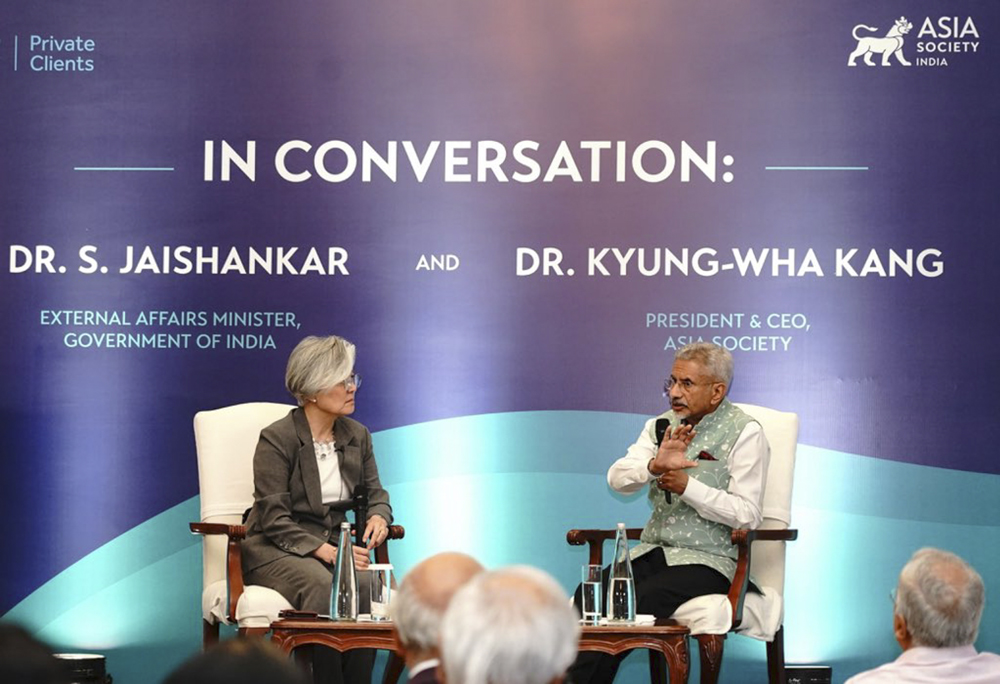
In this image released by @DrSJaishankar via X on March
26, 2025, External Affairs Minister S. Jaishankar with Asia Society President
and CEO Kyung-wha Kang during an event of Asia Society, in New Delhi.
(@DrSJaishankar via PTI Photo)
NEW DELHI — India and the US are holding "very active" and "intense"
discussions on trade, External Affairs Minister S Jaishankar said on Wednesday,
as the world waits with anxiety over US President Donald Trump's reciprocal
tariff that will kick in on April 2.
In an interactive session hosted by leading think-tank Asia
Society, Jaishankar, however, declined to pre-judge the immediate outcomes of
the trade negotiations but said there is a strong "business case" for
a bilateral trade agreement (BTA) between the two countries.
Following talks between Prime Minister Narendra Modi and
Trump in Washington DC last month, the two sides announced to negotiate the
first tranche of the BTA by the fall of 2025.
"There's a very active and intense trade discussion
going on at this point of time," Jaishankar said at a session moderated by
Kyung-wha Kang, President and CEO of the Asia Society and a former foreign
minister of South Korea.
Brendan Lynch, the assistant US trade representative for
South and Central Asia, is currently on a five-day visit to India from Tuesday.
It is not immediately known whether there are discussions
on extending India some kind of waiver when the reciprocal tariff comes into
force early next week.
On trade, we had a very open discussion and it is the
result of the decision by PM Modi and US President Trump to have a bilateral
trade agreement by fall this year, Jaishankar said.
"I have every confidence that they (negotiators)
will negotiate what is the best possible deal for us. While noting the
concerns, I wouldn't prejudge the outcome. I would wait and see really what
happens in terms of our ability to reach an understanding with the United
States," he added.
The external affairs minister said this while responding
to a question on concerns in India over opening up the long-protected
agricultural market, "But I don't believe that a problem should in itself
be an insuperable obstacle, because there is a strong business case for a BTA
with the US," he said.
Jaishankar also talked about India's ongoing discussions
for separate free trade pacts with the European Union and the United Kingdom.
These agreements are "very serious" and they
are quite advanced, he said, adding, "We'd like to wait and see whether
actually you have a new set of very big agreements." On strategic ties
with the US, Jaishankar said New Delhi is certainly expecting a "more
substantial" and "higher quality" defence relationship under the
Trump administration.
"We saw a president who is much more open and much
more active in terms of building a security and defence partnership," he
said, suggesting that the Trump administration is more forthcoming in sharing
American technologies with India.
Jaishankar said New Delhi is also looking at boosting its
energy ties with the US and making sure that there's a "stable,
reasonable, predictable" energy energy environment that is something
crucial to India's long-term growth and development.
"Now, we saw a president who clearly had an interest
in ensuring that energy availability was more, energy flows were more diverse,
and that countries like India could have more choice than we currently
do," he said.
The external affairs minister recalled that India started
importing LNG from the US decades ago.
"But for various reasons, the business stayed at a
certain level. We have interest in increasing it because the US is a very
stable supplier," he said.
"So we found, from the energy perspective, a very
positive administration. I would also say we had a good discussion on the tech
world," he said.
On Trump's policies, Jaishankar said "Overall, our
assessment was that we saw many changes which suited us or which in some way
formed convergence on which we could build upon."
The US president's tariff tussle has stoked fears of a
global trade war with many countries already announcing counter-measures to
deal with it.
Following talks between Prime Minister Narendra Modi and
Trump in Washington DC last month, the two sides announced to negotiate the
first tranche of the BTA by the fall of 2025.
In line with his "America First" policy, Trump
earlier this month announced reciprocal tariffs on its partners and other
nations that impose higher levies on imports from the US.
India has reduced its average applied tariffs
significantly for key developed countries like Australia, the United Arab
Emirates, Switzerland and Norway under recently concluded bilateral trade
agreements.
Similar negotiations are currently underway with the
European Union and the United Kingdom, among other partners.
The ongoing discussions with the US should be seen in
this context, Indian government sources said a few weeks back.
In its Union budget for 2025-26, India announced its
decision to lower tariffs on Bourbon whiskey, wines, and Electronic Vehicle
(EV) segments.
The decisions were seen as an attempt to send a signal to
the Trump administration that New Delhi is open to bringing down tariffs in
specific sectors.
Washington is also pushing New Delhi to buy more American
oil, gas and military platforms to bring down the trade deficit that stands at
around USD 45 billion in India's favour.
The US was the largest trading partner of India with
overall bilateral trade in goods and services amounting to USD 190 billion for
calendar year 2023.
In the financial year 2023-24, the US was the third
largest source of foreign direct investment (FDI) into India with inflows of
USD 4.99 billion accounting for almost per cent of total FDI equity inflows.