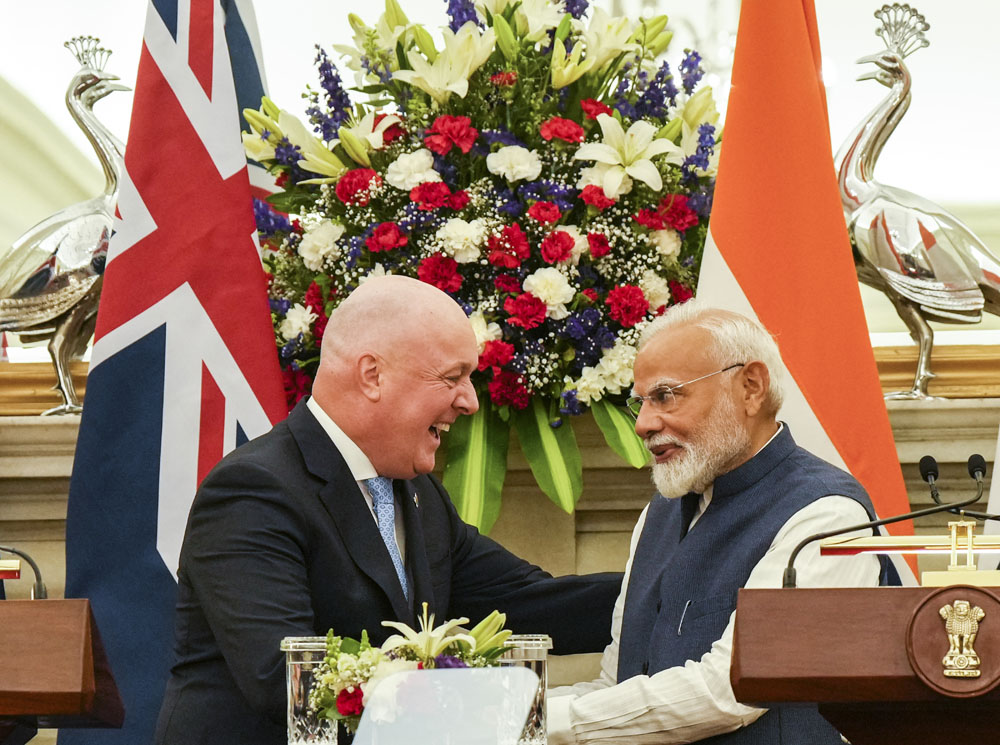
Prime Minister Narendra Modi and New Zealand's Prime
Minister Christopher Luxon during a joint press conference, at the Hyderabad
House in New Delhi, Monday, March 17, 2025. (PTI Phone/Shahbaz Khan)
NEW DELHI — India and New Zealand on Monday inked a mega pact to
institutionalise their defence and security ties even as Prime Minister
Narendra Modi conveyed concerns to his Kiwi counterpart over certain unlawful
elements carrying out anti-India activities in the Pacific island nation.
Modi and visiting New Zealand Prime Minister Christopher
Luxon held wide-ranging talks with a focus on ramping up overall bilateral
ties, especially in areas of trade, defence, education and agriculture.
In his media statement, Modi said both sides decided to
strengthen and institutionalise defence and security partnership and a roadmap
will be prepared for cooperation in the defence industry sector.
"We both are unanimous against terrorism. Whether it
is the Christchurch terrorist attack of March 15, 2019, or the Mumbai attack of
November 26, 2008, terrorism in any form is unacceptable," he said.
The prime minister said strict action is necessary
against those guilty of terrorist attacks.
"We will continue to cooperate together against
terrorist, separatist and radical elements," Modi said.
"In this context, we shared our concern about
anti-India activities by some illegal elements in New Zealand," he said.
Modi said India is confident that it will continue to
receive cooperation from the New Zealand government against all these
"illegal elements".
The prime minister also referred to India and New Zealand
deciding to start negotiations for a mutually beneficial free trade pact.
"This will boost the potential of mutual trade and
investment. Mutual cooperation and investment will be encouraged in areas like
dairy, food processing, and pharma," he said.
Modi said India and New Zealand support a free, open and secure
Indo-Pacific.
"We believe in the policy of development, not
expansionism," he said.
The New Zealand prime minister said Modi and he discussed
a challenging strategic outlook in the Indo-Pacific.
"I reiterated our strong commitment to address shared
concerns over our respective interests in contributing to a prosperous
Indo-Pacific," Luxon said.