


Prime Minister Narendra Modi and Balendra Shah, Prime Minister of Nepal, on Monday announced several initiatives to boost trade and economic ties between the two nations, including air and train connectivity and special emphasis on the energy sector.
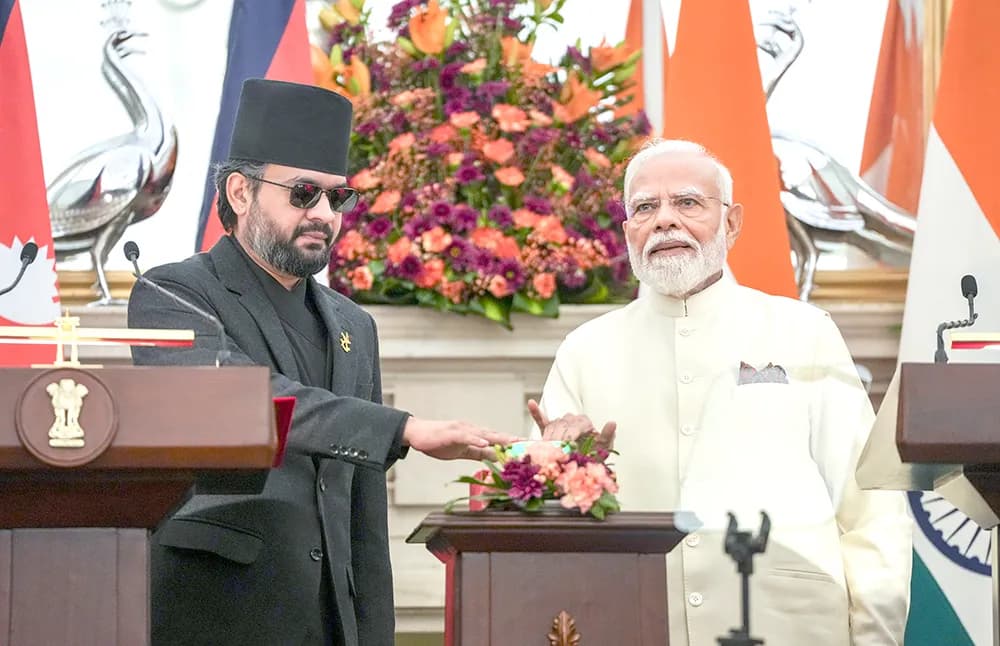
NEW DELHI — Prime Minister Narendra Modi and Balendra Shah, Prime Minister of Nepal, on Monday announced several initiatives to boost trade and economic ties between the two nations, including air and train connectivity and special emphasis on the energy sector.
According to a joint statement, the leaders noted the ongoing discussions on civil aviation matters aimed at enhancing connectivity and boosting bilateral economic engagement.
Both sides agreed that the existing unidirectional B345 Kathmandu-Bhairahawa-Lucknow route will be made bidirectional. Technical consultations will be held to finalize the modalities in this regard and to address other civil aviation proposals from both sides currently under discussion.
Prime Minister Modi also announced a new connectivity avenue for Nepal’s transit trade through Deendayal Port (Kandla, Gujarat). Further, access to Paradip port (Odisha) will also be made available once requisite infrastructure is in place.
According to the joint statement, the two leaders also underlined the importance of improving cross-border connectivity and enhancing border infrastructure, through the establishment of new railway lines, bridges, Integrated Check Posts (ICPs) and petroleum pipelines.
The two Prime Ministers flagged off the inaugural Sarayu-Kamala Express rail service between Ayodhya and Janakpur. This rail service will not only improve connectivity but also give a fillip to religious and cultural tourism along the Ramayana Circuit and strengthen the civilisational ties between India and Nepal.
The leaders agreed to explore similar connections to develop Buddhist and Shiv-Shakti religious tourism circuits.
Both sides announced the finalization of the Field Location Survey for the proposed Raxaul-Kathmandu electrified broad-gauge railway line and announced that the two sides will collaborate in the development of the East-West Railway in Nepal.
A new cross-border motorable bridge between Dharchula (India) and Darchula (Nepal) was inaugurated by the leaders. This will help improve direct connectivity between Western Nepal and India.
In an expansion of cross-border petroleum infrastructure between India and Nepal, the leaders dedicated to the people of Nepal phase II of the Motihari-Amlekhgunj Pipeline.
The two leaders also laid virtually the foundation stone for the development of a petroleum terminal at Jhapa, Nepal and emphasized the importance of early commencement of work on the petroleum pipeline between Siliguri and Jhapa. Both sides agreed to explore cooperation in the construction of gas pipelines between India and Nepal.
Both sides expressed satisfaction at the bilateral progress in the hydropower sector, in keeping with the India-Nepal Joint Vision Document for Power Sector Cooperation and the Long-Term Power Trade Agreement.
Both sides welcomed the active engagement of Indian companies in the hydro-power sector in Nepal and agreed to ensure the expeditious completion of various hydropower projects being developed by Indian companies in Nepal. On this occasion, the two leaders laid virtually the foundation stone for the 669 MW Lower Arun Hydro-Electric Project.
The two leaders directed the Pancheshwar Development Authority and the Joint Committee on Water Resources to finalise the Detailed Project Report of the Pancheshwar Multipurpose Project expeditiously and commence work on the implementation of the project.
Both leaders also agreed on the need to accelerate work on the DPR of the Saptakoshi and Sunkoshi multipurpose projects to harness water resources for mutual benefit and mitigate the impact of floods.
The two sides noted with satisfaction the progress regarding the formation of JVs for two high-capacity cross-border transmission lines between Inaruwa (Nepal) - New Purnea (India) and Dododhara (Nepal) – Bareilly (India).
The two leaders also agreed that India would set up an offshore IIT campus in Nepal. This will serve as a force-multiplier in Nepal’s education sector and also promote job creation.