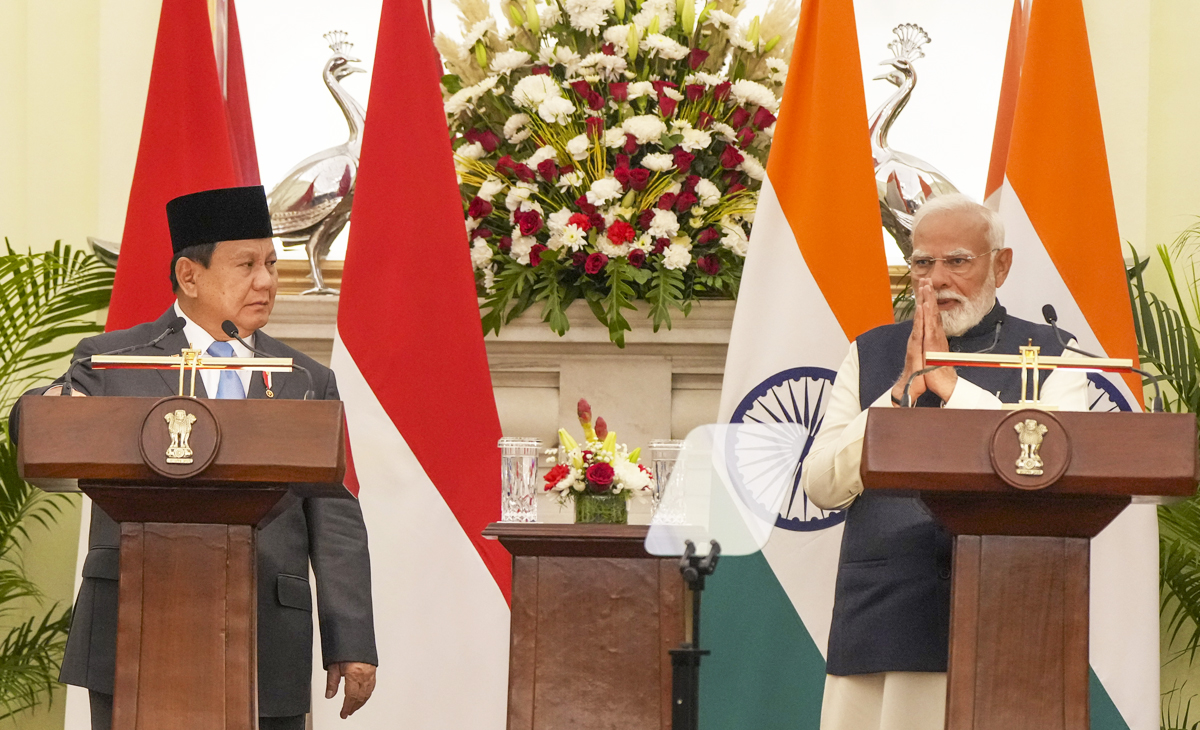
Prime Minister Narendra Modi and Indonesian President
Prabowo Subianto prior to their meeting at the Hyderabad House, in New Delhi,
Saturday, Jan. 25, 2025. (PTI Photo/Arun Sharma)
NEW DELHI — India and Indonesia have pitched for a "full and
effective" code of conduct in the South China Sea in accordance with the
relevant international laws amid China's increasing military muscle-flexing in
the region.
The situation in the South China Sea figured in wide-ranging
talks between Prime Minister Narendra Modi and Indonesian President Prabowo
Subianto on Saturday, according to a joint statement.
In their meeting, the two sides agreed to position a liaison
officer from Indonesia at India's Information Fusion Centre-Indian Ocean Region
(IFC-IOR).
The Indian Navy established the IFC-IOR in Gurugram in 2018
to keep track of shipping traffic as well as other critical developments in the
region under a collaborative framework with like-minded countries.
Modi and Subianto, while strongly condemning terrorism in
all its forms, vowed to enhance India-Indonesia anti-terror cooperation and
called for concerted global efforts to combat the menace without any
"double standards".
Both the leaders called upon all countries to take concerted
action against UN-proscribed terrorist organisations and their affiliates, the
statement released on Sunday said.
The Indonesian president arrived here on Thursday on a
four-day visit.
Subianto was the chief guest at the Republic Day
celebrations at the majestic Kartavya Path on Sunday.
In their talks, the prime minister and the visiting leader
also explored ways to boost India-Indonesia economic ties and emphasised the
importance of expeditious implementation of an MoU inked by the two sides last
year for the use of local currencies for bilateral transactions, according to
the statement.
Modi and Subianto were of the view that the use of local
currencies for bilateral transactions would further promote trade and deepen
financial integration between the two economies.
The joint statement, referring to the situation in the
maritime domain, said the two leaders reaffirmed the importance of maintaining
and promoting peace, stability, freedom of navigation and overflight in the
region.
They also called for unimpeded lawful maritime commerce and
promoting peaceful resolution of disputes in accordance with universally
recognised principles of international law, including the 1982 UNCLOS (UN
Convention on the Law of the Sea).
"In this regard, they supported the full and effective
implementation of the declaration on the conduct of the parties in the South
China Sea (DOC) in its entirety and look forward to the early conclusion of an
effective and substantive code of conduct in the South China Sea (COC) that is
in accordance with international law, including the 1982 UNCLOS," the
statement noted.
The ASEAN countries too have been insisting on a binding
code of conduct (COC) on the South China Sea largely in view of China's
consistent attempts to assert its expansive claims over the region.
Beijing has been strongly opposing the COC.
China claims sovereignty over all of the South China Sea, a
huge source of hydrocarbons. However, several ASEAN member countries, including
Vietnam, the Philippines and Brunei, have counterclaims.
In a ruling in 2016, the Permanent Court of Arbitration at
the Hague dismissed Beijing's claim to much of the South China Sea. China,
however, rejected the verdict.
India has been pitching for a rules-based order in the
region including through upholding adherence to international law, especially
the UNCLOS.
In their talks, Modi and Subianto also agreed to an early
establishment of bilateral maritime dialogue and cyber security dialogue.
The two leaders reaffirmed that India and Indonesia as
maritime neighbours and strategic partners must continue to work to further
deepen and broaden the defence cooperation to a robust one, the statement
noted.
"Both leaders welcomed the ratification of the
agreement concerning cooperation in the field of defence (DCA) and expressed
confidence that this would lead to further deepening of defence ties," it
said.
The two leaders also agreed to commence bilateral
cooperation in hydrography and submarine search and rescue.