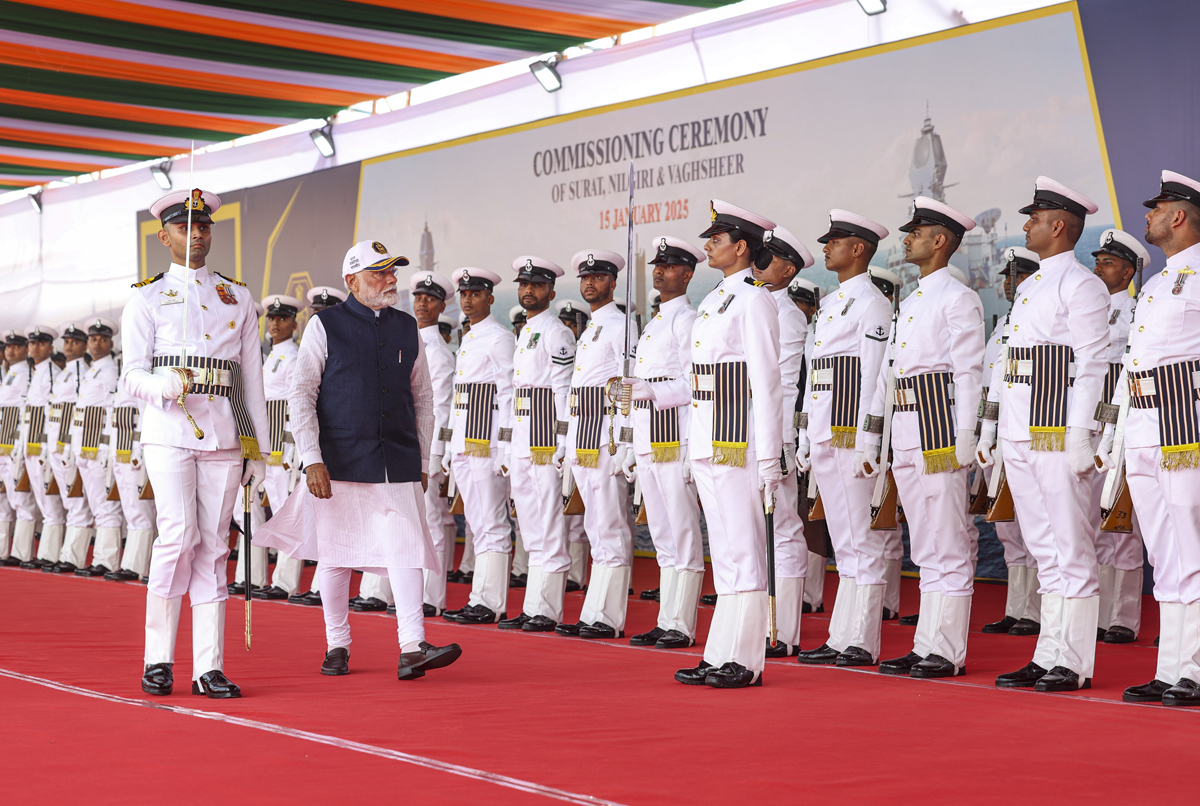
In this image via @AjitPawarSpeaks on X on Jan. 15, 2025,
Prime Minister Narendra Modi during the commissioning ceremony of three Indian
Navy warships INS Surat, INS Nilgiri and INS Vaghsheer, at the Naval Dockyard
in Mumbai. @AjitPawarSpeaks via PTI Photo)
MUMBAI — Prime Minister Narendra Modi on Wednesday said India is emerging as
a major maritime power, and being recognised as a reliable and responsible
partner globally.
He was speaking after three new naval platforms -- a
destroyer, a frigate and a submarine -- were commissioned at a ceremony in his
presence at the Naval Dockyard here.
Pointing out that three warships were being commissioned
together for the first time in the country's history, the prime minister
underlined the nation's progress in defence production, maritime security and
economic growth under the 'Atmanirbhar Bharat' initiative.
"We should become a global partner in securing the
sea from drugs, weapons, and terrorism, and make it safe and prosperous,"
he said, adding that India's growing naval strength is enhancing global
confidence in the country.
The prime minister reasserted the country's commitment to
becoming a global maritime leader. "India is on its way to becoming a
leading maritime power and a global economic force. With modernised defence
capabilities and a robust shipbuilding ecosystem, we are opening new doors to
economic growth and self-reliance," he said.
Noting the strategic importance of the Indian Ocean
region, he emphasised the need to protect territorial waters, ensure freedom of
navigation, and secure trade supply lines.
The prime minister also drew attention to India's
significant contributions as a maritime nation. "In the Indian Ocean
region, India has emerged as the 'first responder,' saving hundreds of lives
and securing thousands of crores worth of national and international
cargo," he said.
India's vision of a secure and inclusive Indo-Pacific
region aligns with its broader global responsibilities, Modi said.
India has always supported an open, secure, inclusive and
prosperous Indo-Pacific region, he said.
The country's defence production has crossed Rs 1.25 lakh
crore, with exports reaching more than 100 countries, he noted.
"In the last decade, 39 of the 40 naval vessels
inducted were built in Indian shipyards, reflecting our commitment to 'Make in
India'," he said.
He also highlighted the ongoing construction of 60 ships
worth Rs 1.5 lakh crore, and its multiplier effect on economy and job creation,
particularly in the MSME sector which supplies most shipbuilding components.
On deep-sea exploration, Modi spoke about the Samudrayaan
project, which will enable scientists to reach depths of 6,000 metres.
"This initiative reflects India's commitment to
harnessing the potential of deep-sea resources," he said, emphasising the
strategic importance of the ocean for future opportunities.
The prime minister also spoke about ongoing reforms to
strengthen India's defence capabilities, citing the establishment of the Chief
of Defence Staff and progress toward theatre commands as examples.
Referring to the Navy's adoption of indigenous symbols
inspired by Chhatrapati Shivaji Maharaj, Modi said, "This reflects our
resolve to free ourselves from colonial legacies while embracing our
heritage."
Earlier, the prime minister witnessed the commissioning
of INS Surat, INS Nilgiri, and INS Vaghsheer.
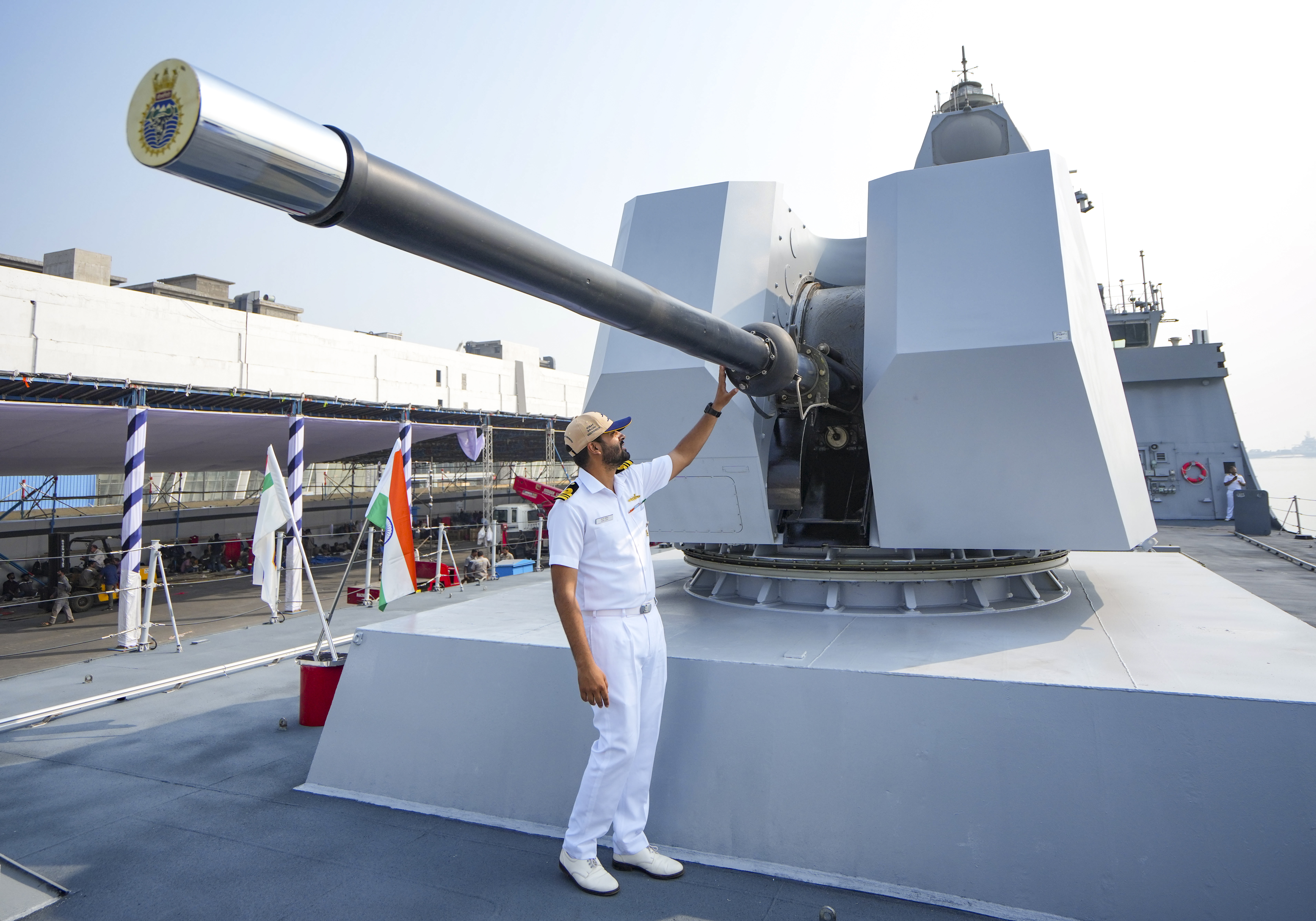
INS Nilgiri, the lead ship of the Project 17A stealth
frigate class, is equipped with advanced stealth technology and reduced radar
signatures, making it a significant advancement over its predecessors. Designed
by the Indian Navy's Warship Design Bureau and constructed by Mazagon Dock
Shipbuilders Limited (MDL), the frigate includes modern aviation facilities and
can operate helicopters such as the MH-60R.
INS Surat, the final vessel of the Project 15B stealth
destroyer class, enhances the Navy's surface fleet with improvements in design
and capability. Built by MDL, it complements India's advanced naval fleet.
INS Vaghsheer, the sixth submarine under the
Scorpene-class Project 75, is designed for roles such as anti-surface warfare,
anti-submarine warfare, and intelligence gathering. Its modular construction
enables future upgrades, including air-independent propulsion technology.