[caption id="attachment_277905" align="alignleft" width="320"]
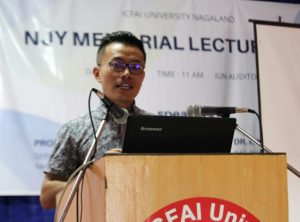 Dr. Riku Khutso speaking at the annual NJY memorial lecture organised by ICFAI University Nagaland on October 15.
[/caption]
Dimapur, Oct. 18 (EMN): ICFAI University Nagaland (IUN) conducted its 7th annual NJ Yasaswy memorial lecture on October 15 with Prof. Buno Liegiese from the department of Education, Nagaland University (NU), and Dr. Riku Khutso, EAC Bhandari, as the speakers.
CP Alexander, vice chancellor of the university, delivered the welcome address and gave a brief biography of NJ Yasaswy, the founder of ICFAI group of institutions, while Dr. Temsurenla Ozukum, department of English, gave an introduction about NJY memorial lectures and also introduced the speakers, an update from the university stated.
In her lecture titled “Recent trend in higher education with emphasis on Nagaland: An analysis,” Prof. Liegise discussed on the importance of higher education in Nagaland and also highlighted on the genesis of higher education in Nagaland.
Focusing on recent trends, she pointed out how colleges in Nagaland are now providing post-graduate courses; the rapid growth of infrastructures of institutions with grants from UGC and the rise of digital enterprise in education. Prof. Liegise pointed out the lack of institutions offering technical and professional courses in the state and the need for research development for students as well as for teachers.
She concluded her lecture by focusing on certain visions of higher education system by emphasising to upgrade and modernise libraries, teaching methods and to focus on competency, professionalism and dedication.
Dr. Riku Khutso also emphasised on education mainly focusing on early educational evangelism in the Naga society in his lecture titled “The making of ‘converts’ and ‘literates’ in the Naga society: The sociology of English language.” He pointed out the positive as well as negative aspects of colonial rule and missionary enterprise and how literacy among the Nagas came hand-in-hand with evangelism.
He also spoke about the assimilation of culture and how Naga Christianity reflected some aspects of the pre-Christian Nagas culture. The principle vision of educational evangelism of the Christian missionaries, as he observed, were “to evangelise,” “to educate,” and “to baptise.”
“Education and the English language as means of indigenising evangelism along with cultural interaction brought about a close cultural affinity which saw a shift in the Naga society,” Dr. Khutso said. He also spoke about how conversion and the transition from tradition to modern sensibility became part of a “structural organisation” of the Nagas.


