


ICAR Nagaland Centre organises field day on sunflower-cum-scientist–farmer interaction.
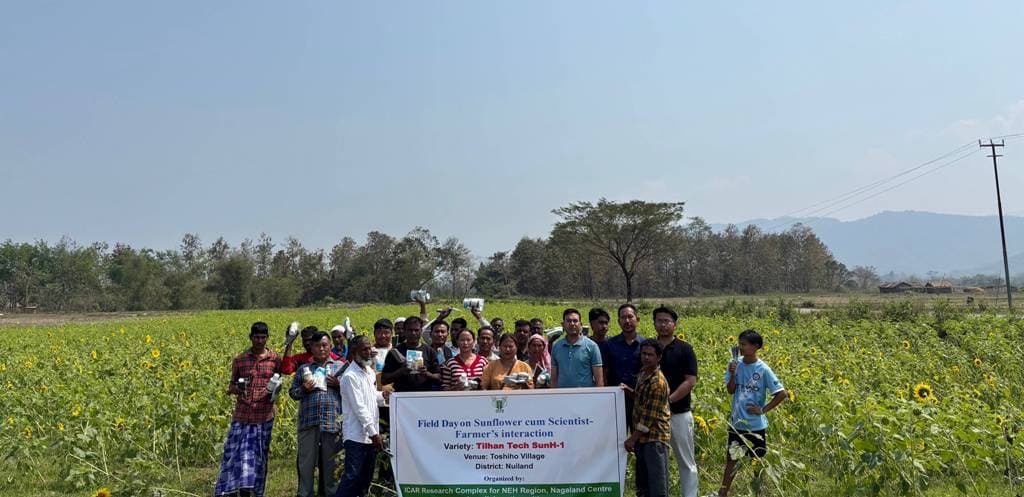
DIMAPUR — The ICAR Research Complex for NEH Region, Nagaland Centre, Medziphema, has organised a farmer field day on sunflower and scientist–farmer interaction programme on March 25. The programme was organised under the aegis of ICAR-Indian Institute of Oilseeds Research (IIOR).
An update from ICAR Nagaland Centre stated that the programme began with a speech from the Head of Research Centre (HoRC), ICAR Nagaland Centre, who highlighted the current scenario and immense potential of oilseed cultivation in Nagaland. He emphasised that despite favorable agro-climatic conditions, oilseed production in the state remains limited, resulting in dependency on external sources.
Stressing the need for self-sufficiency, he encouraged farmers to adopt improved oilseed varieties and utilise rice fallow lands effectively to enhance productivity, nutritional security and income generation.
Also read: Workshop on beggary prevention concludes at NU
It stated the farmer field day was held at Toshiho village under Niuland district, where farmers gathered to witness and learn about improved oilseed cultivation practices directly in the field. The initiative was aimed at promoting oilseed cultivation and to motivate farmers to bring rice fallow lands under productive use, thereby improving cropping intensity and strengthening livelihood opportunities.
The technical session was led by Dr. Harendra Verma, scientist at ICAR Nagaland Centre, who elaborated on the importance of the sunflower variety Tilhan Tec SunH-1 as a high-value oilseed crop with strong market demand and excellent adaptability to post-rice cultivation systems. He urged farmers to take up sunflower cultivation immediately after rice harvest instead of leaving fields fallow, noting that such practices could significantly enhance land use efficiency and farm income.
He further explained key aspects of sunflower seed production technology, including optimal sowing time, scientific crop management practices and the economic advantages of integrating sunflower into rice-based cropping systems.
Meanwhile, Dr. Moatoshi Jamir from the Plant Breeding and Genetics (PBG) division encouraged farmers to expand oilseed cultivation in rice fallows. He highlighted the productivity potential of improved varieties like Tilhan Tec SunH-1 and also shed light on linseed as an additional income-generating crop.
He also discussed nutrient management strategies, improved cultivation practices to promote diversified and sustainable oilseed farming in the region.
It mentioned that a total of 20 farmers actively participated in the programme, engaging in meaningful interactions with the scientists and expressing keen interest in adopting sunflower and linseed cultivation. It added that essential agricultural inputs such as biofertilisers, bio-insecticides and fungicides were also distributed to the participating farmers to support sustainable crop production practices.