


The choice between fixed and floating home loan interest rates is not universal. It is a decision shaped by current rate levels, the borrower's income stability, their ability to absorb rate increases, and their prepayment intentions.
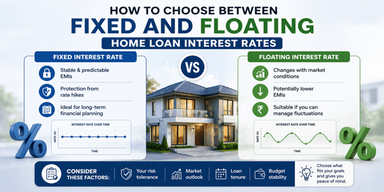
Choosing between a fixed and a floating interest rate is one of the most important decisions a home loan borrower makes. Since home loans usually run for 15 to 20 years, even a small difference in the interest rate can significantly affect the total interest paid over the loan tenure. However, many borrowers make this decision without fully understanding how each option works and may simply choose the lender's suggested option.
The right choice depends on the individual borrower's financial situation, risk tolerance, and honest expectations about the interest rate environment over the coming years.
A fixed rate home loan locks the interest rate at the time of disbursement for a defined period, sometimes the entire tenure, and sometimes for an initial fixed period of three to five years, after which it converts to a floating rate. Throughout the fixed period, the home loan EMI remains the same every month, regardless of market conditions. This predictability is the fixed rate's core advantage.
Fixed rates are typically set at a premium above the current floating rate to compensate the lender for absorbing the rate risk. This means that when a loan is taken out during a period of low or moderate interest rates, the fixed-rate option is more expensive than the floating-rate alternative.
A floating rate home loan is linked to the lender's benchmark lending rate, which may change with movements in the overall interest rate environment. When the benchmark rate decreases, the EMI or the remaining loan tenure may be reduced. If the benchmark rate increases, the EMI or tenure may increase accordingly. In this structure, the borrower is exposed to interest rate changes over the loan tenure.
Most home loans in India are offered at floating interest rates, as they are linked to externally benchmarked lending rates that are reviewed periodically. For example, many lenders, including Tata Capital, offer floating-rate home loan options for eligible borrowers.
Before deciding between a fixed and a floating home loan interest rate, borrowers should review a few important factors related to their financial situation and repayment capacity.
● Income Stability: Borrowers with stable and predictable income may prefer the consistency of fixed EMIs, while those with flexible income may manage floating-rate changes more comfortably.
● Loan Tenure: For longer loan tenures, interest rate movements may have a greater impact, making it important to consider how rates may change over time.
● Prepayment Plans: Borrowers who plan to make regular prepayments may find floating-rate loans more suitable, since interest accrues only on the outstanding principal.
● Risk Tolerance: Some borrowers prefer predictable repayments, while others may be comfortable with fluctuations in EMIs if interest rates change.
● Interest Rate Trends: Reviewing the overall interest rate environment can help borrowers decide which option may be more suitable when taking out a loan.
Considering these factors carefully can help borrowers choose the home loan interest rate structure that aligns better with their financial plans and repayment capacity.
A fixed rate home loan may be suitable when interest rates are relatively low and are expected to rise in the coming years. Locking in a low rate at this point protects the borrower from the EMI increases that would follow rising rates on a floating product. It also suits borrowers with limited flexibility in their monthly budget who cannot absorb a higher EMI if rates increase.
Borrowers who are close to retirement, have limited income growth prospects, or manage a household budget with very tight margins may genuinely benefit from the certainty of a fixed EMI throughout the loan tenure, even if the fixed rate starts slightly higher than the floating alternative.
A floating rate is generally more suitable when rates are at a cyclical high and are expected to trend downward, because the borrower directly benefits from rate reductions through lower EMIs. It also suits borrowers who plan to make regular prepayments on the loan, as prepayments reduce the outstanding principal on which floating interest is calculated.
Younger borrowers with growing incomes, those who expect to make regular lump-sum prepayments, and those who have an adequate financial buffer to absorb moderate rate increases are well-positioned to benefit from the lower starting rate of a floating rate product without being unduly harmed by rate increases over time.
Changes in benchmark lending rates can influence the repayment structure of floating-rate home loans. When interest rates increase, lenders may adjust the borrower's EMI or extend the remaining loan tenure. When rates decrease, the EMI or tenure may reduce, depending on the lender's policy.
For this reason, borrowers with floating-rate loans should maintain some financial flexibility to manage possible changes in monthly payments. Reviewing the loan terms and understanding how the lender adjusts EMIs or tenure in response to rate changes can help borrowers plan their finances more effectively throughout the loan tenure.
Several lenders offer hybrid home loan products in which the rate is fixed for an initial three- to five-year period and then converts to a floating rate for the remaining tenure. This structure provides budget certainty in the early years, when the household is adjusting to the new financial commitment, while allowing the borrower to benefit from any reductions in the floating rate over the longer term.
For borrowers who value initial EMI certainty but do not want to commit to a fixed rate for the entire 20-year tenure, the hybrid structure can be a practical middle ground worth evaluating explicitly.
The choice between fixed and floating home loan interest rates is not universal. It is a decision shaped by current rate levels, the borrower's income stability, their ability to absorb rate increases, and their prepayment intentions. Borrowers who assess these factors honestly, rather than simply following the lender's default recommendation, will make a choice they are comfortable with throughout the life of the loan.
Using a home loan EMI calculator to model the monthly payment under both options, at the current rate and at rates 1 to 2 percent higher, makes the comparison concrete and removes the abstraction from what is ultimately a financial planning decision.