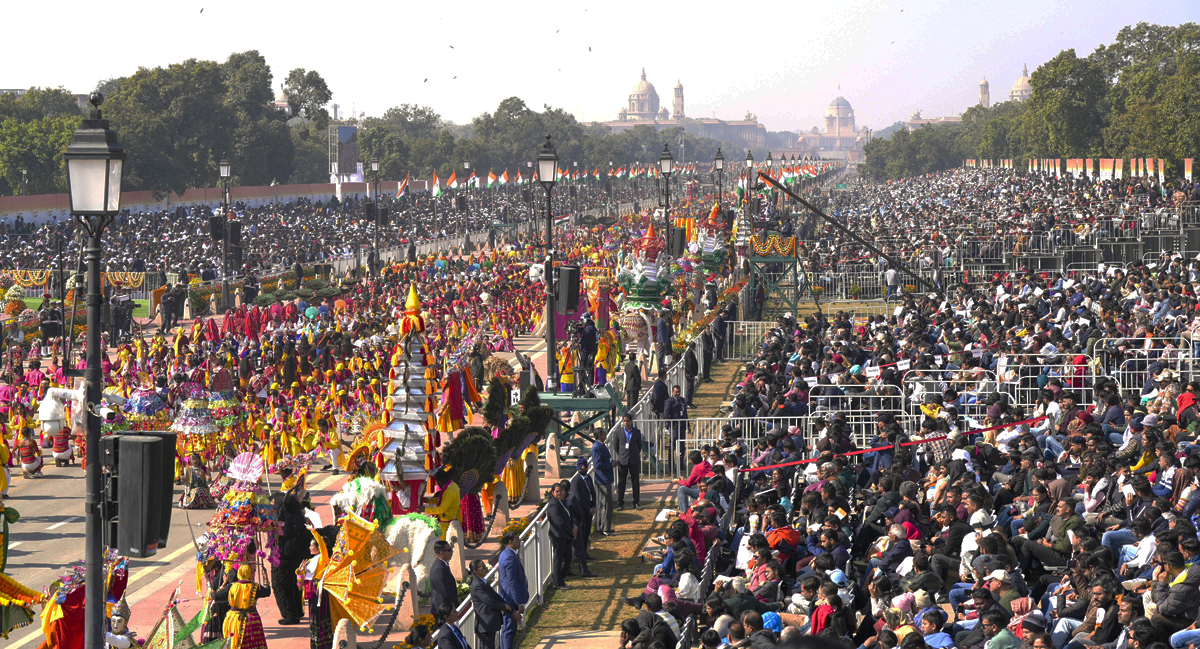
Folk artists perform during the 76th Republic Day parade at
the Kartavya Path in New Delhi, Sunday, Jan. 26, 2025. (PTI Photo/Shahbaz Khan)
NEW DELHI — A motley group of 5,000 artistes drawn from different parts of the
country performed 45 different dance forms on the full stretch of Kartavya Path
on Sunday as part of Republic Day celebrations, and it wasn't just rigorous
practice, but the inter-cultural bonding among them that did the trick.
The nearly 11-minute 'Jayati Jaya Mamah Bharatam', curated
by the Ministry of Culture, was one of the star attractions at the ceremonial
parade, both due to its sheer scale and the richness of experience it offered
to the spectators.
Like various streams of rivers, each group came from
different states, bringing with them their own colour, costumes and culture,
which all seemed to merge into one cohesive whole -- "the colour of
India".
Such was the visual impact and synchronisation in
performance that an official commentator at the ceremony even remarked that it
felt like a 'Kumbh' of 'Republic' at the Kartavya Path, a 'Sangam' of different
cultures.
Even after the parade ended, many guests sought to get
clicked or take a selfie with the artistes dressed in vibrant costumes,
reflecting the sartorial heritage of the region they represented.
From Himachal Pradesh to Andhra Pradesh and Manipur to
Gujarat, a 'mini-India' descended on the Kartavya Path, as artistes wearing
traditional costumes performed like one big team.
The dance forms that were showcased included Jhijhiya
(Bihar), Mayur Ras (Uttar Pradesh), Dangi (Gujarat), Lambadi (Telangana), Kabui
(Manipur) and Chau (West Bengal), among others.
Albertsana Rajkumar, 25, and Langlen, 19, from the Manipur
contingent shared how it took month-long practice and bit of cultural bonding
to get the steps in sync.
"We felt great after the performance... We think we all
did fine. The warmth shown by the people after the celebrations shows we did
something good," Rajkumar told PTI.
An architect by profession, the Manpuri artiste called dance
his passion and said it was this performance that brought him to Delhi for the
second time.
"We practised hard at the Pusa camp for a month, from
morning till evening. Managing such a large crowd was difficult, so it was
divided into various groups and each group had a choreographer," Rajkumar
told PTI as a group of admirers clicked selfies with Langlen, the young woman
artiste.
Langlen said people were getting drawn to their colourful
costumes, especially after the performance.
Asked if the opportunity to perform also gave them an
occasion to bond with artistes representing different cultures, they both concurred:
"Definitely."
"We got to learn about the language and culture of
other states through them and they in turn learnt about our state, which also
helped in better coordination," Langlen said.
Khushi Thakur, 22, and Deepak Sharma, 25, both from Sirmaur
district in Himachal Pradesh, had a similar tale to share.
Thakur and her teammates performed 'Naati', a dance form
typical to their home state.
They both sat along the roadside at the end of the parade,
with Thakur's vibrant costume and Sharma's Sirmau headgear attracting eyeballs.
The 5,000 folk and tribal artistes brought their dance forms
to life with their original and authentic costumes, jewellery, headgear, and
traditional props like spears, swords and drums.
For the first time, the performance covered the entire
Kartavya Path from Vijay Chowk and C-Hexagon to ensure that all the guests
enjoy the same viewing experience.
The musical performance featured folk and tribal artistes
representing youth power, artistic heritage and women empowerment drawn from
the length and breadth of India, representing the varied tapestry of culture
and diversity of India's heritage, officials said.
Bhagirath Mahato, Rakesh Mahato and Chandi Kumar, a trio from
Bokaro, performed Chau dance along with other members of a large contingent
from Jharkhand.
Rakesh Mahato, a third-generation Chau artiste, said it is a
tough art to practise but very engaging for the audience as it involves
somersaults while wearing masks.
After the end of the parade, people wanted to get clicked
with the trio while they waited for transport near the parade venue.
"We are happy to share our culture with people here. We
also learnt abut other cultures, costumes and languages, which not only helped
in coordination but also broadened our horizon," Rakesh said.
The choreography celebrated the themes of 'Viksit Bharat',
'Virasat Bhi Vikas Bhi', and 'Ek Bharat Shreshtha Bharat'.
The lyrics for the 'Jayati Jaya Mamah Bharatam' presentation
were penned by Subhash Sehgal while the music was composed by Shankar
Mahadevan.