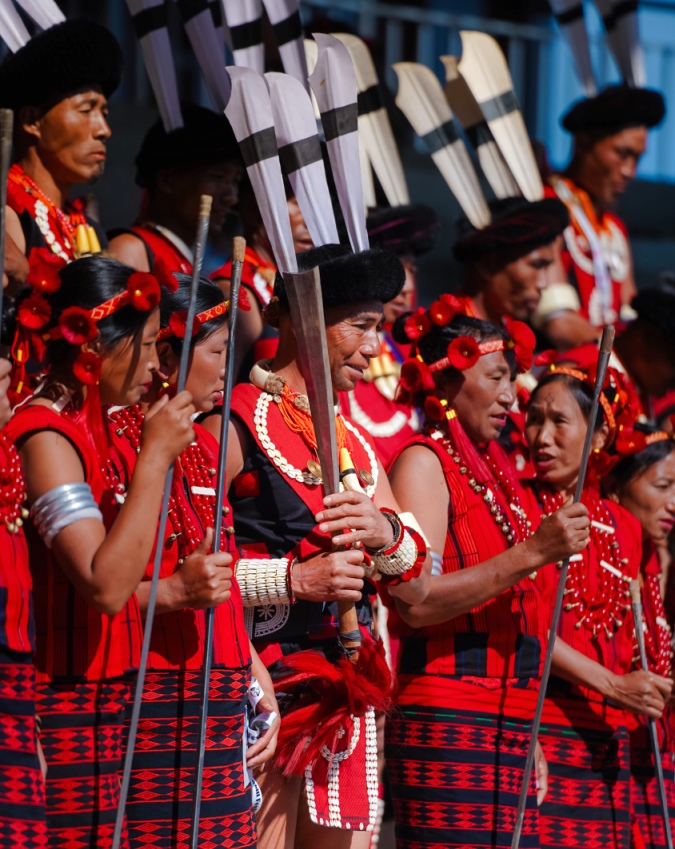
DIMAPUR — The 25th anniversary celebrations of
the Hornbill Festival continued on Day 4 on the theme "Cultural
Connect" with an impressive array of traditional performances by various
tribes of Nagaland.
The morning session was hosted by Deputy Chief Minister, TR
Zeliang, along with the advisor of Tribal Affairs and Elections, H Tovihoto
Ayemi, and Prasielie Pienyu, chairman of Nagaland Handloom and Handicrafts
Development Corporation (NHHDC).
The general manager of Northeast Frontier Railways (NFR), AK
Chowdhury, attended the event as the guest of honour.
The cultural showcase began with a performance by the Tikhir
cultural troupe by presenting ‘Thülu Tong Nü Koyatü Nong Nong Khin,’ a men’s
folk song traditionally sung while returning from the fields. The song
captivated the audience with its unique narrative style.
It was followed by the Sumi tribe with ‘Akhe Shikeu/ Aqhe
Kishi,’ a vigorous war dance performed exclusively by male villagers to
demonstrate their strength and warrior skills. The powerful, synchronised
movements conveyed the tribe’s martial spirit and camaraderie.
The Lotha cultural troupe marked the festival’s silver
jubilee with ‘Rhejung Tokhu Jubilee Nsika,’ a celebratory dance, while the
Rengma tribe presented ‘Akha Khi Kemvü,’ a song sung during the spinning of
cotton threads and the Pochury troupe performed ‘Tsupongho Tsutsongho Chonwi,’
a victory dance historically linked to headhunting traditions.
The Chakesang troupe performed a spirited war dance called
‘Khrokechü,’ symbolising courage and fearlessness, with declarations of being
the village’s protector, while the Konyak tribe softened the tone with ‘Nao
Aepu,’ a lullaby sung by women to praise and bless infants.
The women from the Sangtam tribe showcased ‘Aptarü Nyichiba,’
a celebratory dance performed in the home of village chiefs, who in turn, offer
rice and pork as tokens of gratitude.
The morning session concluded with the Kachari cultural
troupe by performing ‘Barishing Ha KhimGaiba,’ a post-harvest folk dance that honours
the guests.
The event highlighted the rich cultural heritage of
Nagaland’s tribes, fostering a deeper appreciation for their traditions and
unity through diversity, a DIPR report stated.
The co-host for the afternoon session was Advisor of
Minority Affairs and Sericulture, Imkongmar. He was accompanied by Minister of
Rural Development and SIRD, Metsubo Jamir.
The Phom cultural troupe performed 'Cheihdungla,' an
indigenous song and dance where Mithun's horn of different sizes are aligned
and played skillfully to generate different musical tunes creating a divine
sound.
It was followed by Angami cultural troupe by performing
‘Chaze Pfhe,’ a traditional folk song sung by the Angami women while spinning
cotton yarn, while the Ao cultural troupe entertained the gathering with a
mesmerizing warrior dance performance, where the dancers entered the stage with
chants to celebrate with the viewers. The chants and dances were accompanied by
the beating of drums and colorful costumes.
The Chang cultural troupe presented ‘Theai,’ a commemorative
performance by the female who sang while weaving and spinning yarns, while the
Garo cultural troupe performed ‘Anding O'ka,’ is a traditional game where two
young lads sit facing each other and contested in pulling a bamboo baton. The
one who manages to pull the baton away from the opponent wins the game.
Khiamniungan cultural troupe demonstrated ‘Oum Kie Ao,’ a
traditional way of belt making, while the Kuki cultural troupe performed 'Hal
Ngai Lam,' a dance of healing and rejuvenation.
The Yimkhiung cultural troupe presented a folk song called
‘Khohto Khun,’ which talks about the great Barbet that beautifully chirps in
the wild forest.
The session concluded with Zeliang cultural troupe by
performing ‘Kagiuna Lin,’ a honeybee dance.