[caption id="attachment_87758" align="aligncenter" width="550"]
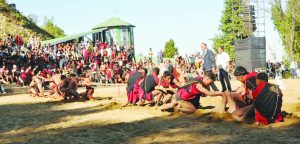
 Ao cultural troupe presenting item at the ongoing Hornbill festival at Kisama on December 9.
[/caption]
Dimapur, Dec. 9: Vivek Alva, Managing Trustee of Alva’s Education Foundation, was the guest of honour of the cultural programme on the ninth day of the ongoing Hornbill Festival at the Naga Heritage Village, Kisama, on December 9.
The day was marked by cultural performances from various tribes. In the morning session, Chindang village cultural troupe from Konyak community performed ‘Sham Shu Pu’ (pulling of the log drum). The log drum is curved out of a tree called Lanyang (Michelia Champara). The tree for the log drum is carefully selected from a place that was free from any dispute and where no evil remarks were uttered. It had to be a healthy tree with a sizable trunk and considerable length.
[caption id="attachment_87759" align="alignright" width="300"]
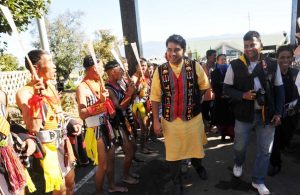 Vivek Alva, Managing Trustee, Alva’s Education Foundation at the Hornbill Festival at the Naga Heritage Village, Kisama, on December 9.
[/caption]
‘KulKon Lam,’ a cultural dance of Kuki was also performed. The dance is associated with Chin-Kuki Mizo ethnic group from the subterranean. The dance signifies and relates the plight and penury of the Kuki people while making their way to overground.
The Waromong cultural troupe from the Ao community performed ‘Pongi-Majen,’ which is a rice stalk threshing game. The harvest game is a great time of joy for the farmers. It is a time when the stamping and threshing of the paddy by the men resembles a dance to signify their strength. The women collect the grains to store in the granaries.
‘Thaonyu Dongsen Chai,’ which means log drum pulling in Chang dialect was performed by the Tuensang village cultural troupe (Chang). The best tree where the hornbill bird takes shelter was selected for the log drum. Before chopping the tree, the village elders will decide whether to cut or not, base on their dreams of what omens it will bring to the village. Prayers and rituals were performed.
The Yehemi village cultural troupe from Sumi community demonstrated Ghiletusho (harvest) activity. In this particular activity, every family go to their field carrying a cock which is killed and offered for a good harvest by invoking for a good harvest.
Phoyisha Range Cultural Troupe from Pochury tribe presented ‘Sedusie Ralie’, a dance where every young boy and girl joyfully take part in paying tribute to Sedusie- a legend who has the beauty of a bird and the strength of a warrior.
The others troupes which performed in the morning sessions included Orangkong Village Cultural Troupe from Phom community who displayed the Bu-Ow folk dance; Pathso Noken Cultural Troupe from Khiamniungan community presenting the Chucha Chu-ye. A traditional Garo game called ‘The Jakol-Kala’ was played by the Ekranipathar Village Cultural Troupe of Dimapur. The Tuensang Cultural Troupe from Chang community beat the log drum as a finale to the performances.
In the evening session, a traditional game was presented by Wokha Village cultural troupe, a game similar to tug of war. The troupe was divided into two groups with each group bound together with rope or shawl, facing the opposite they pull in opposite direction.
‘Uphe Kuthi Li,’ a folk song-dance was displayed by Pholami Dzuvekro Cultural troupe from Chakesang community. The Daosri Delai folk dance was performed by Kachari Cultural Troupe.
In the afternoon session Kithagha village cultural troupe from the Rengma community presented a folk song ‘Akhemi Kevu Khwe,’ while the Sangphur Village Cultural Troupe performed ‘Mure Yankhi,’ which is a ritual performed during the winter festival.
The Angangba Village Cultural troupe from Sangtam community presented a folk song ‘Jumuru Khingkuru Khi,’ while the Mezoma Village Cultural Troupe displayed a folk dance.
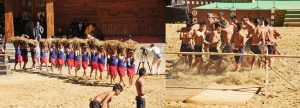
Sumi tribe won the tug-of-war competition by defeating the Yimchunger tribe at the ongoing Hornbill Festival among 15 tribes on December 9. The tug-of-war was played by eight members from each tribe playing best of 3 rounds.
[caption id="attachment_87762" align="aligncenter" width="520"]
[/caption]
The final match was played between Yimchunger and Sumi tribe with Sumi tribe emerging victorious. The champion team received cash prize of Rs Rs 20,000 while the second winners received Rs 10,000.
The prizes were given away by Director of Youth Resources, Asangla Imti. The judges of the competition were Takedovo, Avikha, Kikhwesuiil, Megolhoy and Vizovol.