Hope to introduce new income tax bill in Lok Sabha next week
Hope to introduce new income tax bill in Lok Sabha next week: Sitharaman
Finance Minister Nirmala Sitharaman said she is likely to introduce the new income tax bill, which will replace the six-decade-old I-T Act, in the coming week
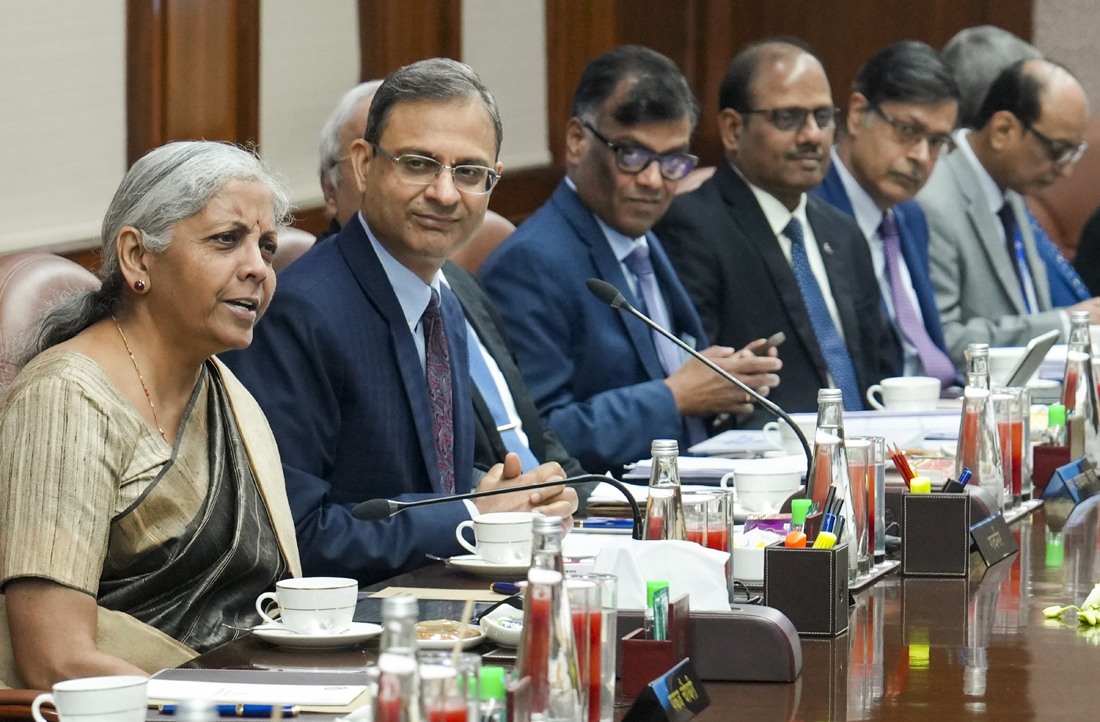
Union Finance Minister Nirmala Sitharaman at a press
conference after the 613th Meeting of Central Board of Directors (CBD) of the
RBI, in New Delhi, Saturday, Feb. 8, 2025. (PTI Photo/Shahbaz Khan)
NEW DELHI — Finance Minister Nirmala Sitharaman on Saturday said she is likely
to introduce the new income tax bill, which will replace the six-decade-old I-T
Act, in the Lok Sabha in the coming week.
After introduction in the Upper House, the bill will be
sent to a parliamentary standing committee for scrutiny.
The Union Cabinet, chaired by Prime Minister Narendra
Modi, approved the bill on Friday.
"Yesterday, the Cabinet cleared the New Income Tax
proposal, I hope to have it introduced in the Lok Sabha in the coming week.
Post that it will go to a committee," Sitharaman said a media briefing
after addressing the post-Budget customary meeting with the central board of
directors of the Reserve Bank of India (RBI).
The bill will again go to the Cabinet after the
parliamentary committee gives its recommendations on it. After Cabinet
approval, it will again be introduced in Parliament.
"I still have three critical stages to pass
through," Sitharaman said to the query regarding rollout of the new income
tax law.
Sitharaman had first announced a comprehensive review of
the Income-Tax Act, 1961 in the July 2024 Budget.
The CBDT had set up an internal committee to oversee the
review and make the Act concise, clear, and easy to understand, which will
reduce disputes, litigations, and provide greater tax certainty to taxpayers.
Also, 22 specialised sub-committees have been established
to review the various aspects of the Income Tax Act.
To another question, the Finance Minister said the last
week's Budget announcement on customs duty rationalisation is a work that has
been on since the last two years.
"So we had rationalised some even two years ago. We
also set certain norms saying evergreening is not going to happen on anti-dumping
duties, which had played a big role in giving some kind of a protection for
India's own manufacturing capabilities," she said.
Sitharaman further said with every such expiry date
getting closer, the government will review it thoroughly, and only in
exceptional cases duties will be extended, but most often they should be
concluded so that the protection does not become a perpetual protection.
"So, this is an ongoing process. We want to make
India a lot more investor-friendly, trade friendly, and at the same time,
balance it with Aatmanibhar Bharat where we need to have production,
particularly through the MSMEs. We will provide the tariff protection as
required by the industry," the Finance Minister, who presented her eighth
straight Budget on February 1, said.
In her Budget speech, Sitharaman had announced
rationalisation of customs tariff structure for industrial goods.
As part of comprehensive review of customs rate structure
announced in July 2024 Budget, on February 1, 2025 she proposed to remove seven
tariff rates.
This was over and above the seven tariff rates removed in
the 2023-24 Budget.
There will be now only eight remaining tariff rates,
including 'zero' rate.