


Nagaland University Vice Chancellor Jagadish Kumar Patnaik urges Naga students to consider higher education options within the state after Class 12.
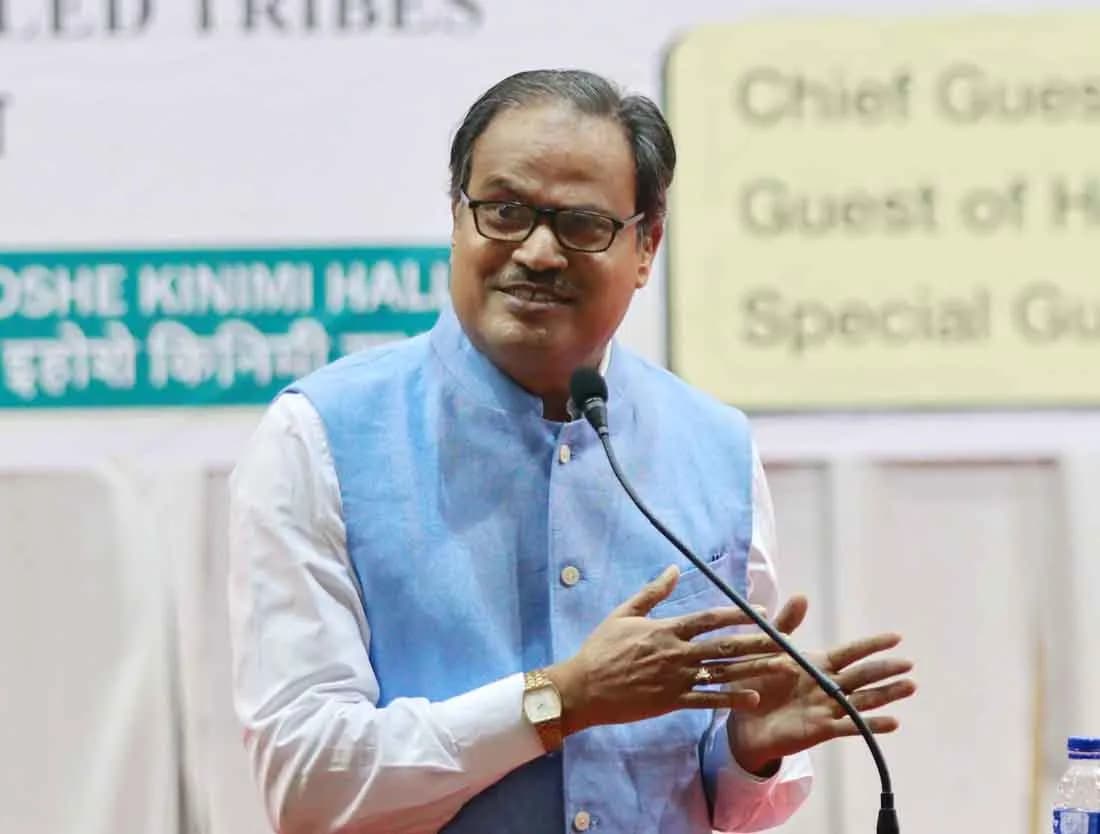
DIMAPUR — For many Naga students completing Class 12, choosing a university often comes with another decision: whether to stay in Nagaland or leave the state for higher education.
The pull of universities and colleges in Delhi, southern India and other parts of the country remains strong, particularly among students who can afford to study outside the state. But Prof. Jagadish Kumar Patnaik, Vice Chancellor of Nagaland University, believes students should take a closer look at the options available at home before making that choice.
With the Common University Entrance Test Undergraduate (CUET UG) 2026 results declared on June 23 and counselling underway, Patnaik spoke to Eastern Mirror about some of the issues Naga students should consider while seeking admission this year, from their choice of institution to errors in documents that can affect admission.
Patnaik, a political scientist who received his Ph.D. from Queen’s University, Canada, in 1993, took charge as Vice Chancellor of Nagaland University on September 15, 2022. He had earlier served as Pro-Vice-Chancellor at Mizoram University, where he superannuated as a professor.
During his tenure, Nagaland University’s National Assessment and Accreditation Council (NAAC) grade has moved from ‘B’ to ‘B+’. The university has also returned to the National Institutional Ranking Framework (NIRF) 151-200 band after a two-year absence. Around 45 patents have been granted, while some members of its faculty have been recognised among the world’s top 2% scientists.
The university has initiated the construction of 20 new buildings and upgraded laboratories, including facilities for cancer research. It has also introduced academic reforms, including a four-year multidisciplinary undergraduate programme and incentives for students performing well in competitive examinations.
The pull of studying outside Nagaland
For Patnaik, one of the concerns during undergraduate admissions is the belief among students that leaving Nagaland is necessary to receive a good education.
“Many Naga students, particularly those from the upper strata of society, tend to go outside the State to pursue liberal arts and other subjects. One of the reasons for this trend is the misconception that the facilities and academic opportunities available at Nagaland University are inadequate. There has also been a tendency among students to seek admission to universities in southern India and in Delhi,” he said.
Students, he said, “need not necessarily go outside the state in search of quality higher education.”
The question becomes particularly relevant when a student has to choose between a lower-ranked college outside Nagaland and a programme offered by Nagaland University at its campuses in Lumami, Kohima and Medziphema.
Nagaland University takes 30% of its seats through CUET. Patnaik said the university’s position has changed considerably in recent years.
“Nagaland University has, in recent years, made a significant mark at the national level in the areas of research, innovation and academic excellence. The university's infrastructure has improved drastically over the last four years, accompanied by a transformation of its academic and institutional ecosystem,” he said.
According to him, the change is also being reflected in applications.
“In fact, the demand for admission to Nagaland University has increased several-fold this year, reflecting the growing confidence of students in the University,” he said.
Getting the paperwork right
Choosing where to study, however, is only one part of the admission process. Documentation can become an equally serious problem.
Errors involving old Scheduled Tribe (ST) certificates or differences between the name on Aadhaar and other academic records have caused difficulties during admissions. Patnaik advised candidates to make sure their documents are updated well before they are required for verification.
“With regard to issues related to Aadhaar, candidates need to ensure that their names and other particulars are correctly updated on the Aadhaar portal,” he said.
All affiliated colleges have adopted the Academic Bank of Credits system, and Patnaik said the respective colleges are responsible for guiding students who face problems with it.
“Furthermore, Nagaland University issues marksheets containing the ABC ID, which should facilitate the uploading and verification of academic records through DigiLocker,” he said.
Students going through counselling should therefore have an updated Aadhaar card, an ST certificate in the central format, Class 10 and Class 12 marksheets, their CUET scorecard and their ABC ID or DigiLocker documents ready. Names and other personal details should match across the records.
Another option that students may overlook is Nagaland University’s Four-Year Undergraduate Programme in basic sciences, which began last year.
Patnaik said the programme received applications from across India this year and all its seats have already been taken.
“This year, the response to the Four-Year Undergraduate Programme (FYUGP) has been overwhelming. Students from across the country applied for admission, resulting in a high level of competition. All 50 available seats have been filled,” he said.
The full intake also means students hoping to enter Nagaland University after missing an earlier round will not have another opportunity through a spot admission this year.
“Admissions for the current academic session are now closed. Since all available seats have been filled, there will be no spot admission this year,” Patnaik said.
Students who have not secured a seat at NU will therefore have to turn their attention to subsequent CSAS rounds at other central universities rather than wait for a spot round at Nagaland University. Keeping the required documents ready and checking the admission schedules of the universities they have applied to can help prevent another opportunity from being lost.
A case for studying closer to home
For students who are still in Class 12, particularly those studying in districts such as Mon and Kiphire, Patnaik’s advice is to consider what is available within Nagaland alongside institutions elsewhere.
“My advice to students who are completing Class 12 is that they need not necessarily go outside the State in search of quality higher education. Nagaland University offers high-quality and affordable education, with academic standards comparable to those of leading institutions at the national level,” he said.
“Students can pursue quality education, research and innovation within the State while making use of the improved infrastructure and opportunities available at Nagaland University.”