Mussoorie, July 28 (PTI): The Himalayan states on Sunday came together at a conclave here to demand a separate Union ministry to deal with problems endemic to them and a green bonus in recognition of their contribution to environment conservation.
The twin demands formed part of a common agenda of the Himalayan states and a proposal in this regard was handed over to Union Finance Minister Nirmala Sitharaman at the end of the conclave, Uttarakhand Chief Minister Trivendra Singh Rawat told reporters after the event.
Sitharaman inaugurated the one-day Himalayan conclave held here on Sunday.
Chief ministers and representatives of the Himalayan states -- Jammu and Kashmir, Uttarakahand, Himachal Pradesh, Sikkim, Arunachal Pradesh, Meghalaya, Nagalaland, Tripura, Mizoram and Manipur -- took part in the conclave. The only absence was of Assam, which has been ravaged by the floods.
It is for the first time that the Himalayan states have come on a single platform to take a unanimous stand on the issue of green bonus and a separate ministry to deal with problems unique to them.
Explaining the rationale behind the demand for a green bonus, Rawat said most of the country's rivers originate in the Himalayas and therefore the states have to play the most significant role in the prime minister's water conservation initiative.
He said it was also necessary because the Himalayan states' contribution to environmental conservation was the biggest with their green cover.
The states were also at a disadvantage because large swathes of land fell into ecosensitive zones where all sorts of development activities could not be carried out, Rawat said.
A green bonus thus is needed to compensate the Himalayan states for their disadvantages, he added.
Himachal Pradesh Chief Minister Jai Ram Thakur, Meghalaya CM Conrad Kongkal Sangma, Nagaland CM Neiphiu Rio, Arunachal Pradesh Deputy CM Chowna Mein, Mizoram minister T J Lalnuntluanga and Tripura minister Manoj Kanti Deb, along with senior officials from other states and the Centre were present in the conference.
Chairman of the 15th Finance Commission N K Singh, NITI Aayog Vice Chairman Rajiv Kumar, Secretary, Department of Drinking Water and Sanitation, Ministry of Jal Shakti, Parameswaran Iyer, member, National Disaster Management Authority, Kamal Kishore, and professor at Indian Institute of Forest Management Madhu Verma, also attended the conclave.
Rio highlights contribution of Himalayan states
[caption id="attachment_262930" align="aligncenter" width="565"]
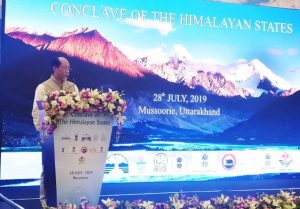 Neiphiu Rio speaking at the Conclave of the Indian Himalayan Region States held at Mussoorie on Sunday.
[/caption]
Speaking at the conclave, Chief Minister Neiphiu Rio said that Himalayan states face various challenges due to its topography, harsh terrain and a number of other factors, which contribute to development disability.
According to a press release from the chief minister’s office on Sunday, Rio urged the central government and the 15th Finance Commission to consider those aspects while allocating funds.
Rio reminded that the most important fact is that the hilly and mountainous states of the country are the sentinels of border security for the nation as all share sensitive international border with Pakistan, China, Myanmar and Bangladesh respectively, which pose military and demographic security threats especially to the IHR states and the country.
Besides this, all Himalayan states provide innumerable eco-system services to the nation like climate regulation, carbon sequestration etc., as well as act as the water tower of the country and therefore, special attention should be given by considering those factors, he said.
Rio supported the proposal for increase of the share of taxes of states from 42% to 50% but added that in the context of Nagaland, even with this increase, the state would remain revenue deficit. “In fact, it will only result in a corresponding reduction in Revenue Deficit Grant. Since the share of taxes tend to vary depending on actual collections, we have the apprehension that our receipts may fall below estimates even more than what it is now. My state has experienced negative receipts every year of the 14th Finance Commission period,” he said.
The chief minister said that more benefit would accrue if the Commission agrees to fully cover the Revenue Deficit and provide funds for critical infrastructure needs so that the infrastructure and developmental deficit are effectively addressed.
The chief minister recounted how the manufacturing sector in the state was contributing a substantial amount of INR 14,123 lakh to the state’s economy comprising 6.09% of the GSDP up to the year 1997-98. This suddenly dropped to INR 6402 lakh in 1998-99 and then to INR 3362 lakh in 1999-2000 shrinking to 1.32% of the GSDP.
‘This is attributed to the judgement of the Supreme Court in WP (Civil) 202 dated December 12, 1996 in TN Godavarman Vrs Union of India and Others against felling of trees in the Northeast. The manufacturing sector that was somehow emerging in the form of sawmills, plywood and veneer mills and furniture making, could never make a comeback and till today the manufacturing sector in the state hardly adds about 1% to the state’s economy,’ Rio stated.
“This is the price paid by the state for the sustenance of the forest cover at the behest of the nation. It has however, never been accounted for, or compensated by any of the Finance Commissions or the government of India. Conservation and preservation of the ecosystem is not without cost and this cost can only be understood by the people who pay the price. Their voices have therefore, to be heard with patience and understanding and appropriately redressed,” Rio reasoned.
The chief minister suggested that since the conclave was being held on the ground that the participating states fall under the Indian Himalayan Region, it would be more appropriate to replace the phrase ‘Special Category States’ with ‘Indian Himalayan Region States’ in the proposed joint memorandum to the 15th Finance Commission with appeals for consideration of the problems and issues faced by IHR states on the basis of being hilly and mountainous states.


