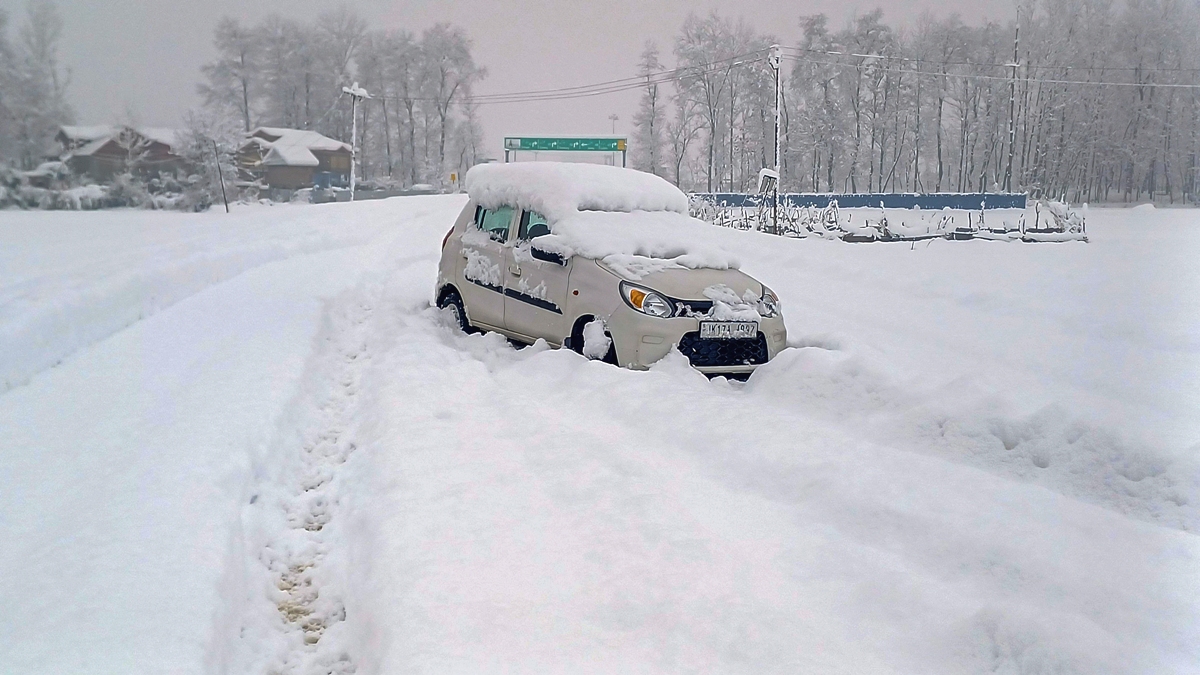
A vehicle stranded on the Jammu-Srinager National Highway
after heavy snowfall, in Anantang district, Saturday, Dec. 28, 2024. (PTI
Photo)
SRINAGAR — The Kashmir Valley received the season's heaviest snowfall on
Saturday which threw normal life out of gear, affecting air, rail and road
traffic as well as disrupting power and water supply, officials said.
Chief minister Omar Abdullah reviewed the snow clearance
operations in a video conference meeting with all deputy commissioners.
Moderate to heavy snowfall was recorded across Kashmir
from Friday, including the season's first snowfall in Srinagar city and other
plain areas.
In South Kashmir, heavy to very heavy snowfall was
recorded in the plains, while central Kashmir’s plains received moderate
snowfall. The plains of North Kashmir received light to moderate snowfall,
officials said.
The upper areas of the South Kashmir district received
over two feet of snow, they added. Though the snowfall was welcomed by locals
and tourists, it threw daily life out of gear.
The Jammu-Srinagar National Highway (NH-44) was closed
for traffic due to snow, according to Traffic Department officials. They added that
clearance work was hampered due to heavy snowfall at the Navyug Tunnel.
Men and machinery are on the job, and commuters are
advised to avoid travel until the weather improves and the road is cleared, the
officials said.
Train services on the Banihal-Baramulla section were
suspended due to heavy snow accumulation on the tracks, railway officials said.
Efforts to clear the track are underway, they added.
Air traffic to and from Srinagar was also affected, with
flight operations suspended, according to airport officials.
"Due to bad weather conditions, all flights at
Srinagar Airport have been cancelled. No flight operations have taken place at
the airport since the morning due to inclement weather," officials said.
Passengers are advised to contact their airlines for updates.
Flight operations have been affected since Friday
evening.
The authorities launched snow clearance operations at
district headquarters and while most of the main roads and roads to hospitals
were cleared by morning itself, interior roads were cleared by noon, the
officials said.
Abdullah directed the deputy commissioners to personally
supervise snow clearance operations, emphasizing the need to obtain
photographic evidence of cleared areas to ensure thorough removal and prevent
roads from freezing as temperatures drop.
District administrations were instructed to provide
two-hourly updates to the CM's office and the chief secretary’s office.
The Chief Engineer of Public Health Engineering (PHE)
Department informed the meeting that 90 per cent of the water supply across the
valley had been restored, with efforts underway to address the remaining 10 per
cent, officials said.
The Divisional Commissioner of Jammu reported that power
and water supplies in Jammu districts remained unaffected, while the chief
secretary confirmed steady progress in restoring electricity feeders and
assured that district hospitals were functioning smoothly.
The chief minister stressed the importance of ensuring
100 per cent attendance of doctors and paramedical staff at all district and
sub-district hospitals to effectively manage emergencies.
Special instructions were issued to the deputy
commissioner of Budgam to coordinate with airport authorities to assist
stranded tourists and provide transportation if required, officials said.
The Divisional Commissioner of Kashmir assured that sufficient
stocks of essential commodities, including food and other civil supplies, were
available in all districts.
Taking to X, Abdullah said most of the dysfunctional
power feeders in the valley had been restored.
"Out of forty-one 33KV feeders dysfunctional in
Kashmir due to heavy snowfall, thirty-seven have been restored and charged.
Similarly, out of 739 dysfunctional 11KV feeders, 639 have been restored and
recharged, bringing major relief to the valley," Abdullah said.
He said the majority of the remaining feeders were
expected to be restored by the evening.
Abdullah also toured several areas of Srinagar city and
visited his assembly constituency, Ganderbal, to take stock of the situation,
officials said.
He made an unannounced visit to District Hospital
Ganderbal and assessed the services available to patients during the inclement
weather and reviewed the availability of essential medicines, staff on duty,
and the functionality of the central heating system.
Abdullah interacted with the hospital staff, as well as
patients and their attendants.
Speaking to reporters in Ganderbal, Abdullah said he
wanted to visit his constituency to ensure that people did not face too many
hardships due to the snow.
"I wanted to see that the snow clearance operations
on roads are sped up, take stock of hospital and essential services, and the
restoration of electricity wherever the lines were snapped," he said.
Meanwhile, minimum temperatures went up by several notches
across the valley, the MeT Department said.
Srinagar recorded a low of minus 1 degree Celsius on
Friday night, more than six degrees up from the previous night's low of minus
7.3 degrees Celsius, it said.
Gulmarg, a town known for skiing activities in North
Kashmir, recorded a low of minus 5 degrees Celsius, while Pahalgam, the base
camp for the annual Amarnath Yatra in South Kashmir, registered a minimum
temperature of minus 2.8 degrees Celsius.
Kashmir is currently under the grip of the 40-day 'Chillai-Kalan'
-- considered the harshest period of winter -- which began on December 21.