


District Health Society Tuensang conducts a three-day district-level training on DAKSHATA for medical officers, CHOs, and ANMs
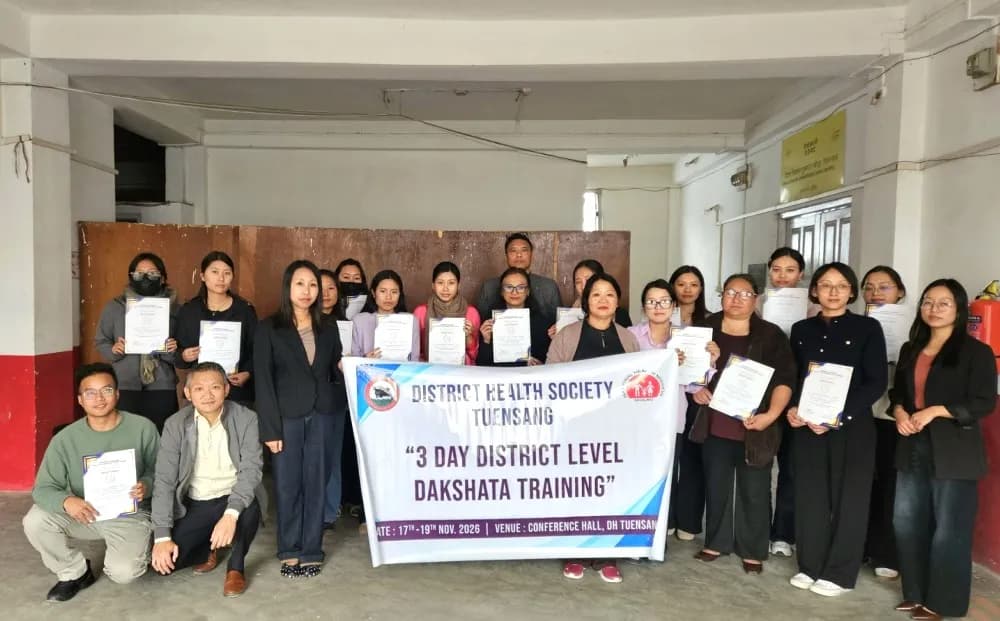
DIMAPUR — The District Health Society (DHS), Tuensang, conducted a three-day district-level training on DAKSHATA at the conference hall of District Hospital Tuensang from November 17 to the 19th.
According to an update, the training was facilitated by Dr. Nungsang, Junior Specialist (Obstetrics and Gynaecology), District Hospital Tuensang, and Sophe, Staff Nurse, District Hospital Tuensang.
The training covered various topics, including the importance of ensuring quality care in the labour room and current practices in client management in labour rooms at the worksite of learners (flow of client care).
Other key topics included understanding stages of labour in relation to the flow of client care, introduction to the safe childbirth checklist (SCC), a simple tool to improve quality of care, orientation to the layout of SCC, BP measurement, Hb estimation by Sahli’s method, urine protein estimation by uristix, and immediate actions for the prevention of major complications in mothers.
Read more local news: PACES training programme launched in Dimapur
Chümoukedima, Niuland launch safe toilet campaign
The sessions also covered the use of antibiotics for infection and management, antiretroviral therapy for HIV management, management of threatened preterm birth (including the use of antenatal corticosteroids), prevention, identification, and management of pre-eclampsia and eclampsia, and empowering birth companions for participation in the care of the mother and the baby.
Further topics included monitoring the progress of labour, plotting and interpreting partographs, principles of timely identification and management of prolonged and obstructed labour, normal delivery and active management of the third stage of labour, conducting normal delivery, ENBC and AMTSL, newborn resuscitation (NBR), review of care of the mother and newborn soon after birth, prevention of complications in newborns, prevention, identification, and management of newborn infections, assessing and managing postpartum complications in mothers, special care for pre-term and LBW babies, postpartum family planning counselling, do’s and don’ts for all four stages of labour, infection prevention practices and biomedical waste management, and recording and reporting of the LR register and monthly reporting format.
Pre- and post-training knowledge assessments and an objective structured clinical examination (OSCE) were also conducted as part of the programme to assess the participants’ knowledge and skills.
The participants in the training were medical officers (MOs), community health officers (CHOs), and auxiliary nurse midwives (ANMs). Certificates of completion were awarded to the participants for the successful completion of the DAKSHATA training programme.