[caption id="attachment_169461" align="alignnone" width="550"]
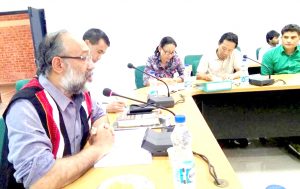 Journalist and author Sanjoy Hazarika speaking during a Naga Scholars Association-organised ‘talk’ based on his recent book ‘Strangers no More: New Narratives from India’s North East.’
[/caption]
Dimapur, March 19 (EMN): The Naga Scholars Association (NSA) hosted a ‘talk’ by journalist-academic-author Sanjoy Hazarika based on his recent book ‘Strangers no More: New Narratives from India’s North East.’
The group issued a press release on Monday stating that the interaction was part of objectives for ‘scholarly interaction’ and to network with academicians and academic institutions. The speaker of the event was Sanjoy Hazarika, who the organisation described as a human rights activist ‘recognised for designing and developing innovative strategies for inclusive health and governance and also known as scholar, author, journalist and filmmaker.’
Sanjoy Hazarika started his discourse by recounting his meeting with Naga leader AZ Phizo which changed his perspective of the Nagas, the updates stated. Hazarika was 19 years of age then, the NSA stated. During that brief encounter, Phizo was quoted as having said that “One day the Assamese will understand what we have gone through. They will speak our language, because the Indian government cannot be trusted.”
‘He turned out to be right,’ said Hazarika. His personal encounters with other figures from Northeast India and of the people of the region in general eventually led him to analyse what it was that drove the people of this region to press on with their aspirations, the press release stated.
Hazarika also talked about his experience as the lone member from the Northeast India in the Jeeven Reddy Committee set up to review the Armed Forces (Special Powers) Act. The committee, however, seemed to undergo a change in their attitude and finally recommended repealing the AFSPA, the updates stated. He recounted the first trip of the Reddy Committee to Imphal for public hearing amidst blockades and protests consequent to the Manorama incident.
“The tipping point for the report is the tragic story of a man who went fishing but never returned - he was caught in crossfire between the paramilitary forces and underground cadres. In this connection, a woman told them, ‘I have something to tell you. I’m the mother. I do not want any other mother to go through what I have. I did not know who will read your report, I do not know who you write it for, but I want to tell you this. This is not right. I don’t want any compensation.’
Also touching upon the ‘protracted negotiation’ and the ‘framework agreement’ between the government of India and the NSCN (IM), he was stated to have maintained that the greater challenge was in reconciliation of political groups and the of the people.
“The civil societies, academia, intellectuals, etc who have the goodwill of the people need to lead the people in reaching out to one another to facilitate reconciliation. Reconciliation, though hard and long, leads to healing and is essential for the people to move forward,” the press release stated. With the need of people’s participation for change, he was said to have “hinted” the need for good leaders by referring to the sacrifices made by Nelson Mandela, whose life and works continue to stir people of different backgrounds to tears till today.
Hazarika said: “The world of the Northeast has seen some good and much bad. We’ve looked at some of these factors, which have shaped and reshaped life and society, politics and power, driven by passion and determination by geography and history, insensitivity and stupidity, by plain common sense, by brutality and by kindness.”
Hazarika is of the opinion that Northeast India has taken inroads, especially in metropolitan cities such as Delhi and that ‘it takes a lot of courage to carry on.’


