[caption id="attachment_248840" align="aligncenter" width="500"]
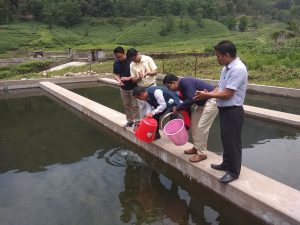 From left: Senti Ao, holding a red bucket, and Debajit Sharma, with a pink bucket, release trout on a raceway on May 13 at Dzüleke village in Kohima district.
[/caption]
Our Correspondent
Kohima, May 13 (EMN): A hatchery for trout, and raceways for them, was inaugurated at Dzüleke village, on May 13 in Kohima district. The concept behind the hatchery was to provide means of livelihood and to contribute to bringing about sustainable development.
Senti Ao, commissioner-secretary for the Fisheries & Aquatic Resources department, said that the initiative was a “perfect example of sustainable development.” He felt the project has the potential to do much more.
Ao explains that this type of rearing is supported by members of the community because fresh water fishing is a traditional practice, he said. The trout hatchery and raceways will take advantage of the natural topography of the village, as well as preserve the delicate fauna of the river system, the officer said.
The main initiative of the project is to increase the density of fish and to improve its quality. That way, rearing trout becomes an economically viable activity. The project also envisages enhancing the quality and productivity of the local varieties of trout without upsetting the delicate eco system of the village, Ao said.
“If this activity is taken up with the right attitude (sic), it has the potential to not only improve the economy of the village but also to contribute substantially to the global conservation efforts,” the officer said.
It is after the Chocolate Mahseer Hatchery at Longkong village in Mokokchung district that the Indian Council Agriculture Research-directorate of coldwater fisheries research (Icar-DCFR) has now inaugurated the trout hatchery at Dzüleke.
Ao appreciated the villagers for showing a positive attitude to the project. He appealed to them to derive maximum benefit from the initiative.
Debajit Sharma, the director of Icar-DCFR, said that the hatchery was the first project of its kind in Nagaland. Around five thousand trout were brought from Kashmir for the pilot project. In the first cycle ie., six months to one year, they are expected to grow 500-600 grams, provided they are fed daily and their holding area is cleaned constantly. After three years of time, the trout will be able to spawn.
The project targets giving benefits to about 10 to 20 farmers in the village. Interested farmers will be provided with intensive training in rearing trout, he said.
Saying that the fish is highly climate dependent, it can be sustained only in cold climate that is below 20 degree Celsius. It also requires sufficient water to survive. Unlike other fish, trout can be sustained only in cemented raceways, that too with 45 metre cube area, Sharma said.
About their feed, trout require food having over 45% proteins. Thus, the making of their artificial feed will be a “difficult task,” as the right percentage of ingredients must have to be ensured. The feed has to happen within six months time, he added.
The climatic and environmental condition of Dzüleke village is favourable for this sort of fish, he said. This project was funded by the Icar-DCFR. Around INR 26 lakh was involved in the overall project, Sharma said.
The official has expressed appreciation to the Fisheries department for ‘implementing well’ and ‘establishing well’ the project.
Pro-Vice chancellor Prof. RC Nayak gave a short address. he said Dzüleke has the capacity of becoming one of the “top tourist attraction spot in the map of Nagaland” provided 'more development' is brought in.
Nayak feels that developing roads is the first requirement. Further, villagers can source energy by making use of available water. He suggested that the Fisheries department coordinate with the Water Resource and Energy department to ensure better facilities.
The additional director of Fisheries and Aquatic Resources, Rongsennungba, no surname given, said that the department had ‘great interest’ to develop cold water fishery for many years. With the trial project at hand, the department will try to bring positive results from the project, he said.
Meanwhile, the villagers welcome the project on their land and look forward to working with the department.


