KHAN YOUNIS (GAZA
STRIP) — Hamas on Thursday released the bodies of four Israeli
hostages, said to include a mother and her two children who have long been
feared dead and had come to embody the nation's agony following the Oct 7,
2023, attack.
The remains were said to be of Shiri Bibas and her two
children, Ariel and Kfir, as well as Oded Lifshitz, who was 83 when he was
abducted. Kfir, who was 9 months old when he was taken, was the youngest
captive. Hamas has said all four were killed along with their guards in Israeli
airstrikes.
The militants displayed four black coffins on a stage in
the Gaza Strip surrounded by banners, including a large one depicting Prime
Minister Benjamin Netanyahu as a vampire. The fighters then carried the coffins
over to Red Cross vehicles, where staffers in red vests covered them in white
sheets before placing them inside.
The Red Cross convoy headed back to Israel, where
authorities will carry out the formal identification of the remains using DNA,
expected to take up to two days. Only then will the families be given the final
notification. The Israeli military confirmed it had received the coffins.
Thousands of people, including large numbers of masked
and armed fighters from Hamas and other factions, gathered at the handover site
on the outskirts of the southern Gaza city of Khan Younis.
Israeli channels did not broadcast the handover. In
Hostage Square in Tel Aviv, where Israelis have gathered to watch the release
of living hostages, a large screen showed a compilation of photos and videos of
Lifshitz and the Bibas family, including a chuckling baby Kfir and the family
dressed up in Batman costumes.
Dozens of residents of Kibbutz Nir Oz, where the four
were kidnapped, gathered to wave Israeli flags outside of their temporary home
an hour north of the kibbutz.
Israelis have celebrated the return of 24 living hostages
in recent weeks under a tenuous ceasefire that paused over 15 months of war.
But the handover on Thursday will provide a grim reminder of those who died in
captivity as the talks leading up to the truce dragged on for over a year.
It could also provide impetus for negotiations on the
second stage of the ceasefire that have hardly begun. The first phase is set to
end at the beginning of March.
Infant was the
youngest taken hostage
Kfir Bibas was just 9 months old, a red-headed infant
with a toothless smile, when militants stormed into the family's home on Oct.
7, 2023. His brother Ariel was 4. Video shot that day showed a terrified Shiri
swaddling the two boys as militants led them into Gaza.
Her husband, Yarden Bibas, was taken separately and
released this month after 16 months in captivity.
Relatives in Israel have clung to hope, marking Kfir's
first and second birthdays and his brother's fifth. The Bibas family said in a
statement Wednesday that it would wait for “identification procedures” before
acknowledging that their loved ones were dead.
Supporters throughout Israel have worn orange in
solidarity with the family — a reference to two boys' red hair — and a popular
children's song was written in their honor.
Like the Bibas family, Oded Lifshitz was abducted from
Kibbutz Nir Oz, along with his wife Yocheved, who was freed during a weeklong
ceasefire in November 2023. Oded was a journalist who campaigned for the
recognition of Palestinian rights and peace between Arabs and Jews.
Hamas-led militants abducted 251 hostages, including some
30 children, in the Oct 7 attack, in which they also killed some 1,200 people,
mostly civilians.
More than half the hostages, and most of the women and
children, have been released in ceasefire agreements or other deals. Israeli
forces have rescued eight and have recovered dozens of bodies of people killed
in the initial attack or who died in captivity.
It's not clear if
the ceasefire will last
Hamas is set to free six living hostages on Saturday in
exchange for hundreds of Palestinian prisoners, and says it will release four
more bodies next week, completing the ceasefire's first phase. That will leave
the militants with some 60 hostages, all men, around half of whom are believed
to be dead.
Hamas has said it won't release the remaining captives
without a lasting ceasefire and a full Israeli withdrawal. Netanyahu, with the
full backing of the Trump administration, says he is committed to destroying
Hamas' military and governing capacities and returning all the hostages, goals
widely seen as mutually exclusive.
Trump's proposal to remove some 2 million Palestinians
from Gaza so the U.S. can own and rebuild it, which has been welcomed by Netanyahu
but universally rejected by Palestinians and Arab countries, has thrown the
ceasefire into further doubt.
Hamas could be reluctant to free more hostages if it
believes the war will resume with the goal of annihilating the group or
forcibly transferring Gaza's population.
Israel's military offensive killed over 48,000
Palestinians, mostly women and children, according to Gaza's Health Ministry,
which does not distinguish between civilians and combatants in its records.
Israel says it has killed over 17,000 fighters, without providing evidence.
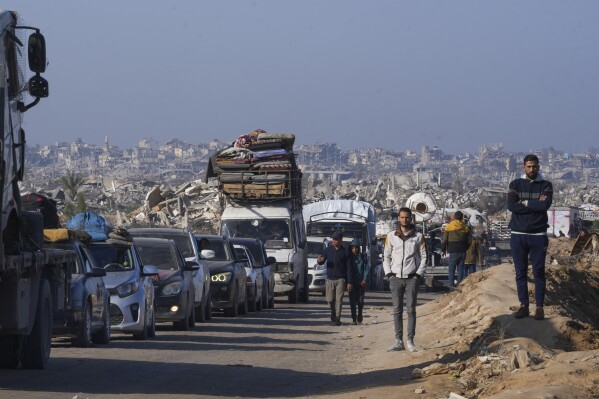
The offensive destroyed vast areas of Gaza, reducing
entire neighborhoods to fields of rubble and bombed-out buildings. At its
height, the war displaced 90% of Gaza's population. Many have returned to their
homes to find nothing left and no way of rebuilding.