Hamas frees 3 hostages, Israel releases hundreds of prisoner
Hamas frees 3 hostages, Israel releases hundreds of prisoners as fragile ceasefire holds
Hamas-led militants released three male Israeli hostages Saturday and Israeli forces began releasing hundreds of prisoners in return, fighting in the
Gaza Strip paused as fragile ceasefire holds
KHAN YOUNIS (GAZA) — Hamas-led militants released three male Israeli hostages
Saturday and Israeli forces began releasing hundreds of prisoners in return, in
the latest indication that a fragile ceasefire that has paused fighting in the
Gaza Strip but had teetered in recent days, is holding.
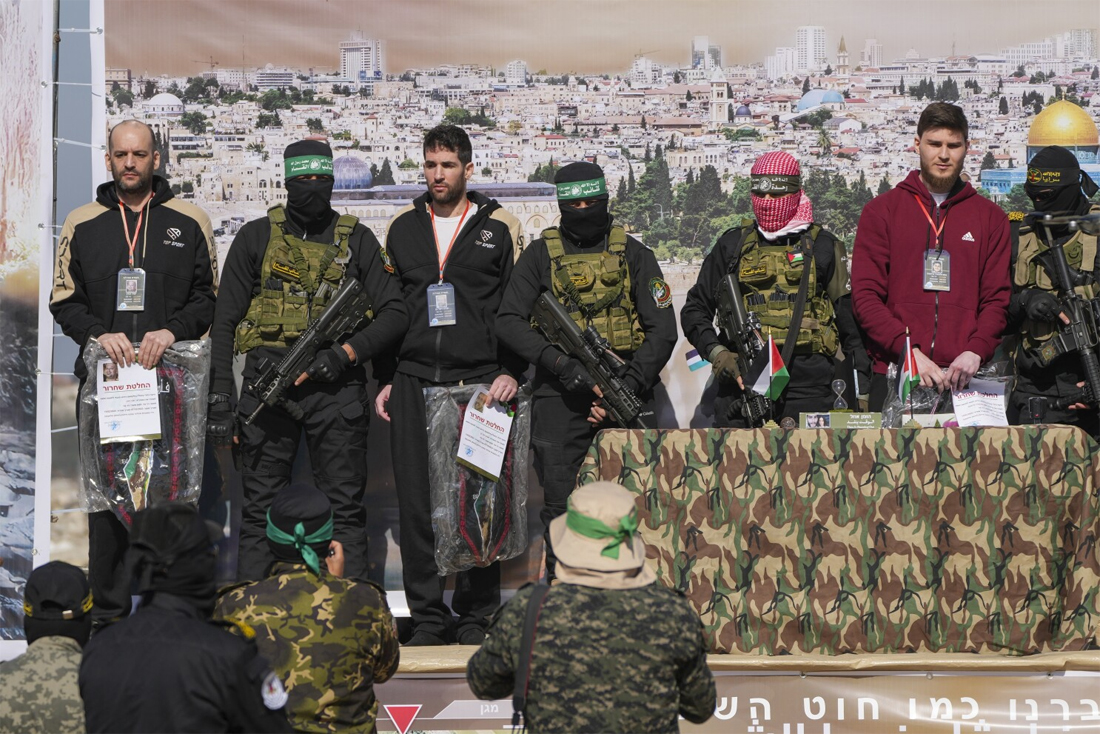
Militants in the southern Gaza Strip paraded the three
hostages — Iair Horn, 46, a dual citizen of Israel and Argentina;
American-Israeli Sagui Dekel Chen, 36; and Russian-Israeli Alexander (Sasha)
Troufanov, 29 — before a crowd before releasing them.
All had been abducted from Kibbutz Nir Oz, a community
that was hard-hit in the October 7, 2023, attack that ignited the war. They
appeared pale and worn, but seemed in better physical condition than the three
men released last Saturday, who had emerged emaciated from 16 months of
captivity.
The truce that began nearly four weeks ago had been
jeopardised in recent days by a tense dispute that threatened to renew the
fighting.
US President Donald Trump's controversial proposal to
remove more than 2 million Palestinians from Gaza and settle them elsewhere in
the region has cast even more doubt on the future of the ceasefire.
But Hamas said Thursday it would move ahead with the
release of more hostages after talks with Egyptian and Qatari officials. The
group said the mediators had pledged to “remove all hurdles” to ensure Israel
would allow more tents, medical supplies and other essentials into Gaza.
As with previous exchanges, the hostage release was
heavily choreographed, with the captives made to walk onto a stage and speak
into microphones before the crowd. Dozens of masked, armed Hamas fighters lined
up near the stage festooned with Palestinian flags and banners of militant
factions.
In Tel Aviv's Hostages Square, a huge cheer went up as
the hostages were transferred to the Red Cross. “Iair, Sagui and Sasha are on
their way home!” an announcer said.
In return for the hostages' release, Israel began
releasing 369 Palestinian prisoners and detainees, including 36 serving life
sentences over deadly attacks. A bus carrying the first released prisoners
arrived in the occupied West Bank town of Beitunia and were greeted by a cheering
crowd of relatives and supporters.
Some appeared gaunt, and the Palestinian Red Crescent
emergency service said four were immediately taken for medical treatment.
It is the sixth swap since the ceasefire took effect on
January 19. Before Saturday, 21 hostages and over 730 Palestinian prisoners
were freed during the first phase of the truce.
Who are the
hostages and prisoners being released?
Horn was abducted along with his brother, Eitan Horn, who
had been staying with him at the time. Eitan, 37, remains in captivity and is
not on the list of hostages expected to be released in the ceasefire's first
stage.
"Now, we can breathe a little. Our Iair is home
after surviving hell in Gaza," his family said in a statement. “Now, we
need to bring Eitan back so our family can truly breathe.”
Dekel Chen had been working outside when militants
stormed the kibbutz. His pregnant wife, Avital Dekel Chen, hid in a safe room
with their two daughters. She gave birth to their third daughter two months
later. Speaking to Israeli media Saturday, she said she was overwhelmed with
happiness to see Sagui back in Israel, where he will meet his youngest
daughter, Shachar, for the first time.
Troufanov, whose father was killed during the October 7
attack, was taken hostage along with his grandmother, mother and girlfriend.
The three women were released during a brief ceasefire in November 2023.
Troufanov was informed of his father's death after his release, shortly before
being reunited with his family, who said they were “overwhelmed with emotion
and gratitude” as he crossed into Israeli territory.
Of the 369 Palestinians who were being released from
Israeli prisons, 36 were serving life sentences, according to the Hamas-linked
Prisoners' Information Office.
Among the most prominent is Ahmed Barghouti, 48, a close
aide of militant leader and iconic Palestinian political figure Marwan
Barghouti.
Israel sentenced Ahmed Barghouti to life on charges that
he dispatched suicide bombers during the Second Intifada, or Palestinian
uprising, in the early 2000s to carry out attacks that killed Israeli
civilians. He was arrested alongside Marwan Barghouti in 2002.
Concerns are high
about the remaining hostages' condition
Of the 251 people abducted during the Oct. 7 attack, 73
remain in Gaza, around half of whom are believed to be dead. Nearly all the
remaining hostages are men, including Israeli soldiers.
Concern has been growing about their condition,
particularly after the release of three last Saturday, who emerged looking
emaciated and frail.
One of them, 65-year-old Keith Siegel, said Friday in a
video message addressed to Trump that his captors treated him worse as the
15-month war intensified, kicking him, spitting on him and holding him without
water or light.
The truce remains
very fragile
The ceasefire appeared dangerously close to collapse in
recent days.
Hamas had said it would delay the release of the hostages
after accusing Israel of not adhering to their agreement by not allowing in
enough shelters, medical supplies, fuel and heavy equipment for clearing
rubble. Israel said it would resume fighting Saturday unless hostages were
freed.
While the immediate crisis may have been averted, the
truce faces a much bigger challenge with the deal's first phase set to conclude
in early March. There have not yet been substantive negotiations over the
second phase, in which Hamas would release all remaining hostages in return for
an end to the war.
At its height, the fighting displaced 90 per cent of
Gaza's population of 2.3 million. Hundreds of thousands have since returned to
their homes as the ceasefire took hold, though many found only rubble, buried
human remains and unexploded ordnance.
The war has killed over 48,000 Palestinians, mostly women
and children, according to Gaza's health Ministry, which does not say how many
were fighters. Israel says it has killed over 17,000 militants, without
providing evidence.
Trump's plan
increases uncertainty
Trump's proposal to remove some 2 million Palestinians
from Gaza and settle them elsewhere in the region has thrown the truce's future
into further doubt.
The idea has been welcomed by Israel's government. But it
has been strongly rejected by Palestinians and Arab countries. Human rights
groups say it could amount to a war crime under international law.
Trump has proposed that once the fighting ends, Israel
would transfer control of Gaza to the United States, which would then redevelop
it as the “Riviera of the Middle East.”
Prime Minister Benjamin Netanyahu's far-right allies are
already calling for a resumption of the war after the first phase with the goal
of destroying Hamas and implementing Trump's plan. The militant group remains
in control of the territory after surviving one of the deadliest and most
destructive military campaigns in recent history.
Hamas may be unwilling to release any more hostages if it
believes the war will resume. The captives are among the only bargaining chips
it has left.