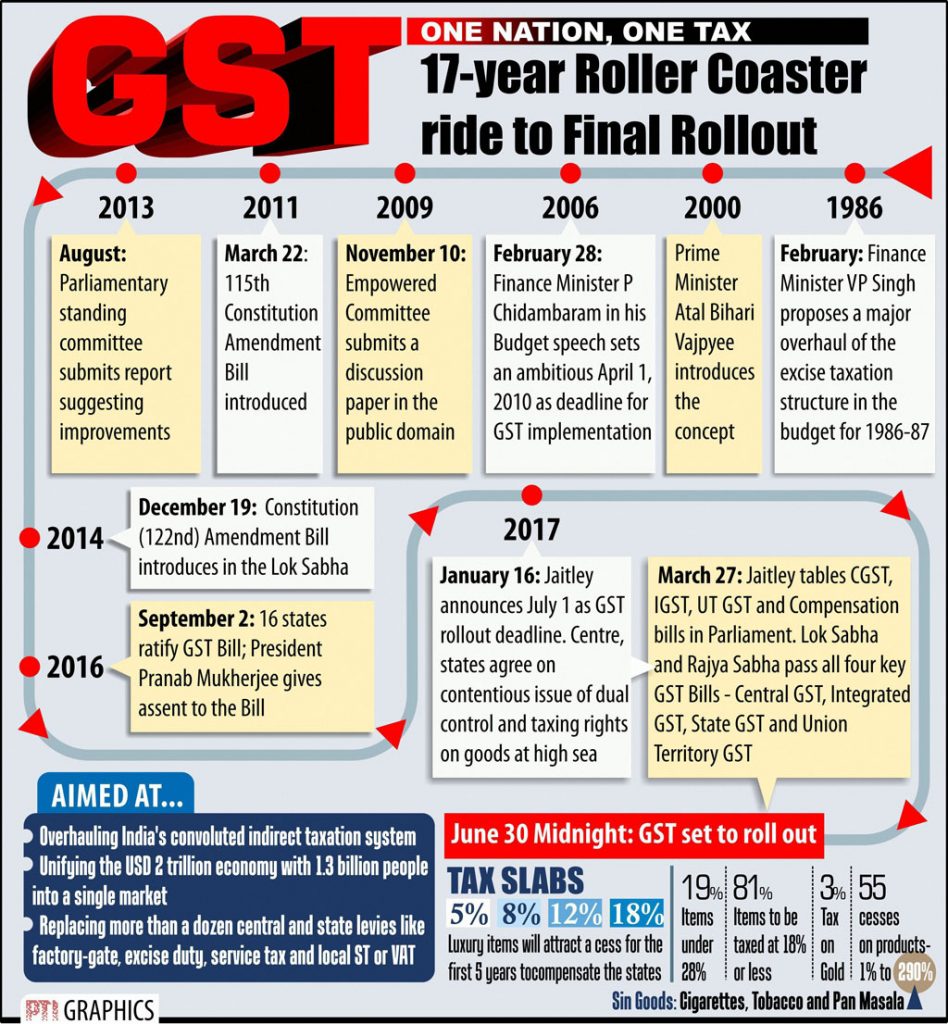
 New Delhi, July 1 (IANS):
 The Goods and Services Tax (GST), India’s biggest tax reform since Independence, rolled out past midnight Friday in the precincts of the hallowed Central Hall of Parliament to usher in a new indirect tax regime in an event that sought to evoke memories of the famous ‘Tryst with Destiny’ night the country got freedom in 1947.
A minute after the stroke of midnight, President Pranab Mukherjee and Prime Minister Narendra Modi pressed the button to launch the new indirect tax regime on a digital screen with “GST” emblazoned on it in a golden hue.
Conceived on the principle of ‘one nation, one tax, one market’, the tax that subsumes 17 central and state levies was launched in the presence of Vice President Hamid Ansari, former Prime Minister H.D. Deve Gowda, Lok Sabha Speaker Sumitra Mahajan, Finance Minister Arun Jaitley, MPs, chief ministers, state finance ministers, officials of the Centre and states.
Notwithstanding the fact that the GST Law was a consensus product evolved over 14 years, the function in colorfully-decked Parliament House was boycotted by major opposition parties like Congress, Trinamool Congress, RJD, DMK and Left parties, saying the government was making a spectacle of a legislation for self-promotion, a charge Jaitley rejected. In keeping with his party’s decision, former Prime Minister Manmohan Singh kept away from the event. However, MPs and leaders of Congress allies NCP and Samajwadi Party attended the function.
Addressing the gathering, President Pranab Mukherjee said the introduction of GST is a moment of precedent for the country and a matter of personal satisfaction for him because of his role as Finance Minister earlier. “I had always believed that GST was a matter of time and was happy when it was enacted and I gave assent to the Constitution amendment last year,” he said.
He said the new law is a tribute to the maturity and wisdom of Indian democracy. The GST Council was a unique experiment under the Indian Constitution because of the shared sovereignty.
In his speech, Modi said the roll out of GST is the best example of cooperative federalism and success of Indian democracy. “The credit for the new law does not go to one party or one government but was a shared legacy of all,” he said.
In a veiled rejoinder to opposition criticism of the midnight function in Parliament, the Prime Minister said there cannot be a “better and sacred” venue than the Central Hall for the historic roll out.
The GST process cannot be confined to just economic system but was a collective effort of all, he said, adding it was a product of long discussions among the best brains of the country. “It is an example of Team India’s strength and ability,” he said.
Referring to the eminent personalities like Jawaharlal Nehru, Sardar Patel, Maulana Abul Kalam Azad and Babu Rajendra Prasad who had adorned the Central Hall, Modi said like Patel had integrated the country, the GST would integrate the country economically.
He described the GST as ‘Good and Simple Tax’ -- good because there will be no tax on tax and simple because there will be only one form of tax. It will also help eliminate black money and corruption because of the transparency it seeks to bring in, he said.
Modi said whatever was lacking in growth and development of the country, GST will provide the opportunity to realise them.
Ahead of the launch, the GST Council slashed the rate of fertilisers from 12 per cent to 5 per cent and of exclusive parts of tractors from 28 per cent to 18 per cent to reduce the burden on farmers.
The launch of GST, which the government claimed would result in reduction of prices of articles of common consumption, also came amidst fears from various business sections that prices would go up under the new regime.
Welcoming the gathering, Jaitley described GST as the biggest and most ambitious tax reform which is an achievement of the country through consensus. It highlights the fact that India can rise above narrow politics and work for country’s benefit. In making the GST, neither the Centre nor the states gave up their sovereignty.
He said all MPs, state governments, political parties, state finance ministers and dedicated officials of the Centre and states deserved to be appreciated for realising the project of GST Law.
Jaitley said under GST, the revenues will go up as the compliance goes up and the GDP will also increase.
Parliament’s Central Hall has witnessed such a function only on three occasions earlier. First was on the occasion of Independence when first Prime Minister Jawaharlal Nehru made the famous ‘Tryst with Destiny’ speech. The second was on the occasion of silver jubilee of Independence in 1972 and golden jubilee in 1997.
The GST is expected to check tax evasion and broaden tax base. In the new regime, all filings will be done only through electronic mode to ensure non-intrusive administration. This will minimise taxpayers’ physical interaction with the tax officials.
The GST regime seeks to reduce rates of over 50 per cent of items of daily use and charge others at much lower rate of 5 per cent, 12 per cent and 18 per cent.
A higher tax rate is imposed on luxury and sin goods at 28 per cent in the new regime. Certain services like telephone, banking and insurance are expected to feel the pinch of higher taxes.
The GST also promises taxpayers a refund against their sales within 60 days. Similarly, exporters will get refund within seven days. For protection of consumer rights, the new law provides anti-profiteering provisions. In a departure from the normal practice, the GST will be administered together by the Centre and the states.
Traders here today held a sit-in and took out a march against the proposed implementation of the GST, which they claimed would lead to erosion of the special status and the fiscal autonomy of Jammu and Kashmir.
The traders assembled in the city centre Lal Chowk here under the banner of Kashmir Traders and Manufacturers Federation (KTMF) and held a sit-in against the GST.
The traders said they would not allow the implementation of the new tax regime in the state in its present form, claiming that it would lead to erosion of the special status and the fiscal autonomy of the state.
The GST was rolled out all over the country, except Jammu and Kashmir, from today.
The police later detained many traders, including KTMF president Mohammad Yasin Khan.
KTMF had yesterday called for a general strike across the valley and protests today against the new tax regime.
After the countrywide launch of the Goods and Services Tax (GST) on Friday midnight, many businessmen in Delhi-NCR on Saturday seemed confused about the new indirect tax regime, with some even refraining from buying and selling any products.
However, there were some who found different ways of generating bills, while a number of businesses with updated software generated bills with GST levied on their products.
Some eateries were seen handing out bills displaying state GST as well as central GST applied on the sale.
Noida's Kay Dee Electronics Manager Naresh did not sell any product on the first day of the new tax regime, saying there was no clarity on its imposition.
"We are waiting for the complete information from the GST Council about levying of the taxes. Only after receiving it, we will resume our business. There's a lot of confusion about the rates," Naresh told IANS.
Similar was the condition of several other shopkeepers. They also waited to have some clarity to be able to go ahead with the transactions.
"Very few customers have been visiting us, but they are also being sent back as we haven't been able to understand the new law as of now," said Anand Kumar from a handloom emporium.
"We will resume as soon as we get a clearer picture about it," he said.
Kumar expressed disappointment and questioned the government's "hasty move" of implementing the policy.
"Why so much hurry to implement this policy, which is not clear to the majority in the country?" he said.
On the other hand, there were proprietors using the cash memo and providing hand written bills after levying GST.
When asked if they had complete knowledge of the GST regime, a shopkeeper of CS Electric Company here said that the information available online was helping him make bills.
"We are reading about the GST rates online to be able to make invoices," 45-year-old Ram Gyan Mahto said.
Raymond Manager Pawan Aggrawal told IANS: "We are not generating bills right now. Customers have been taken into trust that they would receive bills on mail once our system is updated."
"Those not comfortable with mails have given us their phone numbers, so they can come and collect it later," the 51-year-old said.
Aggrawal appreciated the new tax system, saying: "It will remove the variation of prices that existed. Now onwards, there will be just one tax on everything all over the country," he said.
A Firefox bicycles outlet has promised its customers to send bills later through WhatsApp, mail and other options, as they are also waiting for the software on their systems to be updated.
Many eateries and restaurants said that they had updated the system soon after the launch of GST and were comfortably generating invoices for the customers.
"We had updated the software before 8 a.m. today (Saturday) as people usually start rushing in early in the morning," Kamlesh Jha from Bikanerwala told IANS.
Aggarwal Bikaneri's Palwal Kumar said: "We were aware that there is going to be a tax of 12 per cent on snacks and 5 per cent on sweets. We were prepared to follow the new system."


