Dr. Amar Ranjan Dey, aged 48, is the vice principal of Tetso
College and holds a Ph.D. in Commerce, with a focus on Accounting and Finance.
He began tutoring during his higher secondary years, viewing teaching initially
as a means of financial support. Over time, his engagement in education
deepened.
Over his career at Tetso College, Dr. Dey has held multiple
administrative and academic positions. Prior to that, he gained experience as
an assistant professor at the Youth Life Moulding Institute of Management in
Duncan, Dimapur. His consistent engagement at the undergraduate and
postgraduate levels, spanning more than 14 years, has shaped his approach to
academia.
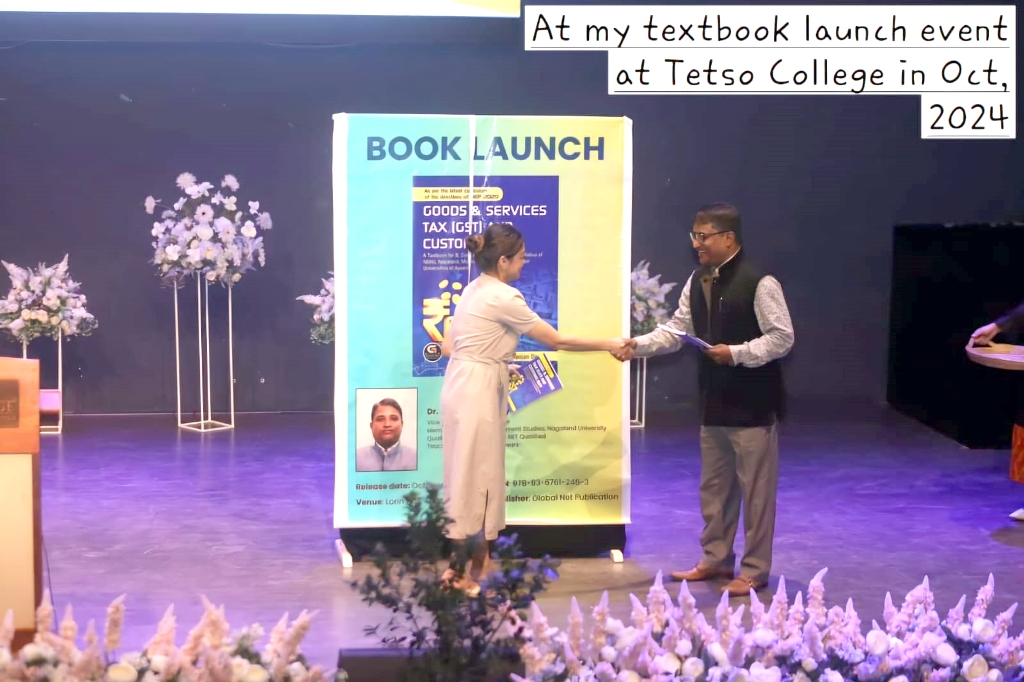
He has authored a textbook (Goods & Services Tax and
Customs Duty), published in 2024 for B.Com students in the universities in the
northeast, and has contributed to national and international journals, book
chapters, and newspapers. He has also presented research papers at conferences
and seminars and participated as a resource person and invited guest on several
occasions.
In this interview with Eastern Mirror, Dr. Dey shares his
insights into the evolving field of taxation and the role of GST.
How would you define taxation? How does GST fit into the
broader study of commerce for students?
In India, the field of taxation is a comprehensive area
within public finance that focuses on the laws, policies, and administration of
taxes imposed by the central, state, and local governments.
To me, GST offers both theoretical knowledge and practical
insights for students, making it a key area of study in modern commerce
education. For commerce students, studying GST equips them with practical
skills, critical thinking, and insights that are indispensable for navigating
modern business environments. Inclusion of GST in Commerce curricula ensures
students are prepared for both professional roles and entrepreneurial ventures.
However, GST is more than a taxation mechanism; it is a multidisciplinary topic
that integrates taxation laws, accounting principles, business operations, and
economic policies.
How can a strong grasp of GST and modern tax systems help
students stand out in their future careers?
In the evolving world of business, finance, and economics,
students having a solid understanding of the Goods and Services Tax (GST) and
modern tax systems is a significant asset. Mastery of GST and modern tax
systems signals that a student is not only skilled in tax compliance but also
understands its broader implications for business and the economy. This
knowledge equips them with technical expertise, critical thinking ability, and
practical skills that are highly valued across various industries.
What steps and courses would you recommend for students
aiming to gain deeper expertise in GST?
To gain deeper expertise in GST and excel in careers
involving taxation, students can follow a systematic approach combining formal
education, certification courses, and practical experience. Students may enrol
in Commerce and Accounting programmes like B.Com or specialised degrees in
Taxation and Finance. This will provide a solid base in taxation laws,
principles, and their application.
Students may intern in taxation firms like CA firms or tax
consultancies to gain real-world exposure to GST compliance, audits, and
advisory services. They may familiarise themselves with tools like Tally, ERP
9, Zoho Books, or ClearTax for GST compliance and reconciliation. Also, they
may learn how to file GST returns using the GSTN portal.
They may enrol in GST-specific certification courses. Many
institutions and online platforms offer specialised courses, such as ICAI,
NACIN, Coursera, Udemy, etc.
What career paths can students with a specialisation in GST
and taxation pursue?
Students specialising in GST and taxation have a variety of
career paths to pursue. These include government tax officers, chartered
accountants, GST practitioners, company secretaries, tax consultants/advisors,
customs officers/consultants, legal experts in Taxation, tax auditors,
compliance officers, and many more.
How has GST reshaped the business environment, and what new
opportunities does it present?
In India, GST has fundamentally reshaped the business
environment by simplifying the tax structure, improving transparency, and
fostering a more efficient economic system. It replaced multiple indirect taxes
with a unified tax, which has reduced compliance complexity and logistics
costs, benefiting businesses, especially SMEs.
GST has not only streamlined business operations but also
opened new avenues for growth in several industries. Some of the new
opportunities arising from GST include tax consultancy and compliance services,
e-commerce and exports, logistics, tech solutions, SME growth, etc.
Are there specific software tools or technologies students
should learn to excel in accounting and tax consultancy?
Yes, to excel in accounting and tax consultancy, students
should focus on mastering accounting software (like Tally, Zoho Books, and
QuickBooks), GST compliance tools (ClearTax, GSTN portal), and financial
reporting tools (Excel, Power BI). Besides, learning cloud-based tools, ERP
systems, and specialised tax platforms can provide a competitive edge in the
industry.
Have you observed changes in how students approach commerce
and tax studies today compared to the past?
Yes, there have been notable changes in how students
approach commerce and tax studies today compared to the past. These changes
reflect a broader shift towards a more dynamic, technology-driven, and
practical approach in education, preparing students better for the demands of
the modern business world.
However, according to my personal observation, students and
institutions in Nagaland, like in many other regions, need to actively adapt to
the changing job market demands by integrating modern tools and technologies
into their learning ecosystems. This proactive approach can significantly
bridge the gap between traditional education and current industry needs.
Are there specific industries where GST expertise is
particularly useful?
GST expertise is particularly valuable in industries where
compliance, multi-stage transactions, or tax optimisation are critical. In
retail and wholesale, it is essential for managing complex GST filings and tax
planning. For export-import businesses, expertise is needed to handle refunds
and IGST on trade.
Manufacturing and supply chain sectors require knowledge of
input tax credit (ITC) and inter-state compliance. Logistics companies benefit
from expertise in tax compliance and route optimization. Financial services
rely on GST professionals for managing complex transaction compliance, while IT
services need support for GST on software and cross-border transactions.
E-commerce businesses must navigate TCS and multi-state
operations, and the construction and real estate industries require guidance on
material taxation and compliance. Hospitality and tourism sectors deal with
multi-slab tax handling, and educational institutions need expertise in
exemptions and compliance for specific services.
How can students leverage their GST knowledge to explore
entrepreneurial ventures or start their own consultancies?
By leveraging their GST knowledge, students can carve out
niches in consultancy, tech solutions, and training, creating valuable revenue
streams while addressing critical market needs.
Students can explore entrepreneurial opportunities in
several ways: starting a GST consultancy to offer registration, return filing,
and compliance services to SMEs; creating educational content such as blogs,
tutorials, or online courses on GST; launching a digital filing service by
developing an app or platform for simple GST filing; setting up sector-specific
advisory services focused on niches like e-commerce, exports, or NGOs;
developing technology solutions to build or resell GST-compliant software for
businesses; and collaborating with CA/CS firms on GST-specific cases.
RAPID INSIGHTS
If you could advise your younger self, what would you focus
on learning first?
Stay updated with economic trends, policy shifts, and
industry shifts. Build professional connections for growth and opportunities.
If you had to sum up your career advice in one sentence,
what would it be?
Keep learning, be open to change, and cultivate valuable
relationships.