[caption id="attachment_208656" align="aligncenter" width="565"]
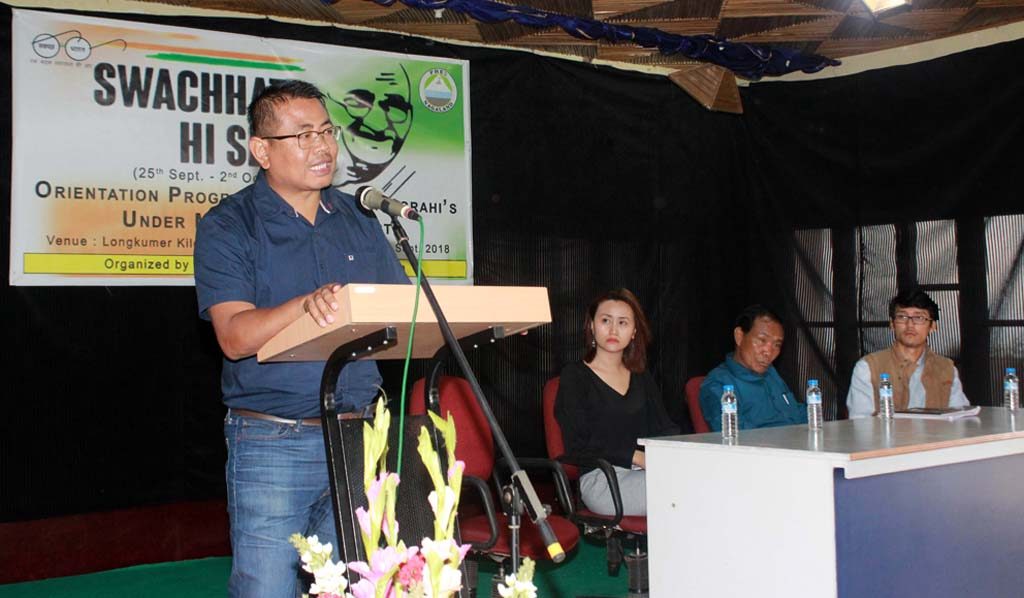 N Yanger Pongen, an engineer with the PHED Mokokchung division addressing the participants of a programme on sanitation at the Longkumer Kilem in Mokokchung on Monday.
[/caption]
Our Correspondent
Mokokchung, Sep. 24 (EMN): To help people learn about the basics of sanitation, an orientation programme on swachhagrahis or Sanitation Motivators was held at Longkumer Kilem in Mokokchung on Monday.
The orientation programme was organised by WSSO, PHED Mokokchung division under Swachhata Hi Seva campaign (Sep. 15-Oct. 02) with the declared vision: ‘cleanliness is service.’
N Yanger Pongen, the executive engineer of PHED Mokokchung division explained that Swachh Bharat Mission (SBM) is one of the topmost prioritised programme initiated by central government in the country. However, he maintained that the objectives of SBM are simple and easy but very hard to execute in practice.
In this regard, he asserted that to monitor the programme as well as constantly motivate and bring awareness to the people from the grassroots level the swachhagrahi are being recruited voluntarily in the rural areas.
Pongen also informed that the main purpose of swachhagrahi is to motivate villages and communities towards sanitation aspects by influencing behavioural changes in the life of the people.
He also maintained that the concept of swachhagrahi is very old in India but here it is being implemented for the first time. He, therefore, said that the sanitation motivators’ most critical responsibility is to initiate an effective process to bring real facilitation and change on the ground.
The engineer further urged the swachhagrahi that even though Mokokchung has achieved open-defecation-free status, they should continue to motivate and bring the behavioural changes in the life of the people.
Meanwhile, Imtiyanger and Masachuba Ozukum both SDO of PHED Mokokchung division conducted the training session while Ajung, a chemist (WSSO), spoke on ‘Swachhagrahi Ke Swachhagrahi: EK Se Anek.’
More than 100 swachhagrahis from 63 villages including village council members and WATSAN committee members attended the training programme.


