[caption id="attachment_282456" align="aligncenter" width="600"]
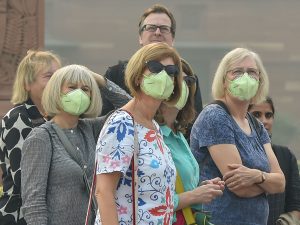 Tourists wear anti-pollution masks amid heavy smog as the air quality further dips to 'severe' category, in New Delhi on Wednesday. (PTI)
[/caption]
New Delhi, Nov. 13 (PTI): The government's efforts in addressing air pollution in the last two years have been phenomenal but the results are marginal, a senior environment ministry official said on Wednesday.
Speaking at an event here, Environment Secretary C K Mishra said tackling air pollution is not the government's duty alone but requires everyone to play a role.
"In the last two years, efforts by the government in tackling air pollution have been phenomenal but the results achieved are marginal. We need at least 50 per cent reduction in current air pollution levels.
"This needs sustained efforts. Emergency and knee-jerk reactions will not help, " he said at the 'sustainable dialogue on air pollution', which was organised by TERI.
Mishra said that "air pollution cannot be the government's business alone."
"Everyone has a role to play. Even if there is an adverse cost, it should be paid," he said.
The Energy and Resources Institute (TERI) has prepared a strategic plan for solving Delhi's air pollution crisis which worsens during winters every year.
The event, which was co-organised with Natural Resources Defense Council (NRDC), was also attended by TERI DG Ajay Mathur, who said Delhi's air pollution is a "solvable problem".
"There are solutions both in terms of technologies and for meeting the necessary costs. TERI is putting forward definitive measures for addressing peak and non-peak pollution sources, both of which are absolutely essential to improve Delhi's air quality.
"We can immediately start working towards implementation, if all stakeholders come together," Mathur said.
Sharing his opinion, Sumit Sharma, Director, Earth Science and Climate Change Division, TERI, said it is possible to reduce Delhi's PM 2.5 level by 46 per cent during winters.
"Some of the peak air pollution episodes during winters can be avoided by controlling agriculture crop burning and fire crackers. But this can only bring down the pollution levels to very poor' category.
"However, if we address both peak and non-peak sources such as transport, industries, residential and road dust, it is possible to reduce Delhi's PM 2.5 level by 46 per cent during winters, which can restore air quality to moderate' category," Sharma said.
Talking about global experience in tacking air pollution, Mitchell Bernard, Interim President and Chief Counsel, NRDC, said air pollution is not a narrow environmental issue.
"There is a huge public health cost. And there is a strong economic argument to be made for combating air pollution on account of lost productivity, medical costs, and opportunity costs," he said.
The event was also attended by Dr Arvind Kumar, chairman of Centre for Chest Surgery, Sir Ganga Ram Hospital, who spoke about the looming health crisis.
"In 1988, patients of lung cancer were mostly known smokers. In 2018, 50 per cent cases of lung cancer are non-smokers.," he said, warning that Delhi is likely to see an explosion of lung cancer cases in the coming years.
The schools in the national capital will be closed on Thursday and Friday, the Delhi government announced on Wednesday following an order from the Supreme Court-mandated anti-pollution authority EPCA as the air quality hovered close to 'emergency' levels.
"In view of deteriorating air quality because of pollution due to stubble burning in Uttar Pradesh, Delhi govt has decided to close schools tomorrow and day after," Deputy Chief Minister Manish Sisodia tweeted.
The Environment Pollution (Prevention and Control) Authority also extended the ban on hot-mix plants and stone-crushers in Delhi-NCR till November 15.
The apex court had on November 4 banned construction and demolition activities in the region till further orders.
All coal and other fuel-based industries, which have not shifted to natural gas or agro-residue, will remain shut in Faridabad, Gurugram, Ghaziabad, Noida, Bahadurgarh, Bhiwadi, Greater Noida, Sonepat and Panipat till November 15, it said.
In Delhi, industries which have not yet shifted to piped natural gas, will not operate during the period.
Early this month, the Delhi government shut all schools for four days after EPCA declared a public health emergency in the Delhi-NCR region in the wake of rising pollution level.
The schools reopened on November 5 after the air quality had improved.
The city's overall air quality index read 456 at 4 pm, up from 425 at 4 pm on Tuesday.
Rohini and Dwarka Sector-8 were the most-polluted areas with an AQI of 494, followed by Nehru Nagar (491) and Jahangirpuri (488).
Faridabad (448), Ghaziabad (481), Greater Noida (472), Gurgaon (445) and Noida (479) also choked on extremely polluted air.


