[caption id="attachment_170235" align="alignnone" width="550"]
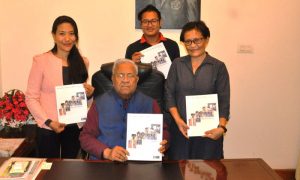 PB Acharya during the release of the Annual Status of Education Report 2017, on March 21 at the Raj Bhavan in Kohima.
[/caption]
Dimapur, March 23 (EMN): Nagaland governor and rector of Nagaland University, PB Acharya, has released the Annual Status of Education Report (ASER) 2017, Nagaland Chapter, on March 21 at Raj Bhavan, Kohima.
Nagaland chapter ‘ASER 2017: Beyond Basics,’ was carried out in partnership with the state education department and the Nagaland University.
For the first time since 2005, ASER has focused on 14 to 18 year olds who have moved just beyond the elementary school age. Kohima district was one of the 28 districts assessed from 24 states of the country.
The ASER report 2017 was an attempt to look ‘beyond basics’ to explore a wider set of domains and the preparedness of the age group in applying their literacy and numeracy skills to real world situations. Four domains namely activity, ability, awareness and aspirations were considered in preparing the report. Besides recording enrolment and learning levels, varied tasks like telling time, purchase decisions, weights and assessments of digital, financial access were applied.
Data highlights for Kohima district showed higher enrolment than all other districts with only 8% youth not enrolled anywhere, while it was 14% for all districts. Kohima registered 63% of all youth (enrolled and not enrolled) who have completed eight years of schooling as compared to 81% in other districts.
In Kohima, 77% could read fluently while 46% could read and follow written instructions as compared to other districts in which 75% could read fluently and 54% read and follow written instructions.
According to the report, in Kohima 86% could tell time on simple clock face and 49% could tell hours and minutes, whereas it was 83% and 59% in other districts. To a question about a T shirt at 10% discount, 20% could answer correctly in Kohima, while it was 38% in other districts. In Kohima, 78% could name their own state, while it was 79% in other districts. In Kohima, 50% have bank accounts while 23% have deposited or withdrawn money from the bank, whereas it was 78% and 51% correspondingly in the same categories. About 15% used ATM in Kohima while it was 16% in other districts.
Data also showed that whether enrolled or not, in Kohima 27% worked (including regular chores, farming), while for all districts it was 42%. About 2.5% in Kohima received vocational training whereas it was 5% in other districts. It was observed that 51% in Kohima have never used a computer, while it was 56% in other districts. Further, it was observed that 59% in Kohima have never used the internet and 61% in other districts.
ASER 2017 report stated that many young people, who have completed eight years of schooling, have difficulty applying their literacy and numeracy skills to real world situations. Overall patterns indicated that while basic foundational skills like reading and arithmetic are very helpful for daily tasks and common calculations, not everyone who has these foundational skills can correctly complete these everyday tasks. Data also showed that females performed worse than males on almost all tasks.
Since 2005, ASER Centre- the research unit of Pratham, has focused on children ranging from age 5 -16 years, reporting on schooling status, and the ability to do basic reading and arithmetic tasks. The annual survey covered nearly every state and rural district in the country. ASER has highlighted the fact that although almost all children are enrolled in school, many are not acquiring foundational skills like reading and basic arithmetic that can help them progress in school and life.
To materialise India’s much awaited ‘demographic dividend,’ ASER 2017 finding has suggested ensuring young people reach adulthood with knowledge, skills, and opportunities.


