[caption id="attachment_83955" align="aligncenter" width="510"]
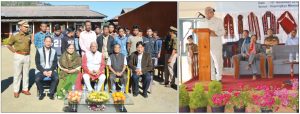 PB Acharya and his wife, Kavita Acharya, seen here with district officials during his visit to the inmates of Tuensang’s district jail. (R) Governor of Nagaland PB Acharya addressing the public reception at Kiphire on November 15.
[/caption]
Dimapur, November 16: The governor of Nagaland, PB Acharya and his wife Kavita Acharya visited Tuensang town on November 15. During his visit, a civic reception was held at the government higher secondary school auditorium in the town. People from all walks of life attended the reception for the governor.
Speaking during the occasion, Governor Acharya thanked the people of Tuensang for the affection and the warm welcome.
‘India is a large country diversified in many aspects. However, it has co-existed and survived as one entity since time immemorial thereby becoming the largest democratic state in the world,’ Acharya said in his address.
The governor also said that the north-eastern states were rich in culture. The Naga people in particular have potential in many areas, he said.
‘If India has to be called a developed country, then the north-eastern states ought to be developed; only then would the real concept of developed India can be,’ he said. ‘India is a rich country but the people are poor which means the fruits of independence have not reached the people equally in all parts of the country,’ the governor lamented.
According to the governor, the current central government has been ‘doing many things to make India corruption-free’ and striving to develop India in all ways–in education, health and infrastructure.
‘Therefore, we must be bold enough to change the mindset to achieve the goals and polices of the government,’ he said. ‘India is expected to have the largest human development resources in the coming years. For this, the Naga people should strive to avail opportunities.’
A representation from the people of Tuensang district was presented to the governor by the vice president of the YTC, Throngso. The representation was read out during the event.
Four tribal communities in Tuensang district i.e., the Chang, the Khiamniungan, the Sangtam and the Yimchunger tribe gave cultural performances during the event.
On the second day at Tuensang, on the 16th of November, Acharya and Kavita Acharya toured various places. He was accompanied by parliamentary secretaries Kejong Chang, and Toyang Chang, besides officials from the district administration and the police.
In the morning, he visited the Durga Temple in the town where he interacted with both the Hindu and the Muslim community. He urged them to ‘maintain unity and understanding.’ After that, the governor visited the district jail and interacted with the inmates. He distributed blankets to the inmates.
The governor also visited the government high school of Tuensang and enquired about the staffers’ attendance register and the mid-day meal scheme of the institution.
During his visit to the district hospital in the town, the governor inspected the diagnostic centre and also checked the hospital’s equipments. He interacted with the doctors and nurses of the hospital. He was briefed about the shortage of manpower at the hospital.
Later in the day, the governor had a public meeting at Tuensang village where he addressed the people and encouraged them to abandon ‘old mindsets.’ He challenged them to step forward so that they can develop their village by ‘virtue of being blessed with abundant natural resources.’
At the end of the day’s events, the whole team visited the Longpang House of Hope where the secretary of the Eleutheros Christian Society hosted a special programme in honour of the governor. A short documentary about the activities of the organisation and a short film about the change in farming techniques and its outcome were shown to the distinguished visitors.
The programme also witnessed the launch of the ‘communitisation of the mid day meal’ by signing a memorandum of understanding between the government of Nagaland and the Eleutheros Christian Society.
The governor has exhorted the people to ‘change their mindsets in order to progress in all fields.’ He also referred to the church and termed it as an institution which brought radical changes in many areas of the people.
The governor is of the opinion that India as a nation is rich so as Nagaland. However, he has expressed disappointment as the people are poor ‘since the society has already been plagued by the menace of corruption which means lack of transparency and accountability in the whole system.’
The governor was also in Kiphire district. PB Acharya and his wife were received by the district administration, minister for power C Kipili Sangtam and public leaders at the helipad in Kiphire on November 15.
During his visit, the governor visited the district jail where he interacted with the jail’s staff and the inmates. He visited Kiphire village’s government primary school. He asked the school’s authorities to provide mid-day meals to the students regularly.
Later, Acharya visited the district hospital of Kiphire. He was accompanied by the minister for Power. The governor met the patients and congratulated the doctors, nurses and hospital staff members for their commitment to serve the sick and the needy.
Later, the governor met with the people at Hopongkyu Memorial Hall in the town. At the Hopongkyu Memorial Hall, he met with leaders of civil organisations and government officials.
Addressing the gathering, the governor said that the north-eastern states had been sharing boundaries with countries such as Myanmar, Bangladesh, and Bhutan. Only 2% of the land in Nagaland is connected with mainland India, he said.
‘Nagaland has 16 recognised tribes and different tribal dialects, where the identity of any society was in its language. Culture is not the only way of life,’ he said. ‘India is a country of diversities and a democratic country which means that the people are free and responsible to elect their own leaders in a democratic manner.’
The governor also lauded the decision of the prime minister of India Narendra Modi for demonetising Rs. 500 and Rs. 1000 currency notes with the intention to do away with black money from the country and to reduce corruption.
The governor called upon the people of Kiphire district to be united and to live peacefully with the communities. He said Kiphire district was not just rich in mineral resources but also had the potential to become a tourism hotspot in the region.


