[caption id="attachment_169839" align="alignnone" width="550"]
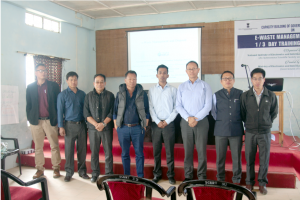 Resource persons and special invitees along with the participants pose for a group photo after the one-day capacity building training for government employees on e-waste management in Kohima on March 21.
[/caption]
Dimapur, March 21 (EMN): A one-day capacity building training for government employees on e-waste management was held at the State Council of Educational Research and Training (SCERT), Kohima, on March 21. The training programme was organised by the National Institute of Electronics and Information Technology (NIELIT), Kolkata, an autonomous scientific society under MeitY, Government of India and funded by Ministry of Electronics and Information Technology (MeitY), Government of India.
The trainers were Er. Kopelo Letou and Angu Bahadur Khadka, IT & e-waste trainer, NIELIT, Kolkata. More than 100 participants from various government departments such as Industries and Commerce, Youth Resource and Sports, Government Higher Secondary School, Kohima, Directorate of School Education, Employment and Skill Development, State College of Teacher’s Education, Kohima , Government Polytechnic Kohima, Directorate of Health and Family Welfare, Directorate of Fisheries, Employment and Skill Development, 4th NAP – COY, Kohima, State Council of Education Research and Training, and others attended the training.
The training programme dwelled on e-waste management Rules 2016, which has come into effect on October 1, 2016. The new e-waste rule will bring the producer under Extended Producer Responsibility (EPR). Further, the state government is required to create awareness and ensure safety, health and skill development of its employees on hazards, management and disposal of e-waste.
NIELIT, Kolkata, successfully conducted trainings in 10 states and Union Territories with the mandate of MeitY, GOI.
‘E-waste’ means electrical and electronic equipment, whole or in part discarded as waste by the consumers. ‘E-wastes’ are considered dangerous as certain components of some electronic products contain materials that are hazardous depending on their condition and density. Management of electronics, which are destined for reuse, resale, salvage, collection, recycling, or disposal, are e-waste management.


