George Foreman, the fearsome heavyweight who became a belove
George Foreman, the fearsome heavyweight who became a beloved champion, dies at 76
45-year-old George Foreman became the heavyweight champion of the world in his 20s, only to lose his belt to Muhammad Ali in perhaps the most memorable fight in boxing history
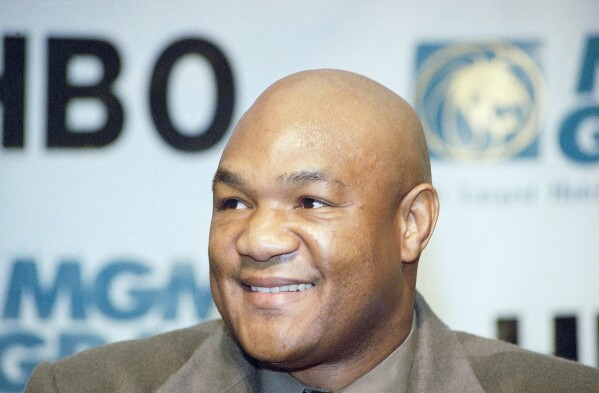
Former heavyweight champion George Foreman of Houston,
reacts during a news conference in Las Vegas, Wednesday, Nov, 1994. (AP
Photo/Lennox McLendon File)
AUSTIN (USA) — .
A full 20 years later in 1994, the 45-year-old Foreman
became the oldest man to win the heavyweight championship, throwing one perfect
combination to steal Michael Moorer's title in an epic upset.
Few fighters ever had more big moments than Big George
Foreman — and even after he finally left the ring, he was only getting started.
The fearsome heavyweight, who lost the “Rumble in the
Jungle” to Ali before his inspiring second act as a surprising champion and a
successful businessman, died Friday night. Foreman was 76.
Foreman's family announced his death on social media, not
saying how or where he died.
“A devout preacher, a devoted husband, a loving father
and a proud grand- and great-grandfather, he lived a life marked by unwavering
faith, humility and purpose," his family wrote. “A humanitarian, an
Olympian and two-time heavyweight champion of the world, he was deeply
respected. A force for good, a man of discipline, conviction, and a protector
of his legacy, fighting tirelessly to preserve his good name— for his family.”
A native Texan, Foreman began his boxing career as an
Olympic gold medalist who inspired fear and awe as he climbed to the peak of
the heavyweight division by stopping Joe Frazier in 1973. His formidable aura
evaporated only a year later when Ali pulled off one of the most audacious
victories in boxing history in Zaire, baiting and taunting Foreman into losing
his belt.
Foreman left the sport a few years later, but returned
after a 10-year absence and a self-described religious awakening.
The middle-aged fighter then pulled off one of the most
spectacular knockouts in boxing history, flooring Moorer — 19 years his junior
— with a surgical right hand and claiming Moorer's two heavyweight belts.
Foreman's 20 years is easily the longest gap between heavyweight title reigns.
Foreman's transformation into an inspirational figure was
complete, and he fought only four more times — finishing 76-5 with 68 knockouts
— before moving onto his next career as a genial businessman, pitchman and
occasional actor.
Outside the ring, he was best known as the face of the
George Foreman Grill, which launched in the same year as his victory over
Moorer. The simple cooking machine sold more than 100 million units and made
him much wealthier than his sport ever did.
“George was a great friend to not only myself, but to my entire
family,” Top Rank president Bob Arum said. “We've lost a family member and are
absolutely devastated.”
In the first chapter of his boxing career, Foreman was
nothing like the smiling grandfather who hawked his grills on television to
great success.
Foreman dabbled in petty crime while growing up in
Houston's Fifth Ward, but changed his life through boxing. He made the U.S.
Olympic team in 1968 and won gold in Mexico City as a teenager, stopping a
29-year-old opponent in a star-making performance.
Foreman rose to the pinnacle of the pro game over the
next five years, but was also perceived as an aloof, unfriendly athlete, both
through his demeanor and through the skewed racial lenses of the time.
Jim Lampley, the veteran boxing broadcaster who worked
alongside Foreman for many years at HBO, told The Associated Press on Friday
night that Foreman's initial demeanor was an attempt by his camp to emulate
Sonny Liston, the glowering heavyweight champ of the 1960s.
“At some point somewhere along the way, he realized that
wasn't him," Lampley said.
Foreman stopped Frazier in an upset in Jamaica in 1973 to
win the belt, with his knockout inspiring Howard Cosell's iconic call: “Down
goes Frazier! Down goes Frazier!”
Foreman defended his belt against Ken Norton before
accepting the fight with Ali in the now-immortal bout staged in Africa by
promoter Don King. Ali put on a tactical masterclass against Foreman, showing
off the “rope-a-dope” strategy that frustrated and infuriated the champion.
Foreman was eventually knocked down for the first time in his career, and the
fight was stopped in the eighth round.
Foreman told the BBC in 2014 that he took the fight
almost out of charity to Ali, who he suspected to be broke.
“I said I was going to go out there and kill him, and
people said, Please, don't say you're going to kill Muhammad,'” Foreman said.
“So I said, OK, I'll just beat him down to the ground.' That's how easy I
thought the fight would be.”
Exhausted and disillusioned, Foreman stopped fighting in
1977 and largely spent the next decade preaching and working with kids in
Houston after his religious awakening. He returned to boxing in 1987 in his
late 30s with a plan to defy time through frequent ring appearances, and he
racked up a lengthy series of victories before losing to Evander Holyfield in a
surprisingly competitive title fight in 1991.
Foreman quit the ring for good in 1997, although he
occasionally discussed a comeback. He settled into a life as a boxing analyst
for HBO and as a pitchman for the grills that grew his fame and fortune.
Foreman briefly starred in a sitcom called “George” in
the 1990s, and he even appeared on the reality singing competition “The Masked
Singer” in 2022. A biographical movie based on his life was released in 2023.
Foreman had 12 children, including five sons who are all
famously named George Edward Foreman.