[caption id="attachment_196694" align="alignnone" width="550"]
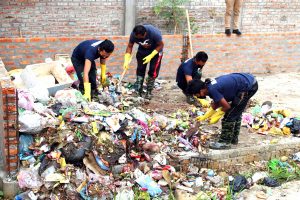 Members of Pro Rural segregating waste materials, in Dimapur. (EM Images)
[/caption]
Eastern Mirror Desk
Dimapur, July 22 (EMN): Dimapur or for say Nagaland is turning into one big garbage dump and the problem is gigantic contributed by every individual. When it comes to waste management nothing is right because of non-cooperation and lack of civic responsibly although there is push from few quarters to make a difference.
One such group are the Pro Rural, a youth led organisation in Dimapur initiated steps for improving the solid waste management practices in not only Dimapur city or Nagaland but in Manipur as well.
Pro Rural is a public benefit organisation registered under the Societies Registration Act of 1860. The group consisting of seven members and voluntary staffs on field came into being following the "North East Youth Summit on Ecology" in 2004 and the launch of the "Youth Employment Summit Global Campaign" in the same year.
These two events inspired the founders of Pro Rural to give focus on youth engagement in sustainable livelihood, peace building, environmental sustainability and climate change issues, recounted Pro Rural community organiser, Zheni Chache and field coordinator, Kiki Hama to Eastern Mirror.
However, the team admitted that Pro Rural was not known to many even though they came into being in 2004 while trying to sustain and it was only recently when they collaborated with the Dimapur Municipal Council (DMC) for their "Garbage to Gold" project that they came into the limelight.
"The most important step is cooperation and a sense of civic responsibility amongst each and every citizen of the city" remarks the team.
With the aim to ensure clean and healthy environment for the citizens, the Pro Rural's mission is to work for holistic development through capacity building, livelihood development, youth engagement and employment, peace building and environment conservation.
The pilot project of the team "Garbage to gold" was launched on Jan. 2018 with the objective to convert bio-degradable household level waste into manure. Since the launching of the project, 11 colonies in Dimapur have been covered with 350 beneficiaries.
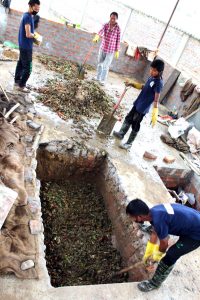
Turning garbage to gold, members of Pro Rural explained that to turn garbage into a 'useful product,' biodegradable waste must have to be separated in a container that has been provided by the team, sprinkle a powder agent (G2G powder) and cover the container with a plank of wood to help retain moisture and heat.
[caption id="attachment_196693" align="alignleft" width="282"]
[/caption]
Every few days the biodegradable waste can be poured into a container, with the powder added to it. They may continue with the procedure, the team explained. The water that is accumulated from out of the waste in the container can then be used to water plants, clean drains and kitchen sinks while the waste can be used as garden manure.
However, it is not an easy ride for Pro Rural advocating the importance of the project. Despite limited resources, the group has been reaching out to citizens giving free trainings and materials but, it has learnt from group’s tracking record, some beneficiaries failed to utilise it. The team has been organising trainings and providing materials to citizen with financial assistance from the DMC and technical support by themselves.
Other than their garbage to gold project and various other activities, the team with the objective to help the city achieve clean and environment friendly habits emphasis on waste segregation.
There are various groups and events advocating on waste management and likewise the Pro Rural through their findings ensures that citizens are well-informed on such environment concern and practice them.
"The main benefit of segregation of waste is that up to 70% of the waste we throw away everyday can be utilised for producing some other useful items. Out of the 70% about 40% can be composted and create manure or used it for producing energy (electricity or gas). After 30% can be reused or recycled to make another useful product".
Careful segregation helps the rejects reduced to only 30% or less. If only 30% of our waste is dumped at the landfill site, then the life span of the landfill will increase.
If the waste is not segregated this happens-90% is thrown away as useless, 10% are gathered by rag-pickers and sold to scrap dealers who sell them to recycle plants. If the 90% mixed waste is dumped at dumping sites, and then in the form of rotting odour that lasts for long time, as well as it produces Carbon dioxide. Methane gas, nitrous oxide and fluorinated gases that is directly responsible for global warming.
Segregation means separate storage of waste depending on its nature. Waste can be segregated as biodegradable which are kitchen waste, vegetables, fruit peels, food waste, and garden waste. Non biodegradable are plastics, glass bottles, laminated papers, tin, metal and glass. Hazardous wastes are thermometer, bulbs, battery, electronic items, and old medicines, they edifies.
Reducing the consumption or buying less of the items like carrying one's own shopping bag instead of buying or accepting polythene bags is reduce and using an object or material again for other purposes is reuse while using waste as raw material to manufacture a new product is recycle.


