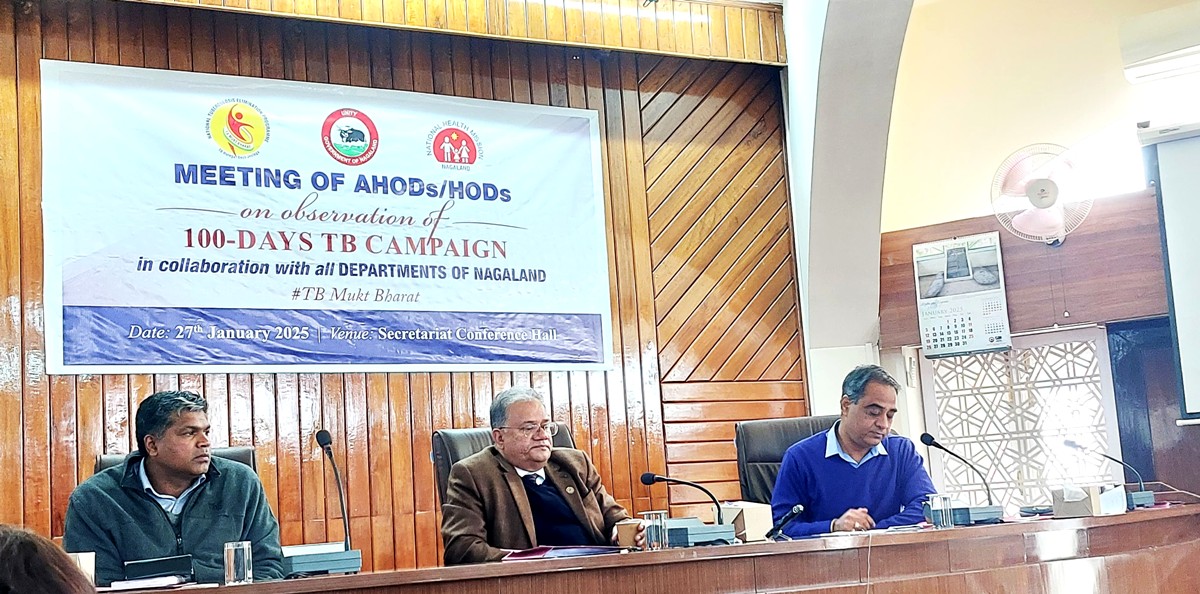
Chief Secretary Dr. J Alam flanked by Vyasan R and Anoop
Khinchi during the meeting on Monday in Kohima. (EM Images)
KOHIMA — Asserting that tuberculosis has
significant health implications if left untreated, Chief Secretary Dr. J Alam,
on Monday, called for efforts to give further impetus to the fight against TB
in Nagaland, in line with the nationwide campaign.
He made this remark during a meeting of administrative heads
of departments and heads of departments at the Secretariat conference hall in
Kohima. The meeting was also virtually joined by the deputy commissioners (DCs)
from the districts as part of the 100-day campaign by all line departments to
eliminate TB by 2025.
Alam reiterated that last December, the 100-day TB
elimination campaign was launched by the Prime Minister. He informed that 347
districts in the country were selected for the campaign, including three from
Nagaland: Kohima, Mon, and Wokha.
“As far as the state is concerned, it has significant
implications for us. We all know that untreated TB, in the first place, is
infectious, so other people can catch it,” he said, emphasising further that
untreated TB is fatal.
However, he reminded, if preventive and timely action is
taken, the cost of treatment is minimal and prevents other complications.
Highlighting that the state has now installed an
insurance-based health system, the chief secretary said that more action taken
at the initial stage would be better for the health system too. He stressed the
importance of outreach and awareness actions to detect the disease and ensure
timely treatment.
Also, the chief secretary urged the DCs of each district to
steer the campaigns while engaging civil society organisations (CSOs), church
organisations, and individuals. He encouraged them to devise their own
strategies for the campaign, including IEC (Information, Education, and
Communication) activities, to make the initiative successful.
Anoop Khinchi, Commissioner and Secretary for Health and
Family Welfare, stated that TB remains India’s biggest public health challenge,
with an estimated 28 lakh new cases occurring annually, contributing to 26% of
the global burden.
He noted that TB causes the largest number of deaths among
all infectious diseases, with 3.5 lakh people dying of TB in India every year,
equating to 1,300 deaths every day.
According to him, Nagaland has about 3,945 TB patients.
Khinchi highlighted that undernutrition and TB share a
bidirectional relationship, with undernutrition increasing the risk of
developing TB and TB worsening undernutrition due to tissue breakdown.
He cited the introduction of the Nikshay Mitra Donor
campaign, the world’s largest crowdsourcing initiative for nutritional support,
which has received tremendous support from all sections of society.
This campaign encourages the community to adopt TB patients
and provide nutritional support, supplements, and additional investigations for
six months at INR 500 per month. Khinchi informed that the success rate is 85%,
and donors can also track the patients they support.
He said that under the Nikshay Poshan Yojana, the government
of India provides INR 1,000 per month during the treatment period, while the
Nikshay Mitra initiative offers additional support.
Khinchi also highlighted the stratified 100-day campaign
launched on December 7, 2024. This initiative aims to find missing cases,
reduce TB deaths, and prevent new TB cases by increasing case detection,
providing nutritional interventions, and raising community awareness about
early detection and complete treatment of TB. The campaign is being implemented
in the high-focus districts of Kohima, Mon, and Wokha.
He emphasised that active participation and timely support
in the nationwide campaign are crucial, and partnerships with various
departments will largely focus on strengthening collaborative activities. These
include displaying IEC materials in offices, generating awareness among staff,
disseminating TB messages through various platforms, registering Nikshay Mitras
from different organisations, screening for TB, and conducting other specific
activities in concerned departments.
Furthermore, he stressed the importance of creating
awareness that TB is treatable, preventable, and effectively managed with free
treatment available at government hospitals.
During the meeting, Dr. Vezokholu Theyo, State TB Officer
under the National TB Elimination Programme (NTEP), gave a presentation on the
100-day campaign overview.
She highlighted the burden of TB, stating that India has the
highest estimated burden of tuberculosis infection (TBI) globally, with nearly
35-40 crore Indians having TBI. Of these, 28 lakh are estimated to develop tuberculosis
(TB) disease annually.
Theyo pointed out that TB is the most common opportunistic
infection in HIV and explained that TB can affect anyone at any age and can
affect any organ except hair and nails.