


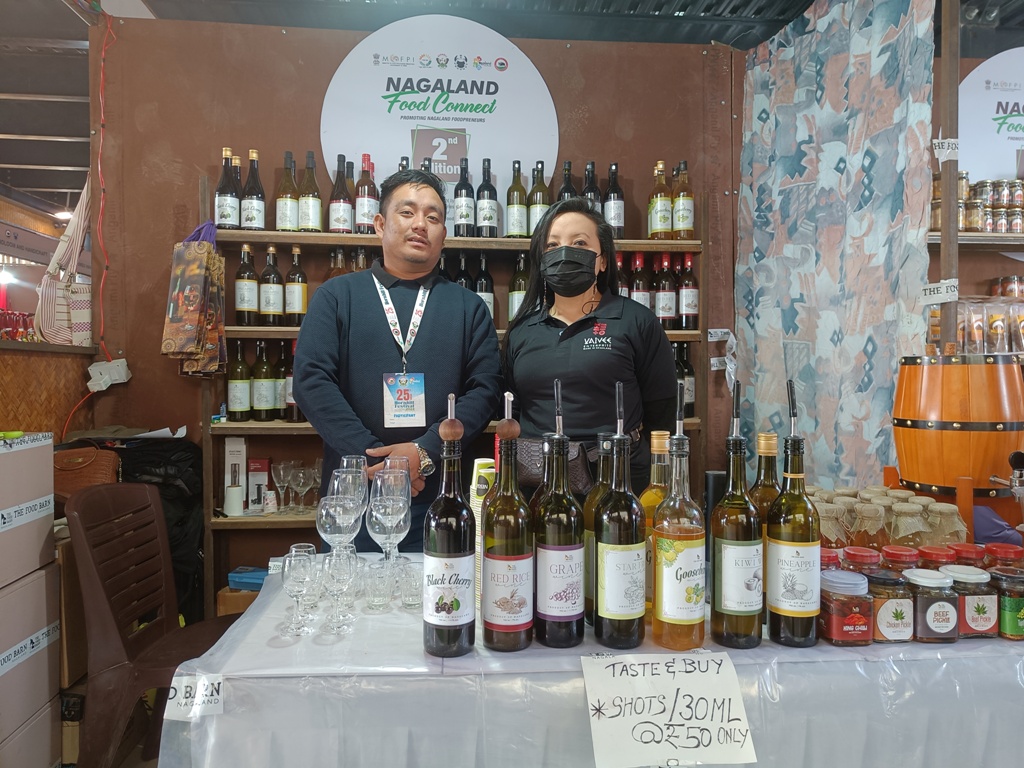
KOHIMA — Knowing that Nagaland has enacted the liquor prohibition law, Asano Zashu had always envisioned starting her own Naga traditional brewing business.
Circa 2020, this vision turned into a reality when she founded ‘Vaivee Enterprise,’ through which the 38-year-old entrepreneur seeks to promote local brews.
Asano told Eastern Mirror that when it comes to brewing local beverages, because of the Prohibition law, the women engaged in this practice face lots of ‘discrimination.’ She observed that most of the women brewing ‘Zutho’ or ‘Thuthse’ (local rice beer in Tenyidie) are widows or divorcees, who have no other means of livelihood.
“Brewing is the only thing they can do because making local rice beer needs the least investment, and that is the only thing they can do to take care of their families,” she said, adding that the raw materials are easily available.
She pointed out that the brewing process involves techniques and traditions passed down from generation to generation. All these contributed to her decision to do something about it and relay the message that “doing anything to earn your living is dignity in labour, and people should not discriminate against any profession.”
“I want to scale up the image of local brewers,” she shared. In 2020, she noticed that the Covid pandemic was pushing women in her circle out of jobs; thus, she decided to start a full-time enterprise.
Asano shared that Vaivee Enterprise is a bootstrapped company, and she got the technique, idea, and concept of brewing wine from her aunties, who are retired brewers.
She started her business from her house at Phesama village and has now opened her own outlet. Soon, she will be opening another outlet at Seluophe village. She also has her own inventory in Phesama, which has now extended to Bayavü in Kohima, too.
Maintaining that they are not into ‘commercialising’ right now, she said that they are still in the stage of experimentation and getting customers’ views and feedback.
Sharing about the process of making wine, she claimed that all of their wines are stored for not less than a year before being sold. They would collect kiwi fruit from Phek, pineapple and star fruit from Dimapur, and the rest of the goods from Kohima, and after collecting, they ferment and store them in American oak barrels to let the wines age.
After that, they do the packaging by themselves from their own inventory, she said.
“These are country wines because they are natural, and the advantage of our products is that they are 100% organic and safe from artificial colourings, as we do not add any artificial colours or goods to enhance the taste or looks of the products. We are focusing on the quality, no matter what,” she maintained.
Vaivee Enterprise has two branches: food processing and jewellery and accessories making. The food processing is done under the brand “The Food Barn Nagaland,” and their best-selling product is the red rice wine.
She has also started employing women from her village, and during peak season she provides employment to 5-6 persons. She has opened a stall in the Handloom and Handicrafts Pavilion at the Hornbill Festival in Kisama.
Challenges and goals
For a woman who makes and sells wine, Asano identified criticisms from a ‘conservative section’ of the society as the biggest challenge.
She aspires to turn her enterprise into a full-fledged company someday in the future because “once we become a legal company, you have the opportunity to give employment to thousands of people who are jobless and also create employment avenues for the educated unemployed.”
She also wants to promote the rich, tangible Naga items, including the food and beverages. She updated that Abeino Metha is the proprietor of the enterprise and Yarmong Longkumer is the marketing manager.
Hornbill experience
According to her, this is her fourth year of opening stalls at the Hornbill Festival. She said that from 2020 to 2023, their sales were above expectations, but this year, the return has been low.
Asano cited transportation problems and early closure of the pavilion as the possible major contributors to this year’s low sales. She mentioned that in the first year, they sold more than 1000 bottles of wine, and last year, over 8000 bottles.
“Demand is huge when it comes to beverages, but we are not able to supply enough,” she said.