Nagaland government admits local fish production cannot meet state-wide demand
[caption id="attachment_197122" align="aligncenter" width="565"]
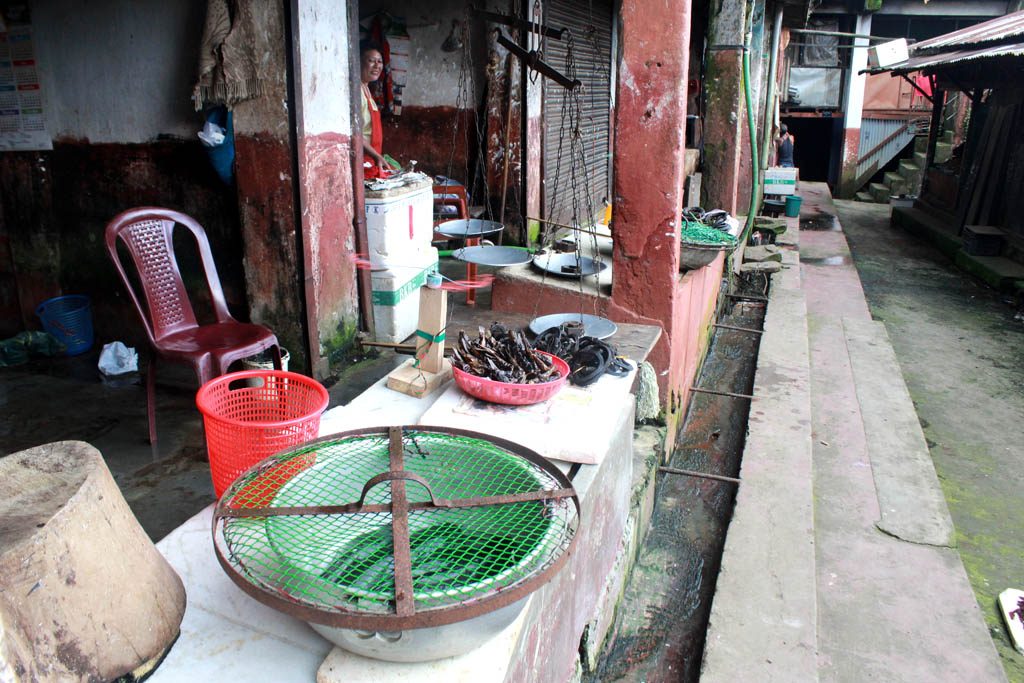 Local vendors in Mokokchung sell catfish and dried fish following the ban on fish import in Nagaland. (File Photo)
[/caption]
Dimapur, July 24 (EMN): The fish market in Nagaland is taking a beating following the ban on fish imports to the state after the discovery of formalin-treated fish. Formalin is a toxic chemical this month and the subsequent blanket ban that was imposed by the state’s authorities.
Formalin is a toxic chemical used to preserve bodies and prevent its decay in mortuaries. It is derived from formaldehyde, potentially a cancer-inducing chemical.
The news about the rampant use of formalin to preserve the otherwise easily decomposable food product came as a shock but the discovery and ban was welcomed from all quarters. The governments of Assam, Nagaland, Manipur, Goa, Kerela etc., also banned the import of fish into their respective state for a certain period of time. In Nagaland, the ban will stand for three months.
Amid an issue that has been overshadowed by health concerns, one thing that remains unaddressed is the question about how the 'fish ban’ has been affecting the local economy.
"While we welcome the activity of the Food Safety department in finding out about the formalin laced fish being sold in the market, yet we are also concerned about the wellbeing and livelihood of the fish vendors," said Tsukti Longkumer, the president of the Mokokchung District Chamber of Commerce and Industries (MCCI). He asserted that the formalin-treated fish that was being sold in the market had nothing to do with the local vendors.
"Most didn't know what formalin is!" Longkumer said while appreciating local fish vendors and wholesalers for coming forward to ‘desist from selling formalin laced fish in the market.’
"In Mokokchung, it was the fish vendors and the wholesalers who came forward to stop selling the fishes in the interest of the consumers," said the MCCI president.
To the question of how the ban could be affecting the local economy, Longkumer estimated that 'four mini-truckload enters into Mokokchung with roughly two tonnes of different varieties of fish,' which is estimated to approximately 10 lakh worth of transaction in the market.
Fish vendors at Mokokchung town number about forty-five, and they are mostly local women. They are at a loss for the moment. The vendors had been doing their business, in a smaller way though, by selling live fish such as eels, catfish and other locally produced fish.
"I think this is the right time for the government to promote the local fish products. The nodal agency, the fishery department should take the initiative and promote the locally produced fish in the market," the MCCI president said.
Wokha town, which has about 30 fish stalls, is also feeling the pinch of the ban. The demand for fish has been mitigated to some extend by local fish especially those from the Doyang River reservoir. However, it is learned that the fish from Doyang are sent mostly to the market in Kohima.
"Hardly six to seven fish stalls are operating in Wokha town at the moment. Some have resorted to selling chicken and other petty business," our correspondent in Wokha reported.
Kohima town also reported a somewhat similar scenario. The capital town has a high population and is losing out on considerable revenue. A government official at the Kohima Municipal Council (KMC), who wished to remain anonymous, welcomed the ban on fish despite loss of revenue in the market. The official said that the matter of public health cannot be compromised, but did share concern about the livelihood of the local fish vendors.
Nagaland’s Food Safety commissioner, I Himato Zhimomi, spoke to
. He said that fish import into Nagaland is welcomed ‘but it should not be treated with formalin.’ He conceded to the thought that local fish production cannot meet the state’s demand. The officer disclosed to have written to the secretary for Fisheries, government of Andhra Pradesh, regarding the issue. He reiterated that the Nagaland Food Safety department shall not compromise with the health of the citizens. He said that the time was perfect to promote local fish in the market.
Zhimomi has also informed about markets being organised by the Fishery department to market the local fish.
Nonetheless, the market is in disarray at the moment. The state’s government seems to be sleeping over the issue apart from banning sale of imported fish. The demand for fish in the market as a rich source of protein is falling short. It must be noted here that fish is among the healthiest foods on the planet. It is loaded with important nutrients such as protein and vitamin D. Fish is also the world's best source of omega-3 fatty acids, which is said to be important for the body and brains.
The question that needs an answer as of now is the effect the ban is having on the local economy, and daily business transaction in the local market. Surely the fish vendors are waiting for an answer from the policy makers. The economy of the state must demand an answer now.
The Assam government banned import and sale of fish from other states, on Tuesday, for a period of 10 days following tests on samples that showed presence of cancer-causing chemical formalin.


