[caption id="attachment_162873" align="alignright" width="330"]
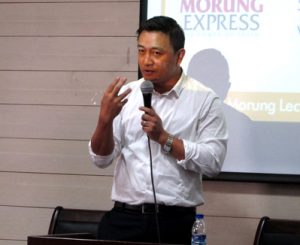 Dr. Kethoser Aniu Kevichusa speaking at the Morung Lecture on Fri. in Dimapur. (EM Images)
[/caption]
Dimapur, Feb. 2 (EMN): Forgiveness and politics share a relationship: Forgiveness that makes politics possible; without forgiveness there is no politics. This was the argument of a local evangelist Dr. Kethoser Aniu Kevichusa who was the speaker of the Morung Lecture on the thematic topic “Forgiveness and politics” on Fri. at the Dimapur Ao Baptist Arogo’s (DABA) in Dimapur.
‘With all declaration of forgiveness, it has done nothing in politics in Nagaland and can forgiveness and politics be mixed. I want us to look at the whole concept of forgiveness, explore how forgiveness and politics can have political purchase or political impact and influence and revisit the whole concept of politics,’ Kevichusa said in the introduction to the lecture. He has written a book about forgiveness and politics.
Emphasising on ‘what is forgiveness not’ in his opening lecture, the evangelist said forgiveness was not just intrapersonal or private but involved at least two people. Forgiveness itself is not the same as healing, he said. According to Kevichusa: ‘It is possible for an individual to forgive someone but not healed’ and to justify this statement, he referred to Revelation 21-22.
Disagreeing with the clichéd ‘forgive and forget’ which Kevichusa remarked was ‘wrong,’ he asserted that forgiveness was not the same as forgetting. He wondered about who would do the forgetting—the victim or the predator. To establish his assertion, the preacher said that ‘if a wrong is forgotten there is no need to be forgiven. It is important to forget serious wrongdoing and if a wrongdoing is forgotten easily, there are chances that it can be repeated.’
Forgiveness is not condoning or a sign of weakness but an appropriate response to imperfect reality, the scholar said. ‘We live in an imperfect and imperfect able world and forgiveness involves truth, condemnation and judgement,’ he said.
Talking about forgiveness and its impact on politics, Kevichusa said that ‘personal acts of forgiveness can point to higher level of empathy and it can remind the society that violence and hatred can be transcended.’ Although there are both ‘yes’ and ‘no’ when it comes to forgiveness in politics in the state—as he has observed—he pointed out that coincidentally some were ‘over forgiving with compromises.’
That said, Kevichusa reminded that an act of forgiveness by political actors can impact the society: ‘And we do not have to be always cynical about politicians.’ This suggested that there was room for reconciliation. As he says, ‘Forgiveness is open to reconciliation’.
Politics, Kevichusa remarked further, was not just about elections as the Nagas’ presume it to be and not just a struggle for power. ‘It is not only about lying or stealing. If a politician lies or steals, he is equal to a liar and a thief, and not a politician,’ he said.
Politics is about interacting and meeting in diversity without going to war, listening to one another and accepting things that are imperfect. Therefore, he said, forgiveness is decisively necessary in politics.


