


The Food Safety Administration and FSSAI conduct comprehensive safety and hygiene audits at multiple campuses and eateries in Kohima.
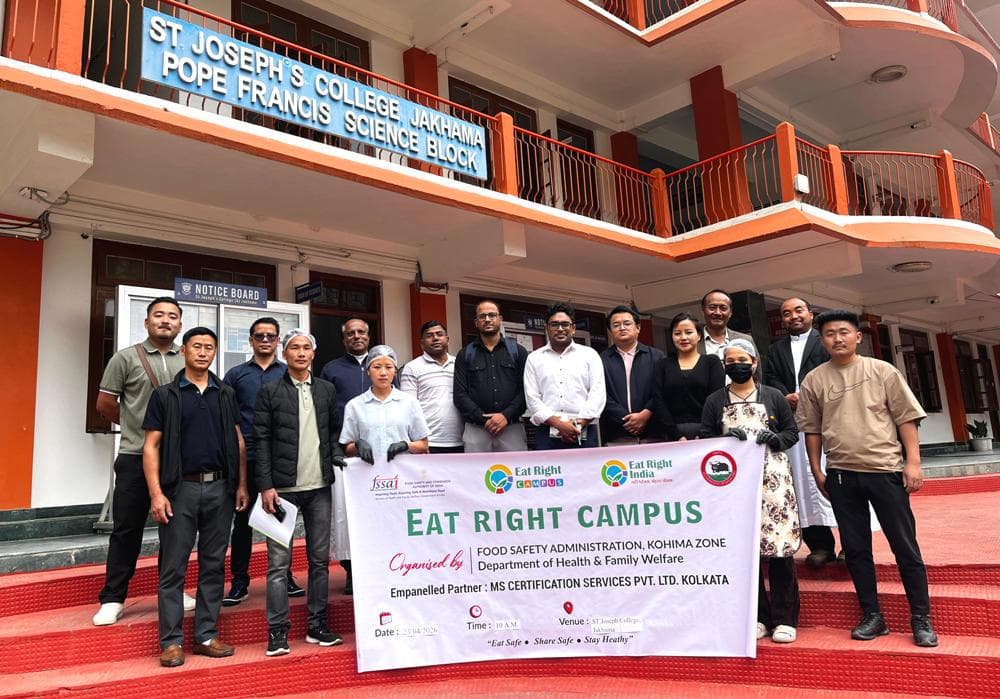
DIMAPUR — The Food Safety Administration, Kohima Zone, under the Department of Health and Family Welfare, in coordination with MS Certification Services Pvt. Ltd, Kolkata, an empanelled partner of the Food Safety and Standards Authority of India (FSSAI), carried out initiatives from April 23 to May 2.
According to an update, under the FSSAI Eat Right Campus, four campuses were audited. These included St. Joseph’s College in Jakhama, Model Christian College in Kohima, the Nagaland Civil Secretariat Canteen, and the Directorate of Health and Family Welfare Canteen.
Under the Eat Right School category, Government High School, Forest Colony, and PM SHREE Government High School, New Market, were audited.
In addition, two mandirs under BHOG (Blissful Hygienic Offering to God), one Clean Street Food Hub at D-Block near the Head Post Office, and one Clean Fruit and Vegetable Market at T-Khel were audited.
Further, third-party high-risk food audits were conducted in 15 licensed premises, and hygiene rating audits were also conducted in 30 food premises. A total of 10 initiatives and 45 food premise audits were carried out.
Read more local news: Dimapur gets Nagaland’s first community waste sorting unit
NBSE compartmental, improvement exams scheduled from June 9
Information, education, and communication materials were pre-distributed on the campuses and in the schools, while food safety display boards were distributed during the audit as per the kind of business.
It was informed that besides the FSSAI registration certificate or licence, only those premises possessing the mandatory Food Safety Training and Certification (FoSTaC) for their food handlers were audited. The training for this was earlier given to the food business operators by the department along with empanelled trainers.
Additionally, other important documents reviewed during the audit included the medical fitness certificates of food handlers, water reports, food grade packaging migration certificates, and pest control programmes.
The Eat Right Initiative certificate, once certified, will be valid for two years, after which it will need to undergo a fresh audit. The hygiene rating certificate will be certified based on the number of smileys obtained during the inspection and is also valid for two years.
Further, campuses and schools interested in obtaining such certification may approach the Food Safety Administration at the office of the Chief Medical Officer in Para-Medical, Kohima.