


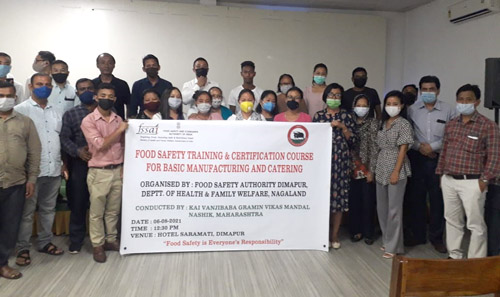
Dimapur, Aug. 7 (EMN): Underlining the importance to take additional care particularly during the current Covid-19 pandemic situation, the chief medical officer (CMO), Dimapur, Dr. Moatemjen urged the food handlers to maintain hygiene while preparing food and to follow appropriate Covid behaviours.
The CMO stated this during a one-day training on food safety and certification course for basic manufacturing and catering, organised by the Food Safety Cell of Dimapur at Hotel Saramati on August 6. He also directed all food handlers to get vaccinated against Covid-19, stated an update from CMO’s office.
Resource person Sanjay Kale, FoSTaC certified trainer and assessor from Kai Vanjibaba Gramin Vikas Mandal in Nashik, Maharashtra, enlightened the participants about the aims and objectives of Food Safety and Standards Authority of India (FSSAI), which was created for the laying down of scientific based standards of food products and to regulate their manufacture, storage, distribution, sale and import and to ensure availability of safe and wholesome food for human consumption.
He also oriented the participants on the functions of FSSAI, food safety hazards and FSSAI rules and regulations besides stressing on the importance of physical health of the food handlers who come in direct contact with food. He further informed that medical fitness certificate of every food handler should be renewed every year.
In his welcome address, designated officer of food safety, Dimapur, Samuel Zehol, informed that all food manufacturers must mandatorily have FSSAI license or registration. He urged the participants to visit the official website and obtain an online FSSAI license or registration.
Report stated that food manufacturers, SHG, caterers, and local home-based food manufacturers attended the programme.
The CMO’s office also organised an awareness programme on hepatitis for NGOs and allied departments in its conference hall on August 7.
The deputy CMO, Dr. Antoly Suu, presented the National Viral Hepatitis Control Programme (NVHCP) implementation and framework, while the resource person and senior specialist of District Hospital, Dimapur, Dr. Neilasakuo Linyü, informed the participants on viral hepatitis and its types. While informing that hepatitis A and E were transmitted through contaminated water and food and could be cured without any intervention, he however stated that hepatitis B and C are infectious and would become chronic.
He stated that NVHCP is aimed at combating hepatitis and eliminating viral hepatitis C by 2030 by providing free screening, diagnosis and treatment. He also informed that a vaccine for hepatitis B is available and added that there is no vaccine for hepatitis C but could be easily managed and cured.
Renbothung from Kripa Foundation and the director of Kripa Foundation Abou Mere also spoke in the programme.
Meanwhile, the CMO’s office also conducted a training on ‘NCD MO portal’ for medical officers and nurses of community health centres (CHC) and primary health centres (PHC) in its conference hall on August 6.
Presenting an overview of National Programme for Prevention and Control of Cancer, Diabetes, Cardiovascular Diseases and Stroke (NPCDS), which is one of the integral national programmes under non-communicable diseases (NCD), Dr. Mereninla Senlem, joint director of Health department and SPO, NPCDCS, highlighted the global as well as the current scenario of NPCDS in the country.
Terming NCD as major threats in the society, she stated that it is imperative to manage and control those preventable diseases before they pose high risks in the community, an update from the CMO’s office stated.
According to her, management of NCD included detecting, screening and treating those diseases. She added that NCD interventions could be delivered through a primary healthcare approach to strengthen early detection and timely treatment and provide healthcare to their door steps.
Vitsiatho Nyuwi, state programme officer of Tata Trusts, oriented the participants on the web portal application and process of data entry and uploading. He presented a step-by-step instruction on how to document NCD in the health unit. He informed that timely documentation could help in early detection and treatment of the disease.