


Our Reporter
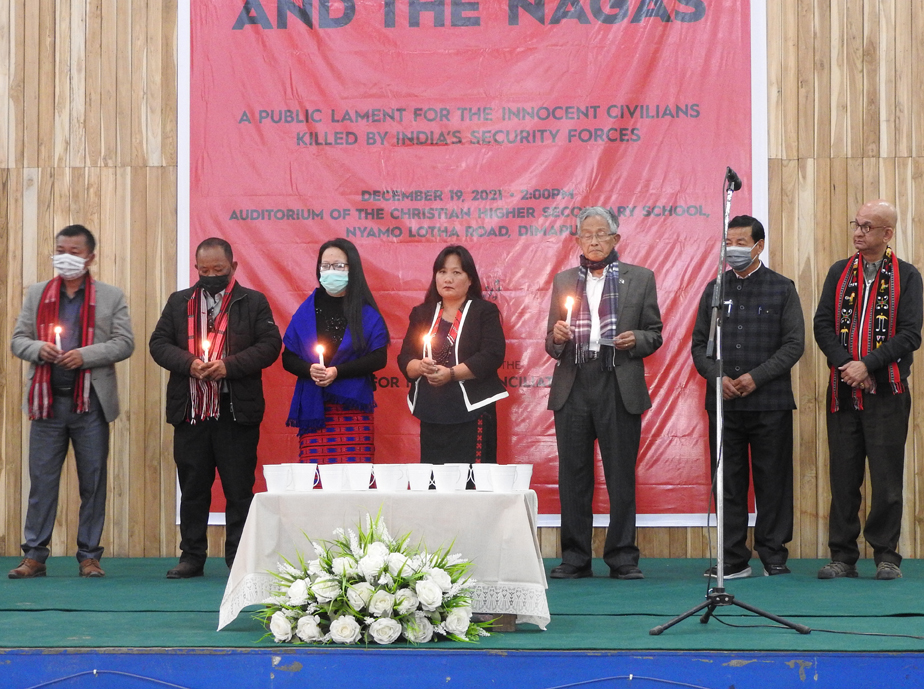
Dimapur, Dec. 19 (EMN): In memory of the victims of the Oting massacre, a public lament for the innocent civilians killed by India security forces was organised by Forum for Naga Reconciliation (FNR) at the auditorium of Christian Higher Secondary School Dimapur on Sunday.
Speaking on the occasion, member of FNR, Dr. Akum Longchari said that the Oting massacre indicates the ‘utter disregard’ for the right to life and personal liberty and a blatant display of force and unjustifiable abuse of power.
Longchari added that without the right to life, all other rights cannot be secure.
According to the suo moto FIR filed by Tizit police station, ‘it was obvious that the intention of the security forces was to murder theIndian civilians’, he said.
Longchari stated there is a clash of truths; ‘people were seeking the truth based on facts, the truth that brings facts to life, whereas for those in power, the truth is to be obscure and cover the facts so that they are never brought to light’.
Longchari said that the Armed Forces (Special Powers) Act (AFSPA) is only a symptom of the people’s political question and the Oting incident reminds them that AFSPA has no place in the contemporary world.
He asserted that nations, states and governments were judged not by the capacity to make war, rather they were judged by their willingness and ability to make peace. He added that they want long term and not short term peace, and Nagas do not want peace that is imposed from above.
‘The tragedies in Oting and Mon have occurred at a time when Nagas were being encircled in darkness as Nagas had become blind in suspicion, selfishness and corruption and their value was degenerating as they were forgetting their history and who they were as people,’ he said.
Longchari added that the civilians were killed without a cause but had created a cause in their death, and ‘perhaps they were reminding them about their history and who they were as people’.
He added that it is time for Nagas to be awakened and reach out to one another and stand in solidarity with each other.
While addressing the gathering, Dr. Visier Sanyu, member of FNR, said that they were gathered to lament, to seek justice with peaceful and love and not to seek revenge.
‘The Indo-Naga war has been going on for more than 60 years and the massacre is nothing new but enough is enough,’ he said and added that the 14 Naga brothers were killed ‘simply because they were Nagas and not because of insurgence or terrorism, and the Indian Army could do so with impunity and no legal proceeding’.
‘Our very humanity, our very existence are challenged by this massacre and we must and we will seek justice with the power of love and we will not rest until justice is done’, Sanyu said.
‘There is a twist in the tragedy of Oting incident, the ground is horrified and dreadful, the wound and pain can never be forgotten yet this tragedy in a mysterious way has united all Naga tribes.
‘Oting has awakened them, it is time for reflection, correction and direction and everyone is united in search for integrity and honesty and it is a time for soul searching,’ he added,
Earlier, stories from ground zero were delivered by President of Konyak Union Dimapur, Mosa Konyak and Nyawang Wangsha from Oting village, while sharing and short speech was also delivered by Konyak Baptist Bumeinok Bangjum (KBBB) Rev. Peihwang Wangsa and President of Eastern Nagaland Women Organisation Dimapur N Langmei Phom.
Meanwhile, the Forum for Naga Reconciliation in solidarity with the Oting village and the Konyak Naga people made a public declaration on Sunday.
FNR has also implored the Naga political groups to shed their differences and take positive steps to reconcile, unite in purpose and cooperate in the common interest of the shared Naga historical and political rights; all Naga leaders – overground and underground – to rise above party politics and self-interests by demonstrating statesmanship and healing leadership using nonviolent means; the Naga public to hold their leaders and themselves accountable, and resist all forms of tribalism and other forms of isms which divide the Nagas.