[caption id="attachment_212121" align="aligncenter" width="600"]
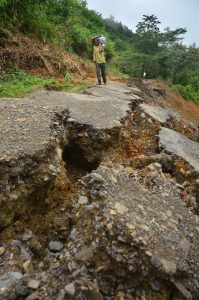 File photo: A man walks past a ruined portion of Meluri-Kiphire road. (EM Images)
[/caption]
Eastern Mirror Desk
Dimapur, Oct 12: October 13 is International Day for Disaster Reduction, an occasion set apart by the United Nations Organisation (UNO) to celebrate ‘how people and communities around the world are reducing their exposure to disasters and raising awareness about the importance of reining in the risks that they face.’ It aims at promoting a global culture of risk-awareness and disaster reduction but how prepared is Nagaland in the face of a possible natural catastrophe?
The state was hit hard by the monsoon rains this year with floods and landslides damaging homes and roads besides taking some precious lives. The Nagaland State Disaster Management Authority (NSDMA) said in a recent report 13.19% of the state’s total population was affected by the recent monsoon. It said at least 11 human lives were lost, five persons injured, 532 villages, and 48, 821 families were affected. A total of 353 people were evacuated, out of which 90 were from Kohima, 35 from Tuensang, Wokha (225), and Mokokchung (3 families).
Apart from monsoon woes that may occur every year, the National Disaster Management Authority has placed Northeastern states, including Nagaland, in the category of region that is prone to landslide. The state also falls in the seismic zone-V, the highest earthquake-prone zone, according to the Geological Survey of India. It is clear that the state is vulnerable to natural disasters like floods, rain-induced landslides and earthquakes but the authorities seem to be clueless on how to formulate a systemic strategy that will help reduce destruction in the face of any calamity.
Non-implementation of Nagaland Building Bye-laws 2012
Additional chief engineer of Public Works Department (Housing), H Kahuto Sumi, told
Eastern Mirror that law that is meant to regulate the construction of houses and buildings in the state is yet to be implemented. And this is despite houses, including big-structured perilously built on hill slopes and narrow plots vulnerable to landslides.
Sumi said that “there is no rule and regulation so far,” for construction of buildings in the state. He added that most people are not following the “Nagaland Building Bye-Laws of 2012” as it is not been implemented, and the law itself is only a “brief description” and does not follow the technical norms.
The additional chief engineer insisted that by any means Building Bye-Laws should be implemented like in other states. As of now, there are no specific rules that regulate the standard of housing or buildings.
The senior engineer also highlighted obstacles to implementation of such laws. He said that the department concerned could not encroach into private property due to ‘land ownership’ issues. Unless there is an approved regulation by the authority concerned, ‘we are helpless and handicapped,’ Sumi added.
He said that the department could set a limit on the number of storeys for a building depending on the soil condition. ‘For government building projects, soil testing and land viability are done and approved accordingly. However, for private buildings we cannot insist because we don’t have any rules or laws in our hand,’ he said.
It may be recalled that the state has faced several disasters in the last couple of decades, including the cloudburst in 2001 in Dimapur. The state also experienced landslides at the New Market area, Kohima in 2003, Mokokchung Town in 2005, Wokha town in 2006, Zunheboto town in 2006, and along the National Highway 29 near Kiruphema in 2007.


