[caption id="attachment_259552" align="alignright" width="320"]
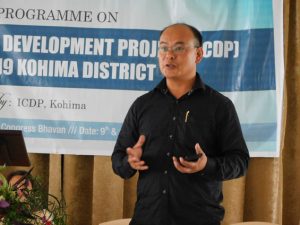 Vikosielie Nagi speaks at the ICDP training programme, on July 9 in Kohima.
[/caption]
Our Correspondent
Kohima, July 9 (EMN): The first phase of training programmes for beneficiaries of the Integrated Cooperative Development Project (ICDP) for Kohima district began at the AMK building, on July 9 in Kohima.
The ICDP was launched in July 2018 as a second phase project for four years in Nagaland. The first phase was introduced in 1989 in eight districts.
The second phase covers five districts: Kohima, Peren, Tuensang, Kiphire, and Longleng with a total project cost of INR 55 cr., according to Anthony Angami, the chief project officer of Kohima district.
The project is financed by the National Cooperative Development Corporation, a statutory agency of the ministry of Agriculture & Farmers’ Welfare. The state government is the guarantor of the project.
In Kohima district, a total of 41 primary cooperative societies’ (beneficiaries) had received approximately INR 15. cr. Depending on the capacity and functions of the beneficiaries, the funds were released accordingly. Kohima and Tuensang district received the highest amount of funds among other districts, Angami said.
The project covers agriculture and allied sectors including livestock, farming, providing transport, cold storage, handicrafts and weavers etc, the official said.
As part of the project, a group called the Vitho Industrial Cooperative Society in Zubza received the first pick-up (a Tata mobile) recently, to market their products.
Five more pick-ups will be introduced in the next phase besides facilities of cold storage, the officer added.
One of the resource persons at the training programme, agriculture inspector Meciesunu Sakhrie spoke about the ways to improving farming and cultivation. She emphasised on the importance of sustainable development. One needs to have a clear vision about farming and cultivating for sustainable use, she said.
Sakhrie spoke also about integrated plants management (IPM). For a bountiful harvest, it is necessary for farmers to start right from taking care of the soil till harvest, she said.
Further, the officer explained the ways to controlling worms and pests through organic treatment. She suggested using neem oil instead of chemicals for pest control.
Vikosielie Nagi, development officer, sub registrar of Co-operative Societies, highlighted at the programme the benefits of forming a cooperative society. Some of the important aspects of it are planning, organising, staffing, directing, controlling, and coordination, he said.
Most cooperative societies failed because of lack of training and their inability to follow guidelines, he added. As business persons, one ought to take risks in life, the told the gathering.
Giving more tips to the trainees, he said it is necessary for any business person to register purchase, sale, and stock activities.
Nagi urged the beneficiaries to maintain discipline, have plan properly and pursue the goals religiously. Likewise, they should learn to manage time, and maintain a record of every work that is undertaken, he said.
Apart from skills in the working aspects of the agricultural application sector, the beneficiaries will be trained also in the other relative topics such as veterinary, horticulture, and fisheries. The programme was organised by the Kohima ICDP.
The first phase of training for beneficiaries of said project was conducted, on July 9 at the Hopongkyu Memorial Hall in Kiphire.
The special guest for the programme was subdivision officer (civil) Nyempo Walling, updates stated on Monday.
The government’s publicity agency, the department of Information and Public Relations, issued updates to the media about the programme.
In her address at the programme, Walling said “many developmental activities” have taken place after Kiphire was declared an “aspirational” (sic) district. She was stated to have urged the people of the district to “show positive challenge to other districts.”
Further, walling urged registered societies that have taken loans from bank to repay their loans in time and to “try to create good reputation of the society.” She urged them to make way for themselves for ‘future loans.’ The officer requested the cooperation department to keep in touch with the district administration to work together.
Also, the joint registrar of Cooperative Societies, Temjen Longkumer, said that the cooperative movement started in 1904. He said that the “cooperative work” is for the poor and needy to help them in establishing livelihood avenues.
The official encouraged the registered societies in Kiphire district to start their work in ‘small amount’ to develop their societies.
The cooperative society is for people’s welfare and should make profits and shared among the members, Longkumer said.
Further, Longkumer, who is also the monitoring officer of the ICDP for Kiphire, said that the project was seed money. The members of the societies should use it judiciously and repay their loans in time to bring in future ‘developmental activities,’ the IPR’s report read.
Again, the officer urged the cooperative societies’ members not to stop their projects half way.
The chairman of Hurung village, Chemlongse also spoke at the programme. The community leader urged the cooperative societies to be “honest” and dedicated to what they have been given by the government.
The training session will continue till July 10, the IPR added.


