


FBMP annual review workshop in Kohima charts next phase for forest and biodiversity conservation across Nagaland.
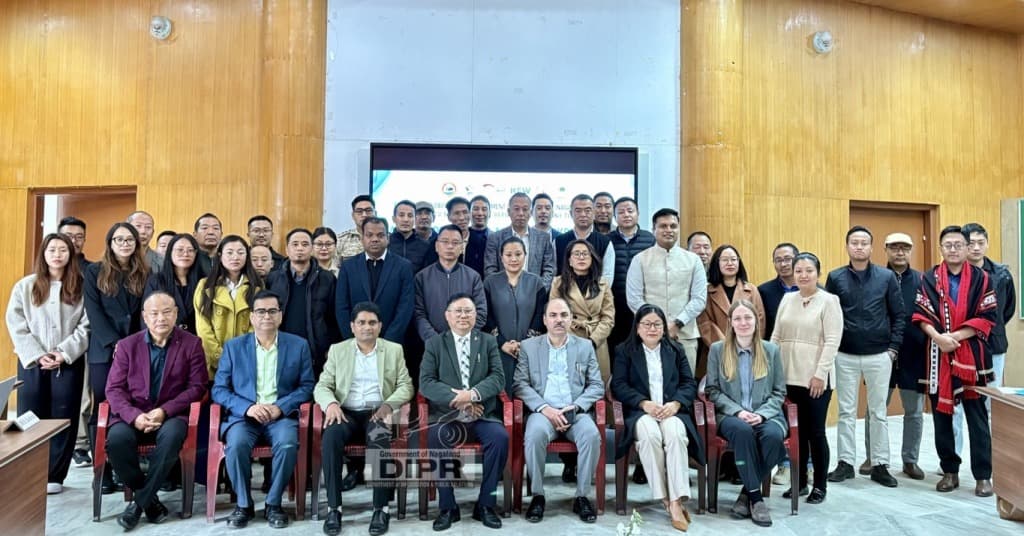
DIMAPUR — The annual review-cum-planning workshop of the Forest and Biodiversity Management in the Himalaya (Nagaland) Project (FBMP), co-financed by the Federal Republic of Germany through KfW, commenced on Thursday at the conference hall of Forest Office Complex, Kohima.
According to a DIPR report, the two-day workshop is aimed at reviewing progress and charting the roadmap for the next phase of implementation.
Addressing the gathering, Vedpal Singh, Principal Chief Conservator of Forests & head of Forest Force, Nagaland, emphasised the need to institutionalise all interventions under the project to ensure sustainability beyond individuals.
He stressed that review meetings must result in measurable and implementable decisions. He also cautioned against spreading resources too thinly and suggested intensive interventions in selected locations to create demonstrative and replicable models.
Also read: IRCS Nagaland observes 44th foundation day, flags off new hearse
Highlighting the importance of visible and relatable issues, he called for strengthening components such as human-wildlife conflict mitigation to enhance public engagement and institutional support.
Principal Secretary, Environment, Forest and Climate Change and chairman of Nagaland State Biodiversity Board, Y Kikheto Sema stated that the project presents a significant opportunity for the state.
He observed that Nagaland, though financially constrained, is rich in biodiversity and must leverage such grant-based projects effectively. He pointed out that with most forest lands under community ownership, grassroots awareness and participation are essential for meaningful conservation outcomes.
He expressed concern over the decline in forest cover in recent years and underscored the need to address root causes, including unsustainable practices. He advocated intensive engagement with communities, prioritisation of ecologically sensitive areas, and focused interventions rather than thin dispersal of resources. Emphasising that conservation must become a people’s movement, KIkheto called for involvement of schools, churches and community institutions in spreading awareness and protecting biodiversity for future generations.
He further stated that Article 371A should not be misconstrued as a barrier to environmental responsibility. Climate change, he said, does not recognise constitutional or administrative boundaries and is already impacting the state through erratic rainfall patterns, drying water sources and changing climatic conditions.
Therefore, communities must be sensitised to understand that conservation is directly linked to their own livelihood security and future well-being, he said.
Referring to shifting cultivation (Jhum), the official said that while traditional practices are respected, there is a need to adapt and adopt more sustainable methods wherever possible. With over 70 per cent of the population residing in rural areas and largely dependent on land-based activities, scientific planning and community cooperation are essential to reduce pressure on forest resources.
Reiterating the need for collective responsibility, he called upon officials to actively engage with village communities, listen to their concerns and build trust through sustained interaction.
Presenting the project status, the project director informed that FBMP is part of the Government of Germany’s Financial Cooperation with India, signed in 2016, focusing on sustainable and effective management of forests and biodiversity in Nagaland. The project has been under implementation since 2020–21 and aims to strengthen adaptive conservation planning at the village, Community Conserved Area (CCA) and landscape levels, improve biodiversity management in selected areas, enhance livelihoods of targeted communities, and build stakeholders’ capacity in conservation.
The project currently covers six districts—Kohima, Mokokchung, Peren, Tuensang, Wokha and Shamator—across seven landscapes, 13 CCAs and 64 villages.
Key components include conservation planning and entry point activities, CCA management, biodiversity-based livelihood interventions, capacity enhancement, strengthening of the Nagaland State Biodiversity Board, and project monitoring and evaluation, with support from implementation and consulting agencies.
Under conservation planning, 64 village micro plans and 75 entry point activities have been taken up. Three landscape management plans and four CCA-cum-landscape management plans have been prepared, while nine CCA management plans have been approved. A total of 35 people’s biodiversity registers have been prepared.
In the area of sustainable biodiversity-based livelihoods, 185 activities have been completed, benefitting over 9,000 people directly and around 12,000 indirectly. Community contribution towards livelihood initiatives stands at INR 2.20 crore.
The workshop was also informed about the human-elephant conflict mitigation plan prepared by the Wildlife Institute of India, with focus areas in Wokha and Mokokchung districts. A Human-Elephant Conflict Control Room has been established in Wokha.
Sharing the perspective of the project management consultant, the chief technical advisor stated that the project has made significant progress, particularly since 2023. The financial participatory approach adopted under the project has been cited as an innovation, with high community contribution and robust financial transparency systems.