Farmer-scientist interaction on livestock held in Zapami
The Indian Council of Agricultural Research (ICAR)-Krishi Vigyan Kendra (KVK), Phek, organised a farmer-scientist interaction on livestock management at Zapami village in Phek district
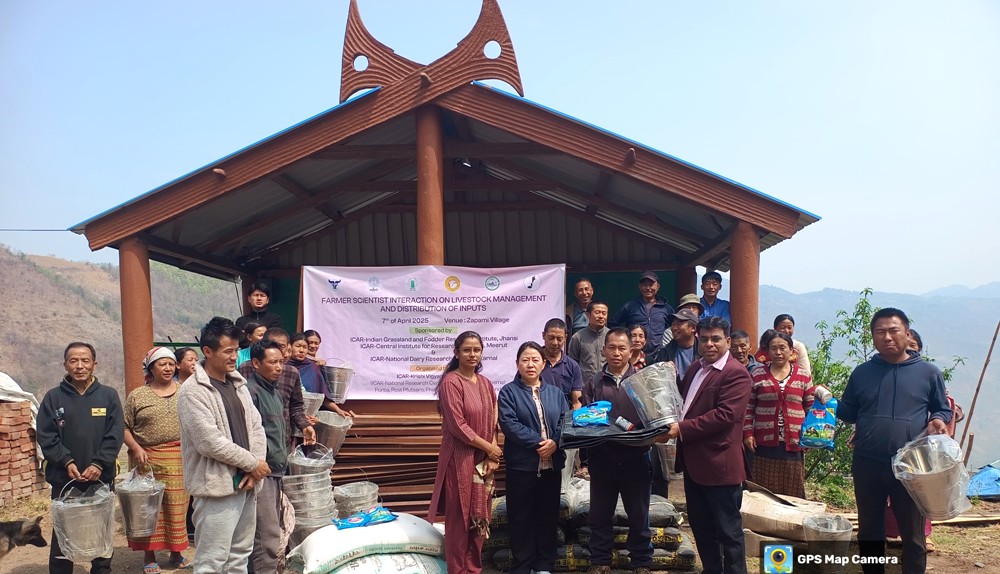
- Officials
and participants during the distribution of inputs following the
farmer-scientist interaction on livestock management at ICAR-Krishi Vigyan
Kendra, Phek, on Monday.
- DIMAPUR — The Indian Council of Agricultural
Research (ICAR)-Krishi Vigyan Kendra (KVK), Phek, organised a farmer-scientist
interaction on livestock management on Monday at Zapami village in Phek
district.
- According to an update, the event was sponsored by
ICAR-Indian Grassland and Fodder Research Institute, Jhansi; ICAR-Central Institute
for Research on Cattle, Meerut; and ICAR-National Dairy Research Institute,
Karnal.
- During the interaction, discussions were held on the
management of Thu-tho cattle. Farmers shared their experiences in cattle
rearing and requested the organisation of health-cum-vaccination camps for
cattle, pigs, and poultry.
- As part of the programme, inputs such as wheat bran, maize,
mineral mixture, supplements, buckets, tarpaulins, and angle iron posts were
distributed to Thu-tho cattle rearers of the village.
- Thu-tho cattle hold a significant place in the agricultural
and cultural life of Zapami farmers. Well adapted to the region's rugged and
hilly terrain, these indigenous cattle are valued not only for their practical
uses but also for their symbolic and cultural importance.
- It was mentioned that Thu-tho cattle are an essential part
of traditional farming systems, as they are used for draught power.
Additionally, their meat serves as a vital source of protein, and their dung is
used as organic manure, enriching the soil and aiding in the cultivation of
vegetables and other crops.


