DIMAPUR — Dr.
Thejanuo Rhetso, 34, completed her B.Sc., M.Sc. in Botany, and Ph.D. at
Bangalore University. Her passion for learning and research led her to teaching
and to her current role as an assistant professor in the Department of Botany
at Patkai Christian College (Autonomous). She embraced teaching not merely as a
career choice but as an opportunity to continue learning and advance her
research.
With a
strong academic foundation, she has contributed significantly to the
understanding of plant science through her research on topics like the
antimicrobial properties of Allium chinense and the phytochemical profiling of
Tithonia diversifolia.
In this
interview with Eastern Mirror, Dr. Rhetso shares insights into the
relevance of Botany in today's world, emerging career opportunities in the
field, and her perspective on integrating technology with plant sciences.
How would
you define Botany for a young audience, and why is it an important field of
study today?
Botany is
the scientific study of plants. It covers everything from microscopic algae to
trees, exploring how plants function, interact with the environment, and
contribute to ecosystems. Botany is an important field of study because plants
create oxygen and food for all living organisms, play a crucial role in food
security, help combat climate change and are essential for biodiversity
conservation.
Which
industries or organisations actively seek graduates with a background in
Botany?
Botanists
are highly sought after by various industries and organisations for their
expertise in plant science. Some of the key sectors include educational
institutions, botanical gardens and arboretums, environmental and conservation
organisations, the agri- and forest sectors, and industries such as plant-based
pharmaceutical industries, food and beverage industries, Ayurvedic and
homoeopathic industries, pulp and paper industries, agro-based industries, and
government organisations for forest management, plant documentation, and
environmental impact assessments.
From
your perspective, what are the most promising or in-demand career paths in
Botany today?
The field
of Botany offers several promising and in-demand career paths. Some of them are
plant biotechnologists, plant taxonomists, plant geneticists, cell biologists,
research scientists, conservation biologists, pharmacognosists, environmental
consultants, teachers and researchers.
Are
there any key competitive exams or certifications that students should be aware
of to pursue higher studies or secure coveted positions in the field?
Yes, some
of the most significant exams are the UPSC-Indian Forest Service (IFS) and the
UPSC-Botanical Survey of India (BSI) Exams; the Nagaland Public Service
Commission (NPSC); the Council of Scientific and Industrial Research (CSIR)-UGC
NET; and the Graduate Aptitude Test in Engineering (GATE), which are key exams
for admission into top institutions like the Indian Institute of Science and
other top universities and research institutes offering Ph.D. programs and to
qualify for lectureship positions at universities.
Could
you shed light on how emerging technologies (like AI, machine learning, or advanced
instrumentation) are shaping the field of Botany?
Technological
advancements have greatly enhanced the ability to study plants; advanced
sequencing methods like nanopore sequencing and gene editing tools like CRISPR
(Clustered Regulatory Interspaced Short Palindromic Repeats) allow precise
genetic modifications to improve disease resistance, drought resistance, and
yield in crops.
New sensor
technologies, including biosensors and remote sensing, provide real-time data
on plant health, growth, and environmental conditions; AI-driven image
recognition software can now identify plant species from photos, accelerating
biodiversity surveys, particularly in remote or underexplored regions, allowing
botanists to build more accurate plant databases. Plant synthetic biology,
where researchers are redesigning plants to promote sustainable agriculture.
Are
there entrepreneurial opportunities for Botany students?
Botany
students have several entrepreneurial opportunities due to the increasing
demand for plant-based products. Mushroom cultivation offers a profitable
income source with low startup costs, offering both local and global market
potential. Botanists can also grow and sell medicinal plants and their
extracts, such as essential oils, for pharmaceuticals, perfumery, cosmetics,
soap, and detergent companies. Other opportunities include plant nursery
management as plant propagator for multiplying plants for plantation purposes
and modern farming by cultivating niche crops like saffron, goji berries,
shiitake mushrooms, etc.
How does
studying Botany help students contribute to environmental conservation, and
what are some real-world applications?
Studying
botany equips students with the knowledge and skills to play a vital role in
environmental conservation. By understanding the complex interactions between
plants, ecosystems, and environmental processes, botanists can identify both
native and invasive species, helping to restore ecological balance in areas
where invasive plants have displaced indigenous flora. They also play a
critical role in reforestation and afforestation, contributing to the reduction
of atmospheric CO₂ levels and helping to mitigate climate change. Botanists,
with their scientific expertise, are instrumental in shaping environmental
policy, advocating for plant diversity, and promoting long-term
sustainability.
Botany
increasingly overlaps with other sciences such as microbiology, genetics, and
ecology. How can students benefit from pursuing interdisciplinary studies?
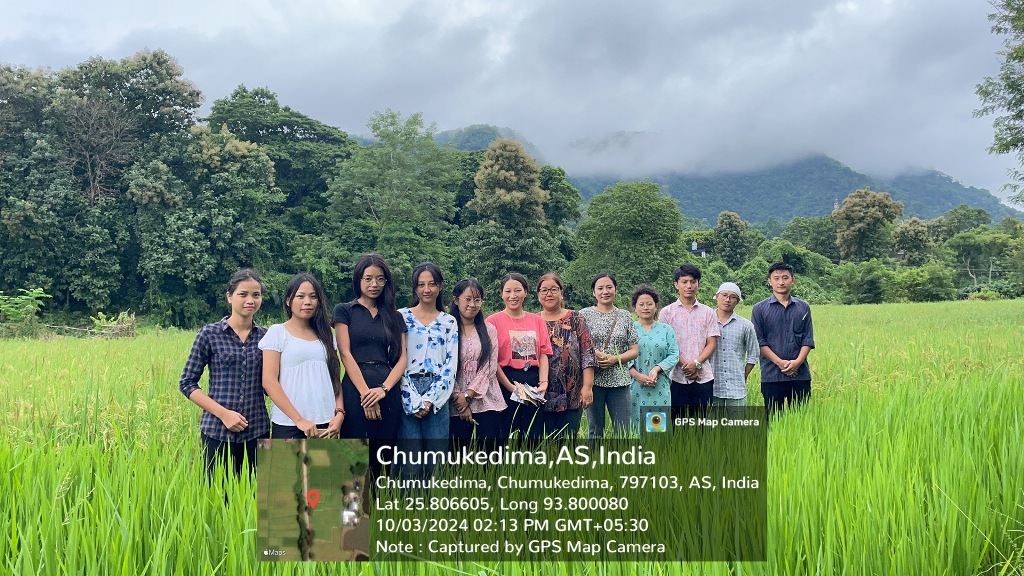
Hands-on learning of rice
hybridisation techniques with colleague Dr. Reingamla Tetso and M.Sc.
final-year students in 2024.
Pursuing
interdisciplinary studies provides students with numerous advantages, enriching
their understanding of plant sciences while broadening their career prospects.
The integration of these disciplines enhances their scientific expertise and
equips them with practical skills to develop innovative sustainable solutions,
preparing them to tackle complex challenges across multiple sectors.
In what
ways is Botany research critical to addressing global issues like food security
and climate change?
Botany is
key to addressing food security and climate change. By using genetic research
and technologies like CRISPR, botanists develop resilient crops that withstand
pests, disease, and extreme weather, ensuring stable food production. Botanists
also identify traits that enhance drought and heat resistance, crucial in
climate change. Through research and innovation, botanists drive ecosystem
restoration, support biodiversity, and develop sustainable agricultural
practices that enhance soil health, reduce pesticide use, boost crop yield for
long-term food security and select native and climate-resilient tree species to
improve carbon sequestration, air quality, and mitigate climate change.
Are
there any specific internships, certifications, or short courses that can help
Botany students stand out to prospective employers or research institutions?
Depending
on their field on interests, botanists can pursue short-term certificate
courses such as mushroom cultivation technology, floriculture, nursery
management, herbal technology, plant propagation techniques, paper and pulp
technology, essential oil extraction, herbarium management, Geographical
Information Systems (GIS) and Remote Sensing (RS) courses, etc.
Beyond
scientific knowledge, which soft skills are most valuable for Botany graduates?
In addition
to scientific knowledge, several soft skills like critical thinking,
dedication, patience, communication, teamwork, attention to detail, time
management, collaboration, organisational skills, and research and analytical
skills help botanists excel.
If you
could offer one overarching piece of advice to a student considering a career
in Botany, what would it be?
My advice
would be to stay curious and never stop learning. The field of Botany is vast
and there’s always something new to discover.
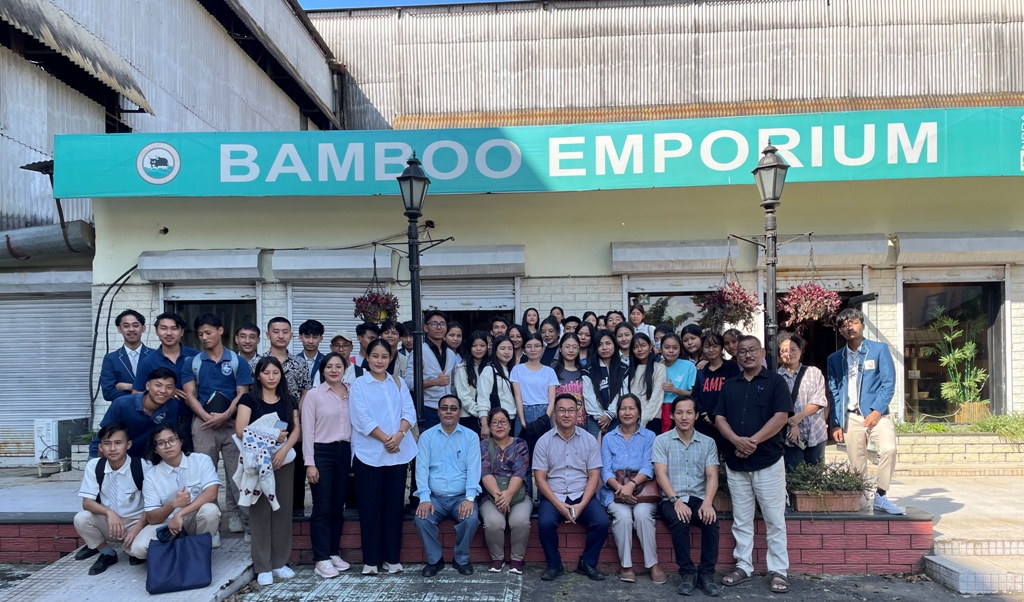
Field trip with colleagues and students (B.Sc. and M.Sc.) to
the Nagaland Bamboo Resource Centre, Sovima, 2024.
RAPID
INSIGHTS
If you
could take your students to any natural site or botanical garden in the world,
where would it be?
Yellow
Stone National Park, a unique blend of fossilised plants and diverse ecosystems
showcasing plant evolution.
What
keeps you motivated?
Challenges
keep me motivated, as they push me to think creatively, adapt, and constantly
improve.
Could
you share a simple eco-friendly habit everyone can adopt?