 Eastern Mirror Desk
Dimapur, Nov. 17:
Eastern Mirror Desk
Dimapur, Nov. 17: This year has been an eventful one for the Bharatiya Janata Party (BJP), going from strength to strength and managing to form governments in northeastern states of Nagaland, Tripura and Meghalaya with its allies, despite criticisms against the party from several quarters. It was also the single largest winning party in Karnataka though it failed to claim the government. That was BJP’s performance in state assembly elections held in the first half of 2018.
The Indian National Congress (INC) on the other hand failed to reclaim power in Meghalaya and faced a washout in Nagaland and Tripura. However, it received some consolation in Karnataka by forming a coalition government with Janata Dal (Secular) after failing to secure a majority. That was Congress’ performance earlier this year.
Now, all eyes are on the upcoming assembly elections in five states – Chhattisgarh, Madhya Pradesh, Rajasthan, Telangana, and Mizoram – considered by many as a prelude to next year’s crucial Lok Sabha elections. Both the BJP and Congress will want to start next year’s election campaign on a positive note by winning in these states that have 83 parliamentarians. It will be a litmus test for both the major national parties.
Elections started in Chhattisgarh with voting in 18 constituencies (first phase) being done earlier this week, while polling for the remaining 72 constituencies will be held on Nov. 20. A close fight is expected between the BJP, which won 49 seats (41.04% vote share) in the 90-member state assembly in 2013, and Congress which won 39 seats (40.3% vote share).
Madhya Pradesh, which has 230 assembly seats, will go to the polls on Nov. 28. The BJP won 165 seats in the last election, while Congress won only 58 but the equation could change this time due to anti-incumbency wave in the rural areas. However, a clearer picture of the possible outcome can be seen only when aggressive campaigning starts.
The BJP pulled down the Congress in a landslide victory in the last election in Rajasthan, winning 163 seats in the 200-member assembly while the Congress’ figures were reduced to just 21 from earlier 96. However, anti-incumbency factor could help Congress bounce back in this election. The state will go to the polls on Dec. 7.
In Telangana, the incumbent Telangana Rashtra Samithi (TRS), which won 63 seats in the 119-member assembly, will try to retain the power but this time, four parties, including Congress, Telangana Jana Samithi (TJS), Telugu Desam Party (TDP) and Communist Party of India (CPI) have formed an alliance called Maha Kootami (Grand Alliance) to take on the party. The Aam Aadmi Party (AAP) has also declared that it will contest in all the 119 seats. Election in the state is scheduled for Dec. 7.
Mizoram, which has 40 assembly constituencies, will go to the polls on Nov. 28. Some may see it as the least important among the five states that are going to the polls because of less representation in the parliament (one seat each in Lok Sabha and Rajya Sabha) but the incumbent Congress and its rival Mizo National Front (MNF) are leaving no stone unturned to win. Interestingly, BJP is said to be keen on entering the state’s political arena through the North East Democratic Alliance (Neda), which MNF is part of. Neda is a political coalition formed in 2016 by BJP along with regional parties of northeastern states.
Counting of votes in all the five states will take place on Dec. 11.
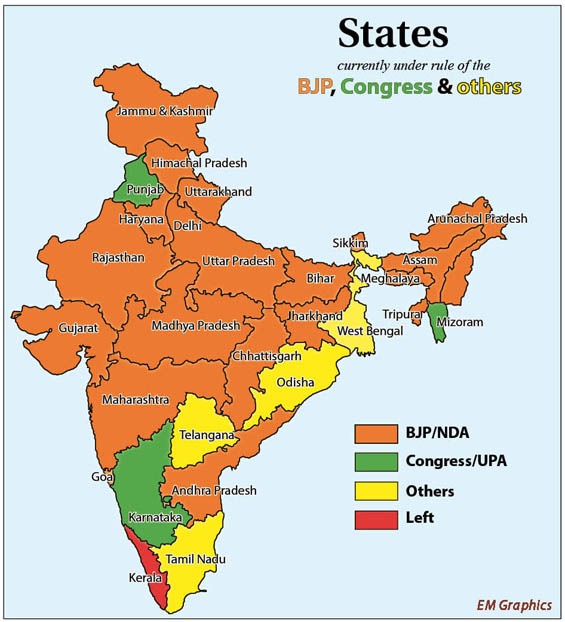
At present, the subcontinent is almost completely saffronised with a total of 21 states out of 29 (including MP, Chhattisgarh and Rajasthan) either ruled by the BJP or its allies. However, it is to be seen if it will expand its frontiers besides retaining the power in its ruling states after this elections.
In the remaining eight states, Congress is in power in Punjab, Mizoram and Karnataka (via coalition with Janata Dal Secular), TRS in Telangana, All India Anna Dravida Munnetra Kazhagam (AIADMK) in Tamil Nadu, Left Democratic Front (LDF) in Kerala, Biju Janata Dal (BJD) in Odisha, and Trinamool Congress (TMC) in West Bengal. It may be mentioned that two union territories, Delhi and Puducherry, are ruled by Aam Aadmi Party (AAP) and Congress respectively.


