Educational institutions in Nagaland conduct various program
Educational institutions in Nagaland conduct various programmes
Educational institutions across Nagaland like Norman Putsure College, St. Joseph University and Nagaland University organised programmes focusing on indigenous knowledge, cultural preservation, skill development, and women empowerment
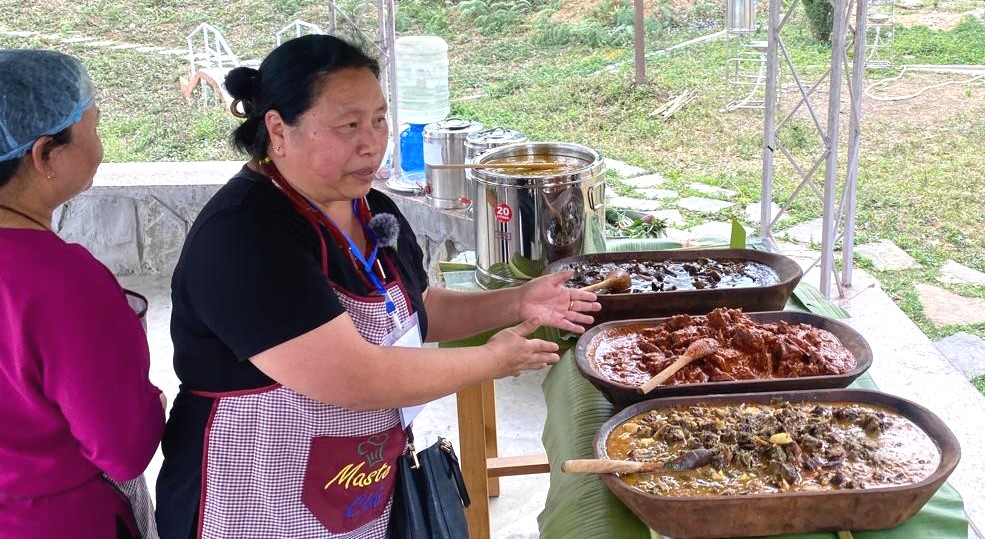
Prof. Visakhonu Hibo showcasing indigenous Naga cuisines
during a training programme on traditional food knowledge at Nagaland
University, Lumami, on Monday.
DIMAPUR — Educational institutions across
Nagaland recently organised programmes focusing on indigenous knowledge,
cultural preservation, skill development, and women empowerment.
Nagaland University:
The Nagaland University (NU), Lumami, is organising a two-day training
programme on the indigenous cuisines of Nagaland.
Spearheaded by the committee for Indigenous Traditional
Knowledge (ITK) of NU, the inaugural ceremony was held on Monday, with Prof. JK
Patnaik, vice chancellor of NU, as the chief guest, according to a press
release.
On the occasion, resource person Prof. Visakhonu Hibo gave a
lecture on Naga cuisines. Hibo highlighted her experience of integrating
traditional knowledge of cuisine into a skill-enhancement course at Japfü
Christian College.
She also highlighted the importance of self-subsistence and
a sustainable way of life by returning to nature. She said nature has the
potential to meet our food needs, given the availability of various plants and
herbs with medicinal properties in our immediate surroundings. She emphasised
the importance of scientific investigation of these plants and also appealed
for community participation in preserving these resources.
Prof. Patnaik stressed the importance of Indigenous
Traditional Knowledge and its preservation in the present context. He said the
ITK will be incorporated into the Indigenous Knowledge System (IKS) Centre,
which is in the pipeline.
He opined that Nagaland University is on the threshold of
making a significant achievement, as the state of Nagaland has not yet been at
the forefront of IKS. He hoped that the proposed Centre will eventually develop
into a full-fledged department based on indigenous resources, encompassing
cuisines, languages, traditional medicines, and more.
Nineteen participants, comprising research scholars, PG
students, and staff members from Nagaland University, are being trained by
culinary experts.
MGM Higher Secondary
School: MGM Higher Secondary School, Dimapur, celebrated its cultural day
on March 15, featuring traditional folk songs, Lotha folk dance, Bihu dance, a
folk tale of Nagaland, and a Manipuri dance.
According to a press release, Rev. Fr. Giju George, the vice
president, in his presidential address, emphasised the importance of preserving
cultural diversity and unity, while Reji Abraham, the Principal, highlighted
the unique cultural richness of Northeast India, dispelling common
misconceptions about the region.
The day ended with an exhibition of different cultural
groups, where students displayed various artefacts, costumes, and artwork from
different cultural groups.
St. Joseph
University: The internal complaints committee of St. Joseph University,
Chümoukedima, in collaboration with the Institution Innovation Council,
organised a special talk on women empowerment on Monday, featuring Dr.
Theyiesinuo Keditsu, aka Mekhela Mama, as the guest speaker.
An update stated that the event aimed to highlight the
importance of empowering women, particularly Naga women, and its crucial role
in fostering social and cultural progress.
Dr. Keditsu, in her address, called for both men and women
to work together towards empowering one another, starting from household
environments to larger public spaces. She encouraged students—both male and
female—to take action and make a conscious effort to support each other in
achieving equality, whether in academic or social settings.
Norman Putsure
College: The second-semester students of Norman Putsure College had their
skill development class at the Sovima Campus on March 15.
The students gained firsthand experience in horticulture
under the expert guidance of Neibu and her team. The objective of the class
focused on the importance of subsistence and organic farming, which is a
prerequisite for our survival and healthy living.
The students were taught practically, where they had to till
the land, segregate the stones from the soil, and fertilise the soil. They
planted various crops, and with the necessary nurturing by the students, the
produce will be harvested by them.