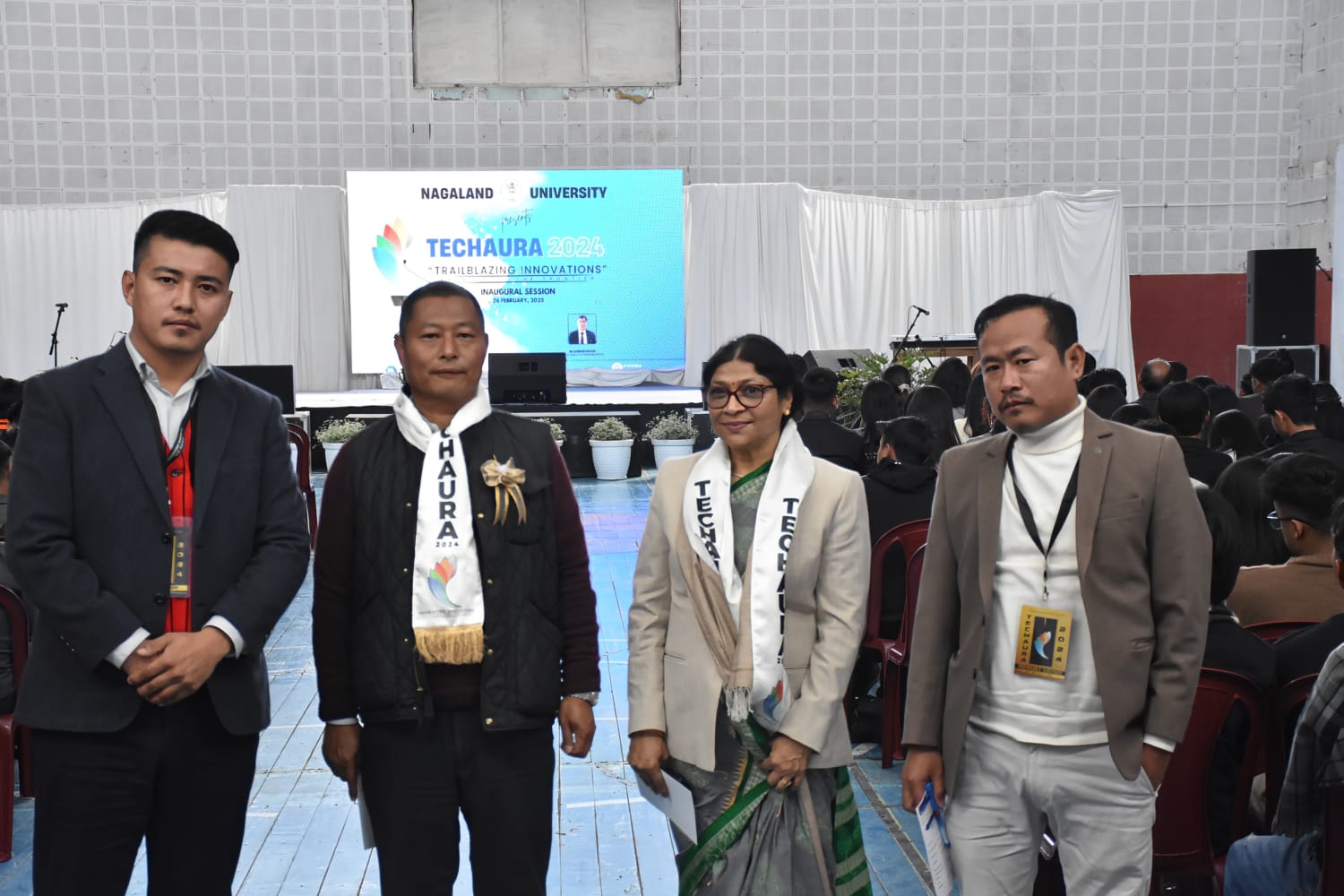
Dr. Kekhrielhoulie Yhome and others during the inaugural
session of TechAura at Nagaland University on Wednesday.
DIMAPUR — The
15th edition of Nagaland University's three-day national-level technology fest,
TechAura, commenced on Wednesday at IG Stadium Hall, themed "Trailblazing
innovations: pioneering innovations”.
Dr. Kekhrielhoulie Yhome, Advisor for School Education and
SCERT, attended the inaugural session as the chief guest, while Keyiekhru
Rhutso, principal of Government Polytechnic Kohima, addressed the audience as
the keynote speaker.
According to a press release, Dr. Yhome, speaking on the occasion,
drew attention to the need for tribal Naga society to be exposed to technology
and innovation through fests like TechAura. He stressed the importance of the
youth venturing beyond their cultural boundaries and adapting to changes in
technology.
The events that followed the inaugural ceremony included
model presentation, robotics: mud race, mental math, voice of TechAura, and
e-sports: MLBB. The three-day tech fest comprises 16 events, with a concert
night on the last day.
St. Joseph University: The department of Political Science,
St. Joseph University, Chümoukedima, organised its seventh annual Veritas
Lecture on Wednesday at the university auditorium, with Mmhonlumo Kikon, an
author and poet, as the speaker.
The topic of the lecture was "Revisiting our history
from the perspective of the native”.
According to a press release, speaking on the occasion,
Kikon urged autonomous colleges and universities to design and adopt curricula
focused on the history of the region. He also discussed 'colonial naming' and
the practices of colonial agents mispronouncing and renaming places and terms
such as Kohima, Angami, Rengma, Lotha, and others.
He emphasised that none of these names are indigenous to the
respective Naga tribes but are a result of the British mispronouncing local
names and terms. He asserted that there has been no decolonisation process in
Nagaland, and therefore the names given by the British are still attached to
the region. He opined that renaming places and identities is an integral part
of the colonisation process, which dehumanises and rewrites the history of the
people.
He also stressed how the British recorded the term
'Kacha-Nagas' for the word 'Ketsa,' given by the Angami to the Zeliang, meaning
'forest dwellers.' What was originally a neutral term, without any ill
intentions, was converted into a derogatory term by the British. He argued that
terms like Kacha-Nagas, savages, non-believers, and others are all binaries of
colonialism, where words are used to subjugate.
He remarked that the policies and rules of the colonial era
have had a lasting impact even after independence, extending into legislation.
Natives continue to use such language because they are not familiar with their
history.
Oriental College: The internal quality assurance cell (IQAC)
of Oriental College, in collaboration with the Social Welfare department,
organised an awareness programme on substance use disorder on Wednesday.
Speaking on the occasion, Ketho Angami, president of the ARK
Foundation, highlighted how addiction is affecting society in various forms. He
noted that it has become common for 13- to 14-year-olds to get involved in
addiction recently.
Llato Kiba, a recovering drug user, shared his testimony,
discussing how his early youth began as a bright student but took a turn when
he started experimenting with drugs at a very young age. These actions led to a
loss of concentration, lack of sleep, restlessness, theft, involvement in
fights, and imprisonment. All these factors ultimately led him to withdraw from
society.
NEISSR: A one-day Financial Literacy Awareness Programme was
organised at the North East Institute of Social Sciences and Research (NEISSR),
7th Mile, Chümoukedima, to equip trainees with essential financial knowledge
and skills for making informed financial decisions.
The resource person for the programme, Isile Nza, capacity
building officer at CRISIL Foundation, Nagaland, highlighted the importance of
financial literacy in today’s economy.
She emphasised that individuals should control money rather
than letting money control them. She noted with concern that financial literacy
in Nagaland stands at a mere 8%, stressing the need for greater awareness and
education on financial management.
Encouraging early investment and disciplined saving habits,
Nza reiterated that starting with a small amount can yield long-term benefits,
ultimately reducing financial dependency.
SJHSS: St. Joseph's Hr. Sec. School, Chümoukedima, kicked
off its 27th annual games and sports meet with Seyievilie Pfukri, EAC
Chümoukedima, as the special guest.
As an alumnus of a Catholic institution, Pfukri, in his
speech, emphasised that sport is not just a competition or physical fitness; it
is a powerful tool for building character, discipline, and resilience.
Pfukri opined that discipline is one of the hardest things
to practice because it does not show instant results. However, for those who
practice discipline, there will always come a time when the unseen efforts of
discipline will help them succeed.
SZCTE: The Red Ribbon Club of Sazolie College of Teacher
Education (SZCTE), Jotsoma, organised an event to promote awareness, challenge
misconceptions, and foster inclusivity for people living with HIV and AIDS,
titled "Walk the talk: HIV awareness fashion show," at Vineizono
Hall, SZCTE, Jotsoma.
The event was themed "Ending stigma together for an
HIV-free generation”. It was attended by Yhuni Khesen, president of the Network
of Kohima District People Living with HIV/AIDS (KNP+).
In her address, she emphasised the need for social inclusion
of people living with HIV and AIDS, urging the community to embrace them with
dignity and equality. She also encouraged individuals to play their part in
spreading awareness.