Eastern Mirror Desk
Dimapur, Jan. 22: In the face of a sensational accusation of having used EVMs, which allegedly could be hacked, in the past elections, the Election Commission of India (ECI) on Tuesday asked the Delhi Police to lodge an FIR against the “cyber expert” Syed Shuja for his claims that the 2014 Lok Sabha polls were rigged and that EVMs can be hacked.
According to a report filed by the Press Trust of India, the ECI in its letter to the Delhi Police Shuja has allegedly violated section 505 (1) of the IPC pertaining to spreading rumours which creates panic.
The commission asked the police to "investigate promptly" the statement made by Shuja on Jan. 21 at an event in London that the EVMs can be tampered with and that the 2014 Lok Sabha elections were rigged.
The “expert’s” claim, in turn has triggered a war of words between the BJP and the opposition parties at the Centre. According to the BJP, the accusation is a "conspiracy" sponsored by the Congress to defame the country's election process.
Various opposition leaders have latched on to the claim and demanded the ECI to conduct a probe.
Recently, days before Shuja’s explosive claims, the ECI wrote to media outlets including Eastern Mirror explaining how conducting elections in the largest democracy in the world is the ‘biggest management exercise’; thus, soliciting the media’s cooperation in spreading electoral message among the voters.
Along with the ECI letter was a booklet titled ‘Presentation on EVM &VVPAT’ (second edition). It informed EVMs were first developed and demonstrated by Electronics Corporation of India Limited and Bharat Electronics—both public sector undertakings (PSU)— in 1980-81.
Both PSUs, it stated, deal with manufacture of sensitive equipment critical to the safety and the security of the nation and have strong security protocols. The EVMs were first used during elections in 1982-83.
However, in 1984, the Supreme Court ruled EVMs could not be used until the Representation of People Act was amended; in 1988, said Act was amended enabling the use of EVMs from Mar. 15, 1989.
Since 2000, the commission informed, EVMs have been used in all elections: three Lok Sabha polls, and 118 state legislative assembly elections. In 2018, the Supreme Court had dismissed a petition seeking for return to use of ballot papers.
Security
Explaining the security features of an EVM, it stated that the standalone machine has neither radio transmission/reception nor is wireless communication possible. It comes with one time programmable chip, dynamic coding of key press etc.
Software validation is conducted as per the System Requirement Specification, by an independent testing group, it informed.
Transport
The transit of EVMs/VVPATs after manufacture is mandatorily monitored through the EVM tracking software. “Only containerised trucks or sealed trucks used for transportation; all trucks sealed with lock and paper seals; GPS tracking; All movement under 24x7 police escort; political parties informed in advance about the opening, stocking and sealing of warehouses while shifting of EVMs/VVPATs; and videography done of shifting process,” it stated.
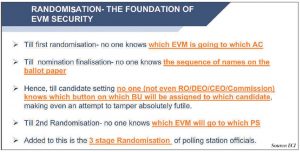
According to the ECI, the EVMs are randomised twice using tracking software.
According to the ECI, an EVM cannot be hacked because it is a stand-alone machine and not connected to any network through wire or wireless and the software programme in the OTP microcontroller can neither be read nor modified.
It stated that there is no possibility to remotely alter the CU display through wireless communication. “It is alleged this can be done by either replacing the original display module with another display fitted with a wireless device or inserting an extra circuit board which can communicate with an external unit via a wireless device and tamper the result by controlling the CU display used for declaring the result.
“Such a modification would require unfettered access to the EVM after FLC – ruled out (the allegation),” it stated.
The ECI also rejected ‘memory manipulation.’ “It is alleged that voting data can be altered by clipping a memory manipulator IC to the memory chip where vote data is stored. This would need full and free access to CUs after the polling is over—ruled out!
“Breaking the seals and locks of the strong room in the presence of two layers of security plus the representatives of the candidates camping near the strong room—ruled out!” it declared.