[caption id="attachment_35526" align="alignleft" width="400"]
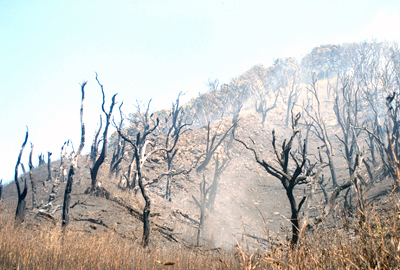
This file photograph shows a razed part of the famed Dzükou valley after fire broke out in the valley the previous year. Just a few days ago, a large swathe of the tourist spot was razed after fire broke out from a yet-unconfirmed source.[/caption]
Our Correspondent
KOHIMA, MARCH 17
[dropcap]F[/dropcap]ollowing the announcement made by the Forest authorities that the major fire which broke out in the scenic Dzükou valley six days ago had been controlled, volunteers have confirmed that the fire has ebbed. Volunteers went into the valley on Monday and Tuesday to inspect the area and have confirmed that there was no more active fire visible.
Southern Angami Youth Organization (SAYO) volunteers who went up to the valley to assess the area have reported that some small streaks of smoke can still be seen billowing out from several small pockets but it is unlikely to spark off any inferno. Nevertheless, SAYO officials said they will continue to send up volunteers for the next few days to monitor and ascertain that the valley is out of danger.The fire on the valley is believed to have caught on from some embers left unattended by careless trekkers, and the local organizations are currently on the lookout for those responsible.
The Forest department has observed that the fire has devastated an area of 8-10 Sq Km approximately in the valley of Dzukou.
According to the department, the valley, which is bordered by mountain ridges with forests around it, has immense ecological and social significance. The area acts as a catchment for rivers and rivulets emerging from the valley and adjoining mountain ranges. The larger parts of the Dzukou valley and adjoining hill slopes are covered by a dense carpet of monopodial bamboo (Arundinaria sp.), a huge swathe of which got destroyed in the recent fire.
The departmental authorities also observed that Mt. Japfü, the second highest peak in Nagaland and other mountain ridges which form a rim around the valley was endowed with rich forest and natural resources. They are considered a repository of valuable natural resources such as potable water (the only major source for the state capital and nearby villages). Forests to the north of valley are abode and breeding ground for the endemic and rare bird species, Blyth’s Tragopan, the state bird of Nagaland.
“This rare ecosystem comprising the valley and mountainous ridges all around, has become a major tourist destination and thus is the pride of the State and the people,” states a department report.
The wildfire on the valley calls for an educational reorientation on how to deal with and care for the environment. “Awareness, and more awareness is what our people need at this point,” says an environment activist based in Wokha. “Inform and involve the grassroots communities, begin from there,” he added.
Now, for the Fire & Emergency services, the dry and windy months of February, March and April are considered to be the most vulnerable time of the year. Although the outbreak of fire is unpredictable and have varied origins, a responsible public can contribute a lot to checking and preventing devastation to life, property and natural resources, especially when weather conditions are dry. Most wildfires are said to be caused by hunters, trekkers, picnickers as well as farmers who after setting up fire to cook or burn bushes for tilling, fail to douse them completely. It is unfortunate that many people still fail to see the profound impact that jungle fires have on the ecosystem.
The negligent attitude of the people is glaringly visible from the frequent reports of both widespread and smaller jungle fires.
In Kohima district, the emergency services were pressed into action on Monday in two different locations i.e., below the highway near Kisama and another near High Court Complex in Meriema, on similar accounts. On Tuesday, another jungle fire reportedly broke out near Kisama again. However, a fire tender rushed to the spot and doused the fire before it could spread.



 This file photograph shows a razed part of the famed Dzükou valley after fire broke out in the valley the previous year. Just a few days ago, a large swathe of the tourist spot was razed after fire broke out from a yet-unconfirmed source.[/caption]
Our Correspondent
KOHIMA, MARCH 17
[dropcap]F[/dropcap]ollowing the announcement made by the Forest authorities that the major fire which broke out in the scenic Dzükou valley six days ago had been controlled, volunteers have confirmed that the fire has ebbed. Volunteers went into the valley on Monday and Tuesday to inspect the area and have confirmed that there was no more active fire visible.
Southern Angami Youth Organization (SAYO) volunteers who went up to the valley to assess the area have reported that some small streaks of smoke can still be seen billowing out from several small pockets but it is unlikely to spark off any inferno. Nevertheless, SAYO officials said they will continue to send up volunteers for the next few days to monitor and ascertain that the valley is out of danger.The fire on the valley is believed to have caught on from some embers left unattended by careless trekkers, and the local organizations are currently on the lookout for those responsible.
The Forest department has observed that the fire has devastated an area of 8-10 Sq Km approximately in the valley of Dzukou.
According to the department, the valley, which is bordered by mountain ridges with forests around it, has immense ecological and social significance. The area acts as a catchment for rivers and rivulets emerging from the valley and adjoining mountain ranges. The larger parts of the Dzukou valley and adjoining hill slopes are covered by a dense carpet of monopodial bamboo (Arundinaria sp.), a huge swathe of which got destroyed in the recent fire.
The departmental authorities also observed that Mt. Japfü, the second highest peak in Nagaland and other mountain ridges which form a rim around the valley was endowed with rich forest and natural resources. They are considered a repository of valuable natural resources such as potable water (the only major source for the state capital and nearby villages). Forests to the north of valley are abode and breeding ground for the endemic and rare bird species, Blyth’s Tragopan, the state bird of Nagaland.
“This rare ecosystem comprising the valley and mountainous ridges all around, has become a major tourist destination and thus is the pride of the State and the people,” states a department report.
The wildfire on the valley calls for an educational reorientation on how to deal with and care for the environment. “Awareness, and more awareness is what our people need at this point,” says an environment activist based in Wokha. “Inform and involve the grassroots communities, begin from there,” he added.
Now, for the Fire & Emergency services, the dry and windy months of February, March and April are considered to be the most vulnerable time of the year. Although the outbreak of fire is unpredictable and have varied origins, a responsible public can contribute a lot to checking and preventing devastation to life, property and natural resources, especially when weather conditions are dry. Most wildfires are said to be caused by hunters, trekkers, picnickers as well as farmers who after setting up fire to cook or burn bushes for tilling, fail to douse them completely. It is unfortunate that many people still fail to see the profound impact that jungle fires have on the ecosystem.
The negligent attitude of the people is glaringly visible from the frequent reports of both widespread and smaller jungle fires.
In Kohima district, the emergency services were pressed into action on Monday in two different locations i.e., below the highway near Kisama and another near High Court Complex in Meriema, on similar accounts. On Tuesday, another jungle fire reportedly broke out near Kisama again. However, a fire tender rushed to the spot and doused the fire before it could spread.
This file photograph shows a razed part of the famed Dzükou valley after fire broke out in the valley the previous year. Just a few days ago, a large swathe of the tourist spot was razed after fire broke out from a yet-unconfirmed source.[/caption]
Our Correspondent
KOHIMA, MARCH 17
[dropcap]F[/dropcap]ollowing the announcement made by the Forest authorities that the major fire which broke out in the scenic Dzükou valley six days ago had been controlled, volunteers have confirmed that the fire has ebbed. Volunteers went into the valley on Monday and Tuesday to inspect the area and have confirmed that there was no more active fire visible.
Southern Angami Youth Organization (SAYO) volunteers who went up to the valley to assess the area have reported that some small streaks of smoke can still be seen billowing out from several small pockets but it is unlikely to spark off any inferno. Nevertheless, SAYO officials said they will continue to send up volunteers for the next few days to monitor and ascertain that the valley is out of danger.The fire on the valley is believed to have caught on from some embers left unattended by careless trekkers, and the local organizations are currently on the lookout for those responsible.
The Forest department has observed that the fire has devastated an area of 8-10 Sq Km approximately in the valley of Dzukou.
According to the department, the valley, which is bordered by mountain ridges with forests around it, has immense ecological and social significance. The area acts as a catchment for rivers and rivulets emerging from the valley and adjoining mountain ranges. The larger parts of the Dzukou valley and adjoining hill slopes are covered by a dense carpet of monopodial bamboo (Arundinaria sp.), a huge swathe of which got destroyed in the recent fire.
The departmental authorities also observed that Mt. Japfü, the second highest peak in Nagaland and other mountain ridges which form a rim around the valley was endowed with rich forest and natural resources. They are considered a repository of valuable natural resources such as potable water (the only major source for the state capital and nearby villages). Forests to the north of valley are abode and breeding ground for the endemic and rare bird species, Blyth’s Tragopan, the state bird of Nagaland.
“This rare ecosystem comprising the valley and mountainous ridges all around, has become a major tourist destination and thus is the pride of the State and the people,” states a department report.
The wildfire on the valley calls for an educational reorientation on how to deal with and care for the environment. “Awareness, and more awareness is what our people need at this point,” says an environment activist based in Wokha. “Inform and involve the grassroots communities, begin from there,” he added.
Now, for the Fire & Emergency services, the dry and windy months of February, March and April are considered to be the most vulnerable time of the year. Although the outbreak of fire is unpredictable and have varied origins, a responsible public can contribute a lot to checking and preventing devastation to life, property and natural resources, especially when weather conditions are dry. Most wildfires are said to be caused by hunters, trekkers, picnickers as well as farmers who after setting up fire to cook or burn bushes for tilling, fail to douse them completely. It is unfortunate that many people still fail to see the profound impact that jungle fires have on the ecosystem.
The negligent attitude of the people is glaringly visible from the frequent reports of both widespread and smaller jungle fires.
In Kohima district, the emergency services were pressed into action on Monday in two different locations i.e., below the highway near Kisama and another near High Court Complex in Meriema, on similar accounts. On Tuesday, another jungle fire reportedly broke out near Kisama again. However, a fire tender rushed to the spot and doused the fire before it could spread.