


Explore how central support and state delivery are advancing Uttarakhand’s highways, village roads, rail connectivity and household rooftop solar.
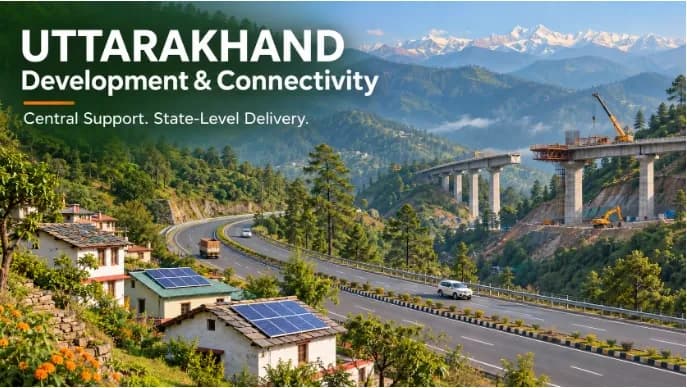
Uttarakhand’s development record includes improvements that residents can already use. The Delhi–Dehradun Economic Corridor has opened a faster route to the national capital, while publicly supported rooftop-solar installations are helping participating households generate electricity at home. Alongside these outcomes, new rural-road approvals and railway construction are extending the state’s infrastructure programme.
The discussion around double engine government in Uttarakhand becomes more meaningful when these projects are examined individually. Central funding and national schemes provide resources; state agencies have responsibilities such as implementing village roads, coordinating local works and supporting electricity connections. The roles differ by project, but together they show how national investment can reach communities through work carried out within the state.
A Faster Connection between Delhi and Dehradun
Prime Minister Narendra Modi inaugurated the 213-km Delhi–Dehradun Economic Corridor on 14 April 2026. According to the Union road transport ministry, the approximately ₹12,000-crore corridor reduces journey time from more than six hours to around two and a half. This is a completed transport improvement, with a practical benefit for people travelling between the two cities.
Shorter intercity journeys can make business visits and family travel easier to plan. The state government’s work on connecting infrastructure is also relevant. In February 2025, Chief Minister Pushkar Singh Dhami directed officials to advance the proposed Rispana and Bindal elevated corridors and seek central cooperation to connect them with the expressway. These city links remain distinct from the operational highway. Local reporting after the opening highlighted congestion at Dehradun’s entrance, showing why the next stage of urban traffic planning matters.
Central Funding and State Implementation for Village Roads
For hill communities, a dependable village road can be as important as a major highway. Under the Pradhan Mantri Gram Sadak Yojana (PMGSY), the Centre and Uttarakhand share programme costs in a 90:10 ratio. The Centre therefore provides most of the shared funding, while the Uttarakhand Rural Roads Development Agency implements the programme in the state. This is a concrete example of central support being combined with state responsibility.
In its update of 25 September 2026, the state government reported that the first round of PMGSY Phase IV covered 184 roads spanning 1,228.20 km, intended to connect 309 villages. The release credited Dhami’s representations to the Centre with helping secure approvals. Pauri Garhwal accounted for 68 intended village connections, with 47 each in Almora and Tehri. These are planned connections, not a claim that all 309 villages are already connected.
The same release reported 2,826 roads completed across the programme’s first three phases. That cumulative achievement spans multiple administrations. The current round builds on this network, with completion, maintenance and monsoon reliability determining how much residents benefit.
Rooftop Solar Brings Development into the Household
PM Surya Ghar provides another way to assess Uttarakhand development projects: through installations and electricity bills. A Lok Sabha reply reported that, by 30 January 2026, Uttarakhand had 63,241 rooftop-solar installations benefiting 63,403 households. Central financial assistance disbursed under the scheme stood at ₹490.84 crore. These dated figures record installed systems and payments, rather than future targets.
The reply also cited the state energy department’s report that approximately 27,295 beneficiaries had received a zero electricity bill by October 2025. This is a tangible benefit for those households, although it does not guarantee a zero bill every month for every participant.
Central assistance is accompanied by state-level support. Uttarakhand’s renewable energy agency publishes state subsidy-disbursement records, including a notice dated 4 November 2026. The state power utility provides forms for grid connection and net metering. For participating households, this means the programme involves both financial support and the connection arrangements needed to use a grid-linked solar system.
Railway Construction Prepares for Wider Regional Connectivity
Among Modi government projects in Uttarakhand, the Rishikesh–Karnaprayag railway is a substantial investment in future connectivity. The 125-km line passes through five districts. In July 2026, the Railway Ministry reported completion of 11 of its 19 major or important bridges. These construction milestones demonstrate progress, while the full line remains under development.
State and district responsibilities are visible in the supporting records. Rudraprayag publishes land-acquisition notices, compensation awards and rehabilitation records for affected villages. These arrangements matter to families whose land is required and to the project’s implementation.
In October 2026, reporting based on an RTI response from Rail Vikas Nigam Limited placed the revised project estimate at ₹37,119 crore and the full-line completion target at December 2029. The railway’s eventual transport benefits should therefore be described as expected, not as services already available across the entire route.
Making Coordination Count for Residents
A fair assessment of Dhami development projects should recognise both delivery and the work needed to make it last. The highway’s opening and reported solar-bill outcomes provide evidence of benefits already reaching users. The rural-road approvals and railway milestones show where additional connectivity is being developed. They deserve recognition on their own terms, with approvals, construction and operational services reported separately.
The strongest case for Modi Dhami development coordination rests on these specific contributions. Central resources support large investments; state agencies help implement programmes and address local requirements. Continuing to publish completion dates, maintenance records and household outcomes would make that contribution easier to assess. For residents, the lasting value is straightforward: roads they can depend on, journeys that take less time and public support that reaches their homes.
(The views and opinions expressed in this guest article are solely those of the author and do not necessarily reflect the views of Eastern Mirror)