- National Domestic Workers Movement demand inclusion in the schedule of employment of the Minimum Wages Act
- Registration of All Nagaland Domestic Workers Union as Trade Union
[caption id="attachment_197718" align="alignnone" width="550"]
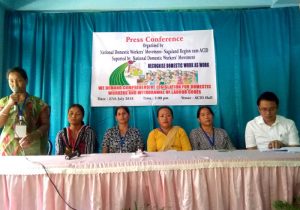 Nagaland Domestic Workers’ Union executives with the NDWM Nagaland region legal advisor Limanochet (extreme right) addressing a press conference at ACID in Dimapur on Friday, July 27. (EM Images)
[/caption]
Eastern Mirror Desk
Dimapur, July 27 (EMN): Amid the National Domestic Workers Movement (NDWM) Nagaland region demand to the Nagaland government for registration of Nagaland Domestic Workers Union as a trade union and inclusion of domestic workers as workers in the schedule employment of Nagaland Minimum Wage, another impediment in the form of Labour Codes reformation proposed by the Government of India which will affect the unorganised workers like domestic workers have curtailed the rights of domestic workers.
In regard to this proposed bill by the GOI, the NDWM addressed a press conference on Fri. July 27 at Assisi Centre for Integrated Development (ACID) Khermahal in Dimapur. NDWM state coordinator Sr. Pramila Lobo said the NDWM demands from the central govt. enactment of comprehensive legislation for domestic workers in which the aspects of regulation of work, social security and grievances redress are included and withdrawal of Labour Codes.
"It is important for all workers to understand and react to these Codes and we should demand that workers' rights and regulation of work should not be camouflaged by the pretentious universal social security coverage", asserted Lobo.
Lobo informed that the National Platform for Domestic Workers and Central Trade unions are organising a rally on Aug. 22 2018 from Mandi House to Samsad Marge in New Delhi where the state NDWM will also support with their presence. And for this movement, 10375 signatures have been collected from the state which will be submitted to the Parliamentary standing committee, maintained Lobo.
The NDWM demands from the state govt., Lobo reiterated was the recognition of domestic workers as workers by including them in the schedule of employment of the Minimum Wages Act and registration of All Nagaland Domestic Workers Union as Trade Union.
In the press conference legal advisor of the NDWM Nagaland region advocate Limanochet expounded that if the proposed bill of Labour Codes is passed by the GOI than the unorganised sectors will face the hitches with token inclusion and this section will have no voice or rights.
Reiterating on the NDWM demands to the state govt. the legal advisor also pointed out that their demand is not just with the state govt. but from the employer and the public to treat domestic workers issue as public and not private and treat them as workers while they treat their working place as a work place.
As the domestic workers in the state awaits recognition and access to rights, they belong to a section who are paid meagre amount, have no social security, day-off and wage rise.
"Our work is physically demanding and we often work without day-off even in ill-health, yet we are treated with little respect and we belong to a section who are vulnerable to abuse and are at the receiving end of false allegations", lamented a domestic helper.
Another domestic worker who has been rendering her service for the past 25 years in a choked voice expressed that even after serving for more than two decades there is no concern for her well-being and hardly make a living. It is not only her but those domestic workers face the same situations that are often deprived of their livelihood on the slightest reason.
"Neither do our employer nor the state government is concern about our welfare and situation", addressed the NDWM.
The indifference towards us is because we do not have a recognised union and because of which our voice and rights are curtailed and domestic work is not recognised as work. If the law address the issues faced by the domestic workers' through recognition of our union than we can be treated with respect by our employer and the public, remarked the domestic workers.


