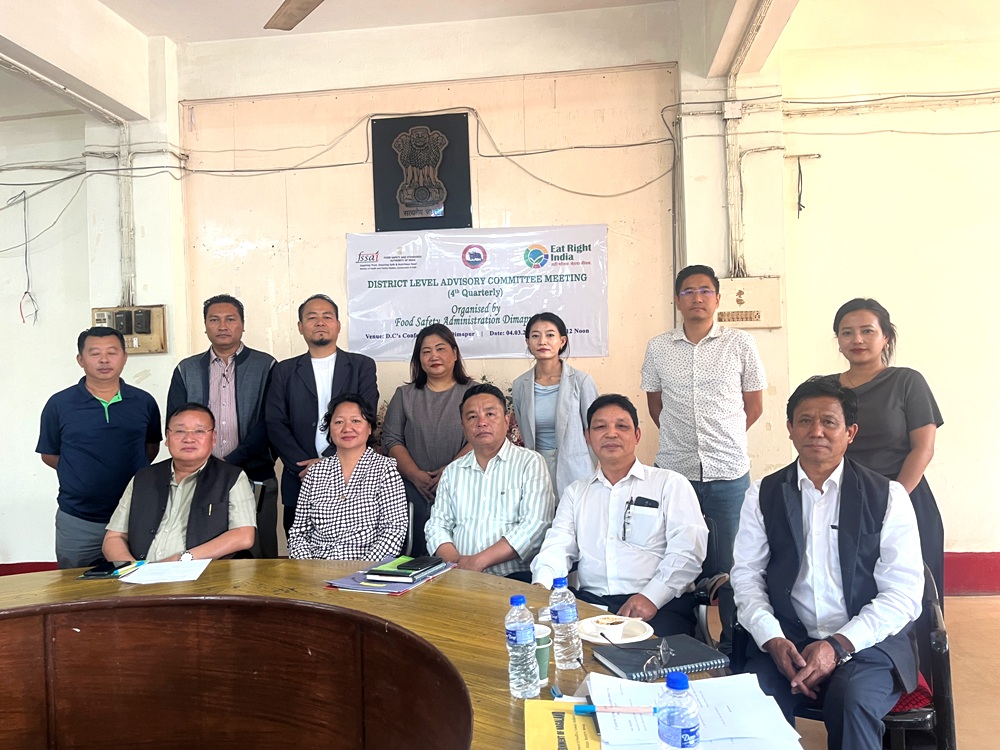
The District Level Advisory Committee in its fourth quarterly meeting aised concerns over the sale of unlabelled and unhygienic food items in the market
Dr. Tinojongshi Chang with officials from various
departments during the District Level Advisory Committee meeting in Dimapur on
Tuesday.
DIMAPUR — The District Level Advisory Committee
(DLAC) held its fourth quarterly meeting on Tuesday at the DC conference hall
in Dimapur.
During the meeting, the Deputy Commissioner of Dimapur, Dr.
Tinojongshi Chang, who is also the chairman of the DLAC, raised concerns over
the sale of unlabelled and unhygienic food items in the market.
According to a press release, he discussed the matter of
conducting routine inspections of hotels and restaurants to ensure they meet
the requirements and comply with Food Safety and Standards Authority of India
(FSSAI) regulations.
Zakabo Rotokha, Additional Deputy Commissioner of Dimapur and
Adjudicating Officer (AO) for Food Safety, spoke about the food cases being
disposed of in his court. He emphasised the need for increased awareness among
food business operators to ensure compliance with the provisions outlined in
the Food Safety norms. He also highlighted the need for more manpower in Food
Safety to ensure the effective implementation and enforcement of the Act.
The Chief Medical Officer, Dr. T Temsu Lkr, who is also the
vice chairman of DLAC, spoke on the importance of obtaining a medical fitness
certificate for all food handlers in manufacturing and food services. He
discussed the issue of packaged drinking water, stressing the need for early
compliance and inspections of water bottling plants by enforcement officials.
He expressed his concern about reaching out to schools and colleges to raise
awareness of Food Safety.
The designated officer for Food Safety in Dimapur, Samuel
Zehol, gave a brief overview of FSSAI. He explained that food safety is based
on science-based standards for all food categories and that FSSAI serves as the
single reference point for all matters relating to food safety, rules,
regulations, and enforcement. He noted that this marks a shift from a mere
regulatory regime to self-compliance through the Food Safety Management System
(FSMS).
A major area of discussion was the registration of street
food vendors in the district. It was mentioned that all street food vendors are
required to be registered with the Food Safety officer, who also serves as the
registering authority for the district. However, the FSSAI has waived the
registration fees for this category of food business operators.
It was also noted that street food, being an easily
accessible and quick choice for the public, especially youngsters and working
individuals, requires strict vigilance by the concerned authorities to protect
the interests of all.