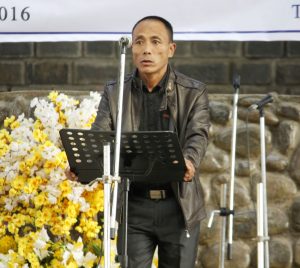
Number of HIV cases increasing in Dimapur
[caption id="attachment_86416" align="alignright" width="300"]
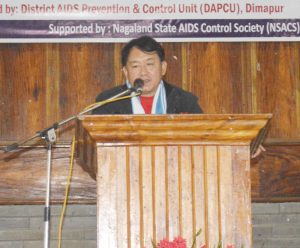 Dr. K Vikato Kinimi addressing the World AIDS Day event in Dimapur on Thursday.
[/caption]
Dimapur, December 1: 527 persons have been detected with HIV/AIDS from April to October 2016 in Dimapur district alone while 7,869 are registered with the Anti-Retroviral Treatment (ART) Centre since the inception of ART Centre. Out of the number, 4,876 are on ART medication while 682 have died till October 2016.
This disturbing statistics was given by Dr. Antoly Swu, the deputy chief medical officer of Dimapur.
Dr. Swu was addressing an event of the 29th World Aids Day at Dimapur. The program was organised by District Aids Prevention and Control Unit (DAPCU) of Dimapur with the theme “Hands up for HIV prevention” on Thursday, December 1, at the Town Hall.
Chief Medical Officer of Dimapur, Dr. K. Vikato Kinimi, asserted that ‘with 53 NGO’s working for people living with HIV/AIDS under the Nagaland State AIDS Control Society (NSACS) working toward creating awareness, the numbers of HIV/AIDS is still on the rise especially in Dimapur district.
This indicates that more needs to be done and to create more awareness, the health official said.
HIV/AIDS can be prevented through proper information to the society instead of discriminating people living with the disease. The society must come forward, and extend a helping hand in solidarity to end all discrimination, the chief medical officer said during the programme. He was addressing the event as the chief guest.
With the number of cases being detected increasing in Dimapur, the health official called upon the nongovernmental organisations working in the field to gear up with ‘their’ awareness activities. He expressed hope that the hard work put in by the organisation would nonetheless stop the trend of increase in HIV related cases.
Dr. Kinimi also admitted that CD4 machines were ‘limited’ in Nagaland. He assured that the department was ‘working towards providing treatment convenient for the people living with HIV/AIDS especially in Dimapur district because of its high prevalent rate.’
Addressing the gathering during the occasion was also Lucy, speaking on behalf of People Living with HIV (PLHIV). She pointed out that with just one CD4 machine available in Dimapur–which is said to be wearing out–people receiving treatment at the ART centre was at the receiving end.
This is especially so because of the high number of people waiting to receive treatment, she said.
The superintendent for Food and Civil Supply Jamonger Ao also spoke during the event. He remarked that World AIDS Day was an ‘important day for the world to unite and show support’ for people affected by the ailment. He called the day ‘significant’ for both the people working with the HIV-AIDS infected and those living with it.
Also, Ao called upon the gathering to be ‘committed to understanding the circumstances of people living with HIV / AIDS and encouraged them to ‘live life with dignity.’
[caption id="attachment_86415" align="alignright" width="300"]
[/caption]
The Network of Mokokchung People Living with HIV/AIDS (NMP+) has recorded that out of 846 registered People Living with HIV (PLHIV) with the organisation till date in the district sixty percent of them are females.
This was informed by the president of the NMP+, T. Temsu Jamir, during interactions with media person on the sidelines of a programme on World AIDS Day, at the Babu-Tzubu Amphitheatre in Ungma village, under Mokokchung district, on Thursday.
Jamir informed that majority of female HIV patients were under the age group of 14-19 years, and when compared with female HIV-infected they come around more than sixty percent out of 100.
The activist said that among the males more than 60 percent of the PLHIVs come under the age group 19-25 years. However, the PLHIVs among the 40 plus age group is decreasing as per previous year record.
Earlier, in his motivational address, Jamir wondered why most of the PLHIVs do not attend World AIDS Day or for that matter, any HIV/AIDS related programmes observed for them. People can know about the struggle and grievances faced by the affected community, he said.
“What shocking is that most of the PLHIVs do not know about World AIDS Day and its significance? non-PLHIVs are the one who knows about this day and has more knowledge about this globally killing disease,” Jamir lamented.
Nonetheless, the activist observed that it might be because PLHIVs might be stigmatising own selves, or could be ignorance and even ‘pride’ for which they stay away from people and events.
‘Why do people often go to other towns and cities to test HIVS and other therapies when such facilities are freely available and institutions are already set up in their own places?’
In this connection, Jamir called upon the PLHIVs to ‘come out from their cocoons’ and to be ambassadors of prevention in stopping the spread of HIV in the society and state.
A special prayer for PLHIVs was also said by Rev Dr Noklen, pastor of Ungma Baptist Church.
Members of the Red Ribbon Club of Mokokchung, Young Women Christian Association of Mokokchung, and Ungma Baptist Church Youth Ministry also performed musical items during the event.
Peren town also observed World AIDS Day with a programme on the day. Speaking on the theme “Hands UP for HIV Prevention,” Albert, vice principal of Peren Government College said that the people ‘need to be serious and come together to eliminate the disease.’ HIV can infect anyone, he said. He called for care and support for people affected by the disease.
The programme was organised by the District Aids Prevention Control unit of Peren in collaboration with the Peren District Music Society, the Peren Town Youth organisation and the Red Ribbon Club of Peren Government College.
World AIDS Day was observed in Kiphire district too at the Sumi Baptist Church (Aizuto) in Kiphire town. The programme was organised by the DAPCU in collaboration with Red Ribbon Club and sponsored by the Nagaland State AIDS Control Society.
TL Khiantsumong, the district supervisor for ICTC, said during the event that the significance of observing the day was to “globally show our support for those people living with HIV/AIDS.” He mentioned that the day was designated to raise awareness and had been observed since the inception of the event in 1988.
Also, Khiantsumong spoke about the importance of proper education and sensitisation right from the grass root. The day provides an opportunity to show support and solidarity to those living with HIV, he said.
Tsiatsuvi, DPO of the DAPCU, gave insights on the district’s HIV / AIDS situation. Approximately 40-45 individuals are tested for HIV monthly, she said. According to the statistics given by her, during April-September 2016, 512 males and 325 females were tested for HIV out of which 17 males and 10 females tested positive.
Also, she elaborated on the risk factors. Individuals under the age group 25-34 years fall under the high-risk group and are the most vulnerable group, she said. Tsiatsuvi also spoke about the different modes of transmission. Chances of transmission from mother to child are the highest, she said.
The importance of spreading awareness through family and peer groups is hence profound, it was implied.
Further, Tsiatsuvi mentioned facilities such as the ICTC and the ART which help in preventing the growth of the virus so that one can live longer, have a healthier life and reduce the risk of transmitting HIV to others.
Khupai who has been undergoing ART treatment for 6 years, also bravely spoke about her experience and urged those living with HIV to not “stigmatise oneself.” She said that once she opened up, she received love and support from her family and friends, and was not discriminated as she had feared. She also spoke about the importance of support received during such times. Without it, one may be affected mentally, she said.
The chief guest of the event was Rezulule, additional superintendent of Kiphire police. The police official said that HIV/AIDS infects a person at the peak of their productive and highest-income-generating phase. This affects the society at large, the chief guest stated.
HIV/AIDS is one of the most dreaded killer diseases that bring about anxiety and depression to the individual, the officer said. She stressed that everyone was vulnerable to the disease and the disease will strike when one least expects it.
One can contribute to the society by taking care of one’s lifestyle, she said. It will go a long way in preventing HIV. Rezulule requested that ‘we educate one another to work towards an HIV/AIDS free society.’